
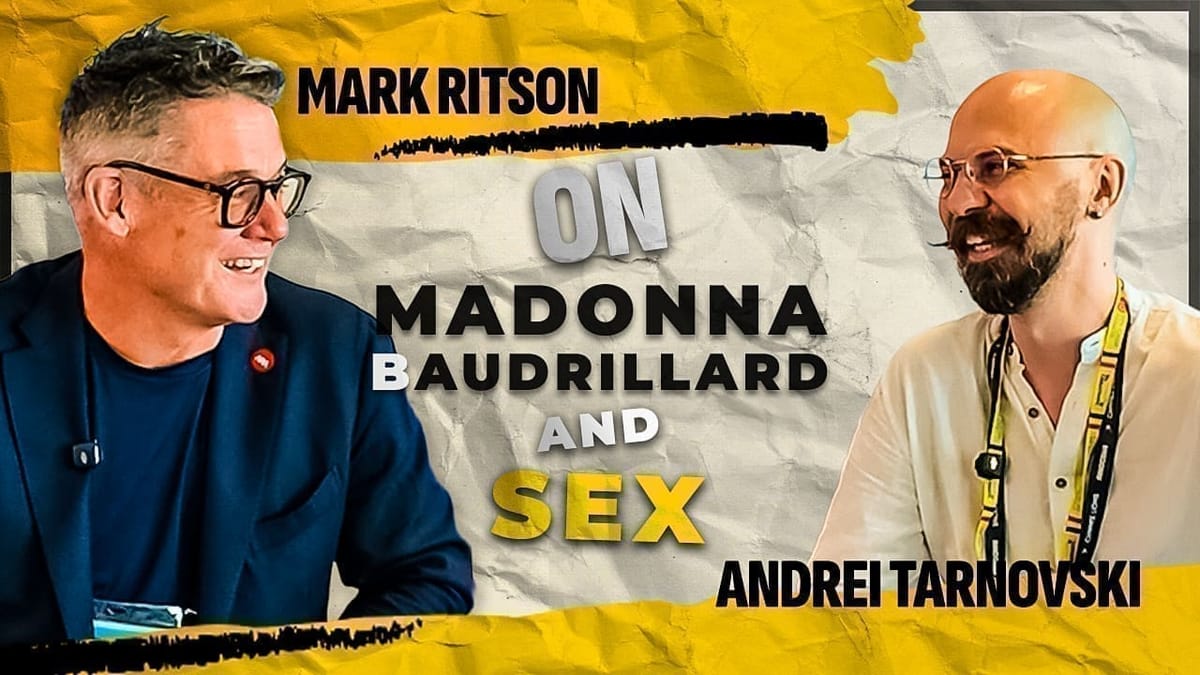


The first episode of Boringly Effective starts with a difficult question:
Does all the marketing talk at Cannes Lions actually change how companies behave?
Mark Ritson is not convinced.
Recorded at Cannes Lions 2026, this conversation between Mark Ritson and Andrei Tarnovski moves through marketing effectiveness, pricing, creativity, brand building, luxury, Cannes, the Mini MBA, Madonna, Baudrillard, Romania, sex, beer, dogs, flooring and the strange difference between the real Mark Ritson and the public version of him.
It is exactly the kind of conversation Boringly Effective exists for: useful, human, opinionated and grounded in the fundamentals of marketing.
No magic. No hacks. No polite keynote theatre.
Just the work behind marketing that actually works.
TL;DR
- Mark Ritson argues that marketers still dramatically underestimate the importance of pricing.
- He questions whether Cannes Lions and the wider marketing industry actually change business behaviour.
- He points out the contradiction between marketers talking about long-term brand building while companies become more short-term.
- He says creativity can amplify media investment, but cannot usually replace it.
- He suggests smaller and more Latin cultures may understand creativity in a more fluid way than Anglo-Saxon markets.
- He identifies BMW and Chanel as brands that reinvent themselves without losing themselves.
- He argues that Apple may be on a decades-long path toward becoming a luxury brand.
- He reflects on the public Mark Ritson persona and whether it is a performance or an amplified version of himself.
- He gives Baudrillard credit for understanding how the mediated version of a person can become the real one.
- He proves that marketing conversations are better when they are allowed to be funny, messy and human.
Why this episode matters
Mark Ritson is one of the most influential voices in modern marketing because he keeps returning the discipline to commercial reality.
In an industry that often gets distracted by new platforms, new acronyms and new frameworks, Ritson's work has consistently pushed marketers back toward evidence, diagnosis, segmentation, positioning, brand building, pricing and effectiveness.
This episode is not a formal lecture. It is better than that. It is a conversation about the gap between what marketers say and what businesses do.
Everyone says they believe in long-term brand building. Companies keep getting more short-term.
Everyone praises creativity. Many brands still underinvest in the media required for creativity to work.
Everyone talks about growth. Too few marketers understand the power of pricing.
That is why this episode is a strong opening statement for Boringly Effective: the useful truths in marketing are often not fashionable. They are basic, difficult and commercially important.
Key Takeaways
1. Cannes creates conversation, but does it create change?
Ritson raises a sharp question about Cannes Lions: does all the discussion actually affect how marketing is practiced? The industry talks about long-term thinking, yet companies move in the opposite direction: shorter timelines, more pressure, more immediate metrics.
2. Pricing may be the most underappreciated marketing lever
When asked what smart marketers still fail to grasp, Ritson points to pricing. It is not a minor tactical decision. It is a transformational business lever. After product, pricing may be one of the most powerful contributors to profitability.
3. Fewer objectives might make marketers better
Ritson would teach more forcefully the importance of setting fewer objectives. Many companies might be better off with only two serious objectives a year. Marketing becomes weak when people try to do too many things at once.
4. Creativity helps, but it does not replace investment
Creativity can amplify what has already been invested. But a brand still needs media spend, distribution and scale. As Andrei puts it: if you multiply by zero, you still get zero.
5. Smaller markets may understand creativity differently
Anglo-Saxon marketing cultures can be too rational in how they treat creativity. Smaller countries and Latin cultures may have a more fluid relationship with creativity.
6. BMW and Chanel reinvent without losing themselves
Asked which brands are most Madonna-like, Ritson names BMW and Chanel. The best brand reinvention looks like disciplined evolution.
7. Luxury takes time
Luxury brands are harder to build because time is essential. You cannot quickly manufacture true luxury. Apple may be on the path to becoming a luxury brand over the next 25 or 30 years.
8. The public Mark Ritson is real but amplified
Ritson says the persona is genuinely him, because people can smell inauthenticity. But he acknowledges the public version may be exaggerated.
9. Baudrillard was probably right
For many people, the mediated version is the real Mark Ritson. In modern marketing, the representation of a person or brand is often the thing people actually experience.
Best Quotes From the Episode
Do we really have any impact on the thinking taking place in the industry?
Every time we say companies should be more long-term, they get more and more short-term.
Pricing is a lever of the whole company profitability.
Creativity will amplify it, but it has to amplify what has already been invested.
If you multiply by zero, there you go.
The video version of me is the real me.
The answer to every question in marketing is innovation.
About the guest: Mark Ritson
Mark Ritson is a professor, columnist, brand consultant and creator of the Mini MBA in Marketing. His work has influenced tens of thousands of marketers.
About the host: Andrei Tarnovski
Andrei Tarnovski is a marketing strategist and founder of TARNOVSKI, a branding and marketing consultancy.
Listen or watch
Watch the full episode on YouTube or listen wherever you get your podcasts.
This episode was recorded at Cannes Lions 2026 and produced by SYMBOLON, with support from RoCreativity by FEPIC and ARICE.
Transcript
Related on this site: long-term vs short-term effects and what brand building actually buys.
Show full transcript · 3,844 words
0:00 Andrei Tarnovski A couple of days earlier, you'll see that the entire city is in billboards with your face.
0:07 Mark Ritson I think people are surprised. They think I go home and, like, sort of shout at my wife and tell her, you know, "Your cooking is bad for the following reasons." Did you hear that, listeners? That's important, right? 300% increase in pricing. Take my cut whenever you're ready. You know, you can just send me the checks.
0:22 Andrei Tarnovski What actually occupies you? Do you have any real passions, hobbies besides marketing?
0:28 Mark Ritson Yeah, it's a big part of my life. I really enjoy sex with my wife.
0:32 Mark Ritson Oh no, I know you guys can drink like motherfuckers. Some interesting Romanian shit that I can get into. I'm already excited about Tuica. I'm gonna drink. Do you have a favorite marketing joke? Oh yeah, I do, I do.
0:53 Andrei Tarnovski First of all, thank you for being at the Romanian Creativity Pavilion.
0:56 Mark Ritson My pleasure, Andrei. The highlight for me is coming to Cannes and seeing the Romanians in action. Congratulations.
1:00 Andrei Tarnovski Thank you very much for that. And I'm honored to be an alumnus of your course.
1:07 Mark Ritson You are?
1:09 Andrei Tarnovski It's changed my life to the better.
1:11 Mark Ritson In what way do you think it's changed your life, Andrei, if I can ask you?
1:14 Andrei Tarnovski I became a lot more confident. Yeah. First of all, and this, plus your autograph on my graduation paper, allowed me to increase prices threefold.
1:23 Mark Ritson Is that right? Yeah. Threefold increase. Did you hear that, listeners? That's important, right? 300% increase in pricing. And I'll just take my cut whenever you're ready. You know, you can just send me the checks.
1:34 Andrei Tarnovski Okay. Very good, very good.
1:37 Andrei Tarnovski You're probably bored of hearing the same questions on and on again.
1:42 Mark Ritson No, no. I'd rather have the same questions than the ones I don't know the answers to. So I'm, you know… No, hit me.
1:48 Andrei Tarnovski Yeah, the question is, which question have you not yet been asked, but you are eager to hear it?
1:56 Mark Ritson Oh, ah, such a question. Yeah, I'm sure there must be. Look, I think we could talk a lot more about the role that Cannes plays in how marketing is working. You know, I think we had a good discussion this morning on the way here. Do we really have any impact on the thinking that's taking place in the industry? Everybody's here and everyone's talking, but what's the impact? You know, I think that's a very tricky question, the impact of creativity for the whole thing. I mean, do we really do it? I mean, we obviously have a good time and everybody's here and it's all very exciting. For example, we'll talk a lot about being more long-term and brand building and not just doing short-term stuff. Every time we say that, companies get more and more short-term. So it appears like nobody is actually listening to anyone. So the impact is where I think we have to be more questioning, I think.
2:52 Andrei Tarnovski Okay. Thank you. Now, close to 40,000 people have graduated.
3:07 Mark Ritson Yeah, yeah, yeah, yeah.
3:08 Andrei Tarnovski I'm one of them. And what's the one concept that even the smartest students don't get?
3:10 Mark Ritson I think it's such a big impact on price and pricing, but I still don't think most of the students grasp it. I mean, you did it very well, right? You got a 300% increase, yeah? It's this idea that if we can price better, the impact on the whole business, it's much bigger than marketing, it's transformational. So I think they still don't appreciate how important pricing really is. But pricing is still quite difficult to get. Yeah, look, I think they get the theory. But when I say at the start of that module how important it is, and it's a lever of the whole company profitability, I don't think they're hearing me. I think you have to argue that product is the most important thing. Because at the end of the day, without the product, it's not going to work. You can have great prices — unless you know what you're doing, it won't work, right? But after that, pricing is the one that's so important, and I don't think marketers realize.
4:04 Andrei Tarnovski Is there any concept, or maybe some piece of theory, some piece of marketing wisdom, that you do know is important, but you don't say it out loud, you don't teach it because it might be misunderstood?
4:18 Mark Ritson Yeah. I mean, the stuff I try and avoid, because it does get overly complex, is setting objectives and setting fewer objectives. And if I was really, really determined, I would make everybody have, like, two objectives a year. But it's too controlling, and it's too reductive. But really, they'd be better off if they could all just do that. You know what I mean? The other one's budgeting. If you just spend 10% of your revenues back on communications, most people would be better off. You know, most companies, that would do it. But if I say it, it causes more problems, you know? So there are certain things that, yeah, I would — you know, if I was more dangerous, I would go for.
5:00 Andrei Tarnovski But on the other hand, I know some real-life cases when the dangerous stuff became a product success.
5:10 Mark Ritson Yeah, yeah. This is a case for it too. You have to have a responsibility, though. I mean, you know, 40,000 marketers — whatever you say, and if they do it and it goes wrong, it's kind of on you, you know? So you have to be careful. When I write columns, I'm much more bold. But when we're teaching, we have to be much more careful, you know, that's the thing.
5:31 Andrei Tarnovski Is there any marketing thinking coming out of smaller markets, or maybe peripheral markets, that is, I don't know, ignored by the more arrogant, bigger markets?
5:45 Mark Ritson The Americans and the British, you mean? Yeah, yeah, I know what you mean.
5:50 Mark Ritson Why not? I do know this: if we were to use the sort of Anglo-Saxon term for that sort of British-American axis, with a bit of Australia in there as well, I think we're not as sensitive, for me, to the smaller countries and the Latin countries and their grasp of creativity. I think, in my experience, there's a real difference between how these big British-American cultures treat creativity, which is very kind of rational, and the way smaller countries have got a much more fluid grasp of creativity. You know, even with the French, you see it. It's a different game, you know? So I think we could learn more about creativity from smaller, more Latin cultures, or certainly not Anglo-Saxon cultures.
6:37 Andrei Tarnovski So could this mean that creativity could compensate for the lower budgets?
6:43 Mark Ritson To some degree. I mean, look, to summarise, you've seen this literature as well, Andrei — but to some degree, you can offset it, but not that much. At the end of the day, you still need the money, right? There's one case in a thousand where they didn't need any money. But in the other 999 cases, you still need to invest the money. Creativity will amplify it, but it has to amplify what's already been invested, you know? And at the end of the day, look, you know, what are the drivers of advertising success? We know this from research. The first one is how big a brand you already are. Then it's creativity. But you've still got to have the money in there first before you get the multiplier effect. So, you know, you still unfortunately need to spend money.
7:22 Andrei Tarnovski Yeah, because if you multiply by zero, there you go.
7:29 Andrei Tarnovski Which of the brands you know are most Madonna-like? I mean, reinventing themselves, but staying true to themselves at the same time?
7:39 Mark Ritson I would say there's probably two that come to mind. I really like the way that BMW have been doing it for 40 years. They refresh themselves annually, so there isn't this big need to suddenly revitalize the whole brand, because it's always nicely updated. The other one is Chanel. I think if you look at Chanel, it's been very, very good at staying true to itself in a Madonna-style way, but also constantly just moving forward a little bit. You look at Burberry. Burberry fell out of favor 10, 15 years ago and had to do this big revitalization, and it's going through it again now. Something in Chanel's team or DNA enables them just to keep staying fresh. But I think BMW, for me, is such a triumph because it never gets dusty, you know?
8:29 Andrei Tarnovski Speaking of BMW — and, okay, it's not a luxury brand, but if we were to summarise it and to oversimplify it — is it easier to build a luxury brand or a mass-market brand?
8:41 Mark Ritson It's probably harder for the luxury brand, because you need time. You've got to cook it for a long time. I firmly believe that Apple is in transition to becoming a luxury brand. It's probably about 25 or 30 years away, and that sounds odd, but if you look at Patek Philippe, or Louis Vuitton, or Dom Pérignon, they were all high-tech brands of their time that then became kind of locked down in their categories. So I think Apple is absolutely on the verge of becoming, for our kids, grandkids, a luxury brand. But it takes a long time to get there. So the reason luxury is harder is time. And you cannot compensate. Look, you know, we can launch a candy brand tomorrow, and it might be successful. A luxury brand is going to take a lot longer.
9:29 Andrei Tarnovski Okay. I'm not sure if you're a fan, but you've certainly read Baudrillard.
9:38 Mark Ritson I love Baudrillard. Perfect. I'm a fan. He doesn't get talked about as much anymore. Have you noticed? You know, 20 years ago everyone was "Jean Baudrillard this, Jean Baudrillard that," and now there's, like, you know… So yeah, I love a bit of Baudrillard.
9:48 Andrei Tarnovski I'm trying to bring it back.
9:51 Mark Ritson Good luck with that.
9:52 Andrei Tarnovski Good. There's a performance component in being Mark Ritson — the swearing, the saying that everything is bluntly and as straightforward as it gets. Yeah. How much of it is the real Mark Ritson, and how much is the character? And has the character influenced the real?
10:11 Mark Ritson I think it's genuinely me. I don't think you can fake that stuff. I think you can smell the inauthenticity if it's not coming from truth. So that's all me. It might be a bit more exaggerated. But yeah, I think people are surprised. They think I go home and, like, sort of shout at my wife and tell her, you know, "Your cooking is bad for the following reasons," you know. "Why have you let the children do this?" You know, I'm the quietest, I'm the least powerful person in my house. My wife is in charge. One child. So, you know what I mean? It's not as if I'm, like, Mr. Bossy all the time. Which I think… well, you say when you do the class, right, everyone thinks that, you know, "I'm going to come in and shout at you in there," and it's very clearly not the case. So, oh, it influences me a bit. I am really like that. I'm quite blunt, you know. But I'm not — I don't think I'm much of a prick, you know what I mean? I think I'm pretty, pretty nice, but I am still blunt, even with people that I'm nice to, you know, I think that's the other part. So, yeah, you know… I think that, you tell me, I mean, you know better than me. I think it's pretty accurate how I am, you know?
11:11 Andrei Tarnovski My feeling was that it's mostly you, but I wanted to hear it from you.
11:17 Mark Ritson Yeah, I mean, Baudrillard would argue that the video version of me is the real me. Yeah. And this me doesn't matter. Yeah. Doesn't exist. But there is a point there, right? That, you know, if you think about these 40,000 alumni, most of them don't know me at all. They've come to know me through this video representation, you know what I mean? So Baudrillard, usually, is correct, you know what I mean? That's me to most people. And when I meet someone that I've taught, they do feel like they know me, because I've been with them for 10 weeks, but I have no idea who they are. So it is, you know, it's a post-modern point, I think. I think once again we can give it to Baudrillard, you know?
11:52 Andrei Tarnovski But on the other hand, those 40,000 people, and many millions probably who watch this video, you are the ones who are drawn to come to your conference this September in Bucharest.
12:05 Mark Ritson This is true. Hopefully, hopefully, Andrei, hopefully. They definitely will. Good. No, I'm very excited. I haven't been to Bucharest in a long time, and I mean 20 years long, so I suspect it's changed quite a lot. So I'm really looking forward to it. It's a nice time of the year. September's got that nice feeling in the air. Do you know what I mean? I imagine it's just the right time. So yeah, I'm very excited, very excited.
12:27 Andrei Tarnovski And if you come a couple of days earlier, you'll see that the entire city is in billboards with your face.
12:34 Mark Ritson Is that right? Yes. As it should be. You're everywhere. That's very important, Andrei. I like that. As it is all through the year, I understand that, right? No, no. I like to get in a day early and do some very heavy drinking, just to stay in tune with the culture, so I can understand the audience. So you can rely on me getting in early and being hammered on the local brew. I hate people that go to somewhere beautiful like Bucharest and then drink Budweiser. Do you know what I mean? There's going to be some interesting Romanian shit that I can get into, and I'm ready for the adventure. I'm very ready for the adventure. Oh, no. I know you guys can drink like motherfuckers, so I'm really looking forward to it. You know what I mean? I know it'll be nice and spicy. I'm ready. I'm ready. I'm ready. I'll give you a couple of recommendations, so… You can buy me a couple if you want. I'll be around. We'll just get a few in. I won't buy you a restaurant, but I can buy you a beer. That sounds good. Good beer, I would imagine, is easy to come by. And I would imagine — I don't know — Romania's one of these places where they've got this sort of second shot, you know what I mean? So what do you call that? There's normally, like, in good drinking cultures — like Korea or Czech Republic — there's good beer, and then there's something that sits with it. What do you drink with it, like a schnapps or something? Tuica, it's some kind of a schnapps. What do you call it?
13:50 Andrei Tarnovski Tuica.
13:51 Mark Ritson Tuica. See, I'm already excited about Tuica. I'm going to drink my body weight in two weeks and see how that works out.
13:59 Andrei Tarnovski Since we're talking about the real you and the virtual you: if you commissioned a brand health check, where would be the weakness of Mark Ritson, the public persona?
14:14 Mark Ritson It's a good one. I think I'm probably seen as being too confrontational. So there's a lot of people that won't do the Mini-MBA because they think the course is me shouting at them. You know what I mean? Like, as if that's what I do. So I think sometimes it can be too strong an association. You know, I want to keep my critical, no-bullshit image, but also to be welcoming and supportive, you know what I mean, in the classroom. So yeah, sometimes that is too strong.
14:43 Andrei Tarnovski One more question about the real Mark Ritson. Okay. Okay, back to the real one now. Okay.
14:49 Andrei Tarnovski What actually occupies you? Do you have any real passions, hobbies besides marketing?
14:57 Mark Ritson I know you're in love with marketing, but — yeah, it's a big part of my life. I really enjoy sex with my wife. And we're really at a place at the moment where, you know, we've got small children, we don't get to do it enough. And I want to underline, with my wife, not with other people. I don't enjoy sex with other people at all. Sex with my wife is right up there. Dinner with my wife and sex with my wife are probably my two most interesting hobbies.
15:18 Mark Ritson Other than that, no, no, I mean, we've got young kids. So it's an apocalypse for another seven or eight years. You know what I mean? It's all right, you know? It's not — you know, you never get to sleep in. You never get to, you know — I mean, I'm here for five days. You know, it's very relaxing compared to, you know, having little people running around. So, yeah, that's mostly it. I don't have — you know, I'm quite happy just knobbing about, you know what I mean? And a drink. And we've got a nice car. We drove it down from London. That was fun. And then we just went to different wine areas on the way, from the UK through France. We drove very quickly to get to a winery. Then we drank pretty much all their wine, slept, got up, and then drove very quickly to another winery and did the same again. That was great. That's my idea of a good couple of days.
16:04 Andrei Tarnovski So you're basically halfway to becoming Romanian?
16:07 Mark Ritson I think so. I think I'm going to gel with the Romanian culture, is my sense. And they like a good, strong cigarette as well, which I'm also in favour of. None of that Marlboro Light horse shit. Yeah, it's going to all be good. I reckon I'll be right in there. Right in there, Andrei.
16:22 Andrei Tarnovski Do you have a favourite marketing joke?
16:38 Mark Ritson Oh yeah, I do, I do.
16:39 Andrei Tarnovski Go.
16:42 Mark Ritson How many marketers does it take to change a light bulb?
16:44 Andrei Tarnovski The punch?
16:45 Mark Ritson Innovation.
16:47 Mark Ritson Because the answer to every fucking question in marketing is innovation.
16:50 Andrei Tarnovski No, this was a good one.
16:51 Mark Ritson That's all I got for you.
16:46 Andrei Tarnovski Questions for both of us. More children or more dogs?
16:46 Mark Ritson Oh, definitely more dogs. No more fucking children. If my wife has any more children, I'm going to shoot myself, or her, or both of us. No, no, no. That's the deal. Definitely more dogs later. Much easier, way better than children, right?
16:59 Andrei Tarnovski Which weather? London or Cannes?
17:03 Mark Ritson Ooh, that's tricky. You know, I'm going to go London. I live in Australia most of the time, and I miss the four seasons. So although this is great, I do like September, October in Europe. Yeah. You know what I mean? Like a bit of snow and a bit of frost. So yeah, actually London. That's crazy, but there's reasons behind it.
17:22 Andrei Tarnovski Well, another "either/or." Young, fit and broke, or old, fat and filthy rich?
17:28 Mark Ritson Tricky, tricky. I'd go with the young and fit. I think the ability to still be super healthy and able to do lots of active stuff… That's tricky, though. It's very good having a bit of money and being middle-aged. God, that's tricky. No, I'll go young and fit. Young and fit.
18:00 Andrei Tarnovski Okay, nice one. Beer or whiskey?
18:07 Mark Ritson Beer. I've really… I don't drink as much whiskey as I used to. Beer. A good beer, especially good cold beer, yeah. Beer, beer.
18:12 Andrei Tarnovski I hope you won't be too angry at this question: Simon Sinek or Seth Godin?
18:20 Mark Ritson Oh God, that's what we call Hobson's Choice. I mean, probably Seth Godin — used to be a lot more on the money; he was quite… My view of Seth Godin is he's gone a bit mad. But early Seth Godin was quite good.
18:35 Andrei Tarnovski Okay. And the last one: if marketing didn't exist — carpenter or chef?
18:40 Mark Ritson Oh, definitely carpentry. During COVID I did some flooring with a handyman, and that was very… I really enjoyed it. I'm very working class. I'd be very happy flooring, specifically. I really love laying a good floor, and I'm quite good at it. I'd say I'm an eight out of ten on flooring, which is rare, you know, which is weird. I'm a good floorer. So yeah, definitely carpentry.
19:05 Mark Ritson I'll drop you a message when I'm going down there. If there's anyone that needs a decent floor, seriously, for an extra couple of days, I'll, you know, I could hammer it in while talking about marketing, do you know what I mean? Best of both worlds. Yeah, yeah, yeah.
19:12 Andrei Tarnovski Brilliant. And looking forward to seeing you this September, at the conference.
19:17 Mark Ritson Can't wait. Can't wait, Andrei. Let's get it on. Thank you very much.