
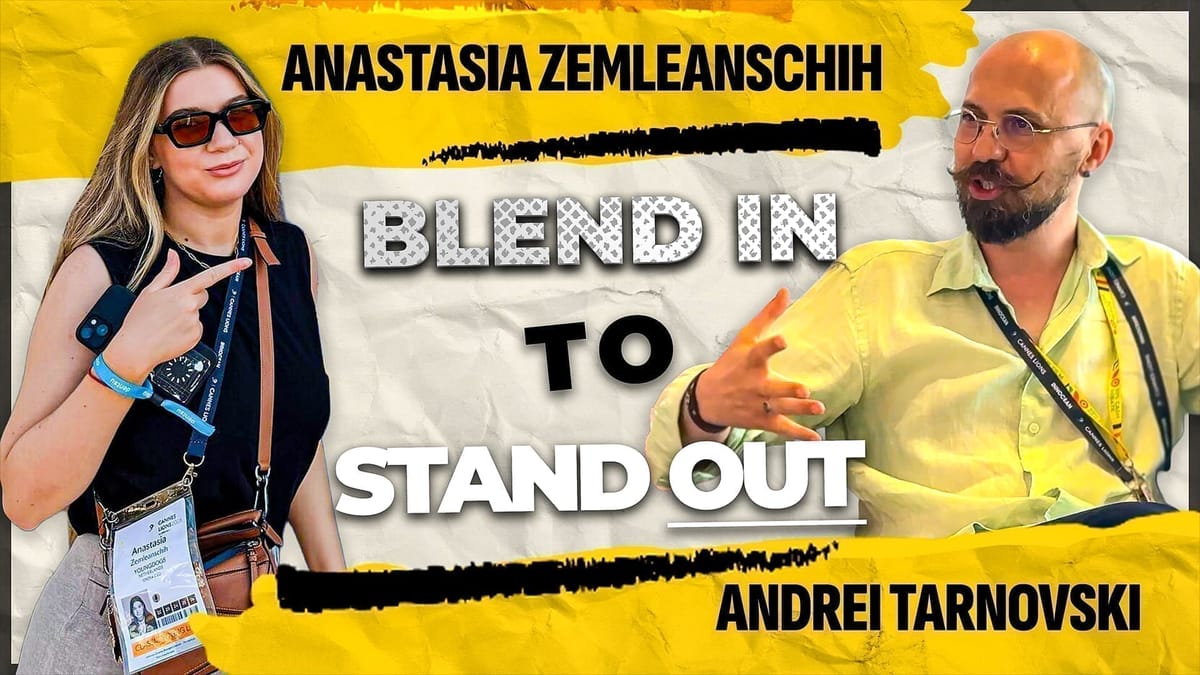


Recorded online (Amsterdam–Bucharest video call), in English. Every quote below reproduces the guest's words verbatim from the episode transcript. Nothing has been added to her meaning.
Watch / listen: YouTube · Spotify · Apple Podcasts · your favourite podcast app
Related on this site: creative testing and AI and marketing effectiveness.
The conversation in one paragraph
She spoke at Cannes at an age most would call impossibly early, and the conversation opens with the obvious question: how does that happen? Anastasia Zemleanschih is an Account Manager at Dentsu Creative & Dentsu Lab and a board member of Young Dogs, the Dutch network that, as she tells it, once hijacked the festival with a bus parked in front of the Palais and effectively invented the Young Lions competition. Andrei Tarnovski sits down with her to talk about why most great ideas never see a room, whether AI is a threat or an amplifier, and what a marketer raised in Moldova learns the moment they work in Amsterdam.
Her central argument is quietly radical and wholly unglamorous. Creatives like to blame a lack of budget for the ideas that die. Anastasia disagrees. Ideas die because they are pitched to the wrong people, and because the trust to carry them was never built. The money is rarely the real wall.
TL;DR
- The budget is rarely the killer. Ideas die when they reach the wrong stakeholder, and when there is no trust between agency and brand. Money, she says, always gets found somewhere.
- AI is an amplifier, not an author. It only works as well as the base and the thinking behind it. Craft still leads; the people who get ahead are the ones who can critically use AI on top of their own work.
- The critical eye is the rare skill. Plenty of people can now use AI. Very few can tell a good idea from a hollow one. That judgement has to be trained on real craft.
- Involve the client before you build. The trick is not to shock a client with a finished concept. You brainstorm with them, plant the seed, and let them feel it was partly theirs. They will defend it internally.
- "Network beats education" is a false fight. For her it was neither. Both matter, depending on the role; passion and figuring things out were enough.
- Blend in to stand out. The greatest advantage a Moldovan finds in Amsterdam is not a single insight. It is multilingual flexibility, the ability to read a room, and the capacity to switch between cultures without losing yourself.
- Delete the word "approach" from every deck. The process slide is, in her experience, never followed anyway. Keep your principles; let the process change as you go.
Key Takeaways
1. Ideas don't die from budget. They die from trust.
Ask most creatives why a strong idea never ran and you will hear the same word: budget. Anastasia has spent four years as the account manager sitting exactly where the idea meets the budget, and she names a different culprit.
"I think majority of the time it's because you pitch them to the wrong stakeholders."
It is, she says, about knowing which battles to pick and with whom. An idea pitched late, or to the person with no mandate to buy it, is an idea that dies no matter how good it is. The real barrier is almost never the arithmetic.
"It's usually the trust. If there's no trust between agencies and brands, then probably they will not go for that crazy idea."
So the job becomes building trust before the pitch, and picking the moment to push. That is where account managers stop being the people who say no. The best creatives, in her view, have commercial discipline: a radar for how far they can push before the idea is lost.
2. Clients say yes when they think they came up with it.
Her most effective trick is not a tactic you will find in a growth handbook. Before a concept is built, her agency runs opportunity workshops where the client goes wild with them, generating a hundred crazy one-pagers together, then narrows them down.
"Make it look like they were the ones to come up with those ideas."
Andrei finishes her sentence, and that is the whole payoff: the client now "vouch[es] also internally for that idea," and you build it step by step "so nobody gets shocked."
By the time the final four are presented, the client was part of inventing them, which means they will defend them in their own building. This is not manipulation dressed up as collaboration. It is the honest version of partnership: the client becomes the idea's co-author and, therefore, its protector.
3. AI is the amplifier, not the author.
The Cannes 2026 conversation around AI swung between panic and hype. Anastasia lands somewhere calmer. AI does not replace the thinking; it scales it.
"The AI part of things is always the amplifier of your own work. So you have to give a proper base and thoughts around it."
The skill that is now scarce, she argues, is the critical eye. Anyone can generate. Very few can judge, select the right tool, and make the right call. That judgement, crucially, still has to be built through craft.
"I think craft is still in the lead and I do think the one, the ones that will get ahead are the ones who can critically use AI to amplify their existing work and craft."
The uncomfortable implication is aimed at her own generation. Young creatives may learn the tools faster than the seniors do, but the taste and the judgement that decide whether the output is worth anything are not downloaded. They are earned.
4. People trust the network story less than you think.
A line at her Cannes session was that network beats education. It split the room fifty-fifty. Anastasia refuses the framing because it never applied to her.
"For me it was neither, it was just figuring out things and sharing my passion, and I think in the agency they saw it and they gave me an opportunity."
She arrived in the Netherlands from Moldova knowing almost no one, studied something completely different from the job she now does, and still landed a role on the strength of a portfolio and persistence. The lesson is genuinely boring and therefore durable: in a small industry with few seats, the people who find their way in are usually the ones who refused to wait to be told they could.
5. Blending in is not the same as disappearing.
There is a real pressure on immigrants to assimilate: speak the language, drop the accent, become one of the locals. Meanwhile the industry they work in pays for difference. Anastasia resolves the contradiction not by choosing a side but by treating identity as a skill.
"I'm pushing myself to just be part of, to blend in. That actually what makes me stand out."
Her example is vivid. She does not speak Dutch fluently, though she understands most of it, and in meetings she asks the whole room to keep speaking Dutch rather than switch to English. The effort to belong is itself what makes her memorable. "We are a bit of a chameleon flexing between those states," she says, "blend in when you need to blend in, stand out when you need to stand out."
For a marketer, the idea lands harder than the anecdote. Difference is not only a personal trait. It is a working asset, and the people who retail it are often the ones who learned to move between cultures early.
6. Your own perspective is the whole point.
Asked for the one piece of advice handed to young creatives that she thinks is genuinely bad, she borrows an answer she heard from a creative director at Cannes.
"The ideas that will spark the brightest is the ones that are being created from your own perspective and that have your own point of view on it."
The bad advice is the standard critique: deliver the idea, then "look at it from a different perspective." Fine for training, she says, but not as a way to make. It teaches you to sand down what is yours to guess what someone else wants to hear. The better discipline is to believe in the version that came from inside you, and only then hold it up against the other angles.
7. Delete the word "approach" from every deck.
Her final and most quotable provocation is aimed at every agency's favourite filler slide. She is, by her own admission, the account manager who should be defending the process.
"I think I never had a project ever executed following that approach that was originally outlined... let's just go iterate, change the process as we go experiment come up."
Process is a frame, and frames are useful, until they become the point. She would rather keep the principles, the standards a team actually believes in, and let the path shift as the work demands. It is, in a single word, the whole show's thesis: fundamentals beat fads, and the process is not the fundamental.
Best Quotes From the Episode
"I think majority of the time it's because you pitch them to the wrong stakeholders." Anastasia Zemleanschih, verbatim from the transcript
"It's usually the trust. If there's no trust between agencies and brands, then probably they will not go for that crazy idea." Anastasia Zemleanschih, verbatim from the transcript
"The AI part of things is always the amplifier of your own work. So you have to give a proper base and thoughts around it." Anastasia Zemleanschih, verbatim from the transcript
"I think craft is still in the lead and I do think the one, the ones that will get ahead are the ones who can critically use AI to amplify their existing work and craft." Anastasia Zemleanschih, verbatim from the transcript
"Make it look like they were the ones to come up with those ideas." Anastasia Zemleanschih, verbatim from the transcript
"I'm pushing myself to just be part of, to blend in. That actually what makes me stand out." Anastasia Zemleanschih, verbatim from the transcript
"We are a bit of a chameleon flexing between those states." Anastasia Zemleanschih, verbatim from the transcript
"The ideas that will spark the brightest is the ones that are being created from your own perspective and that have your own point of view on it." Anastasia Zemleanschih, verbatim from the transcript (heard from a creative director at Cannes)
"Let's just go iterate, change the process as we go experiment come up." Anastasia Zemleanschih, verbatim from the transcript
About the guest
Anastasia Zemleanschih is an Account Manager at Dentsu Creative & Dentsu Lab and a board member of Young Dogs, the Dutch organisation that supports young creatives and connects them to brands and agencies. She moved to the Netherlands from Moldova almost seven years ago, started as a digital producer at a creative agency, and grew into an account manager at the same company while still finishing her degree. She spoke at Cannes Lions 2026 at the Young Dogs network session on the Terra stage. She recorded this conversation with Andrei Tarnovski online, from Amsterdam.
About the host
Andrei Tarnovski is a marketing strategist and the founder of TARNOVSKI, a branding and marketing consultancy. He hosts Boringly Effective, a show for marketers, founders, strategists and brand leaders who would rather understand what works than chase what's fashionable. This episode was recorded online (Amsterdam–Bucharest video call).
Listen / watch / subscribe
- Watch the full episode on YouTube.
- Listen on Spotify, Apple Podcasts, and your favourite podcast app.
- Subscribe to the Boringly Effective Newsletter at BoringlyEffective.com for a weekly round-up of the most important marketing news, plus links to the latest episodes.
This Cannes Lions series was produced by SYMBOLON.
Questions & Answers
Quick answers drawn from the conversation.
What is this episode about?
Account Manager and Young Dogs board member Anastasia Zemleanschih joins Andrei Tarnovski to talk about why good ideas actually die, whether AI replaces craft or amplifies it, and what growing up in Moldova taught her about working in Amsterdam.
Who is the guest?
Anastasia Zemleanschih, Account Manager at Dentsu Creative & Dentsu Lab and a board member of Young Dogs, the Dutch network for young creatives.
Why do good marketing ideas fail?
According to Anastasia, most of the time it is because they are pitched to the wrong stakeholders, and because the trust between agency and brand was never built. The budget is rarely the real obstacle.
What does she think about AI in the creative industry?
She treats AI as an amplifier of your own work. It only works when the base and the thinking behind it are solid, and the scarce skill is the critical eye rather than the ability to generate.
What happened at the Young Dogs meet-up at Cannes?
Young Dogs ran a networking and discussion session on the Terra stage at Cannes Lions 2026, built around "hot takes" that seniors and juniors debated. It is the same organisation whose members, 35 years ago, drove a bus to the Palais and effectively started the Young Lions competition.
Where was the episode recorded?
Online — an Amsterdam–Bucharest video call, in English.
Who is the host?
Andrei Tarnovski, marketing strategist and founder of TARNOVSKI.
Where can I listen?
YouTube (https://youtu.be/WKTqzdnnKlo), Spotify, Apple Podcasts, and your favourite podcast app. For the weekly round-up of marketing news plus new episodes, subscribe to the Boringly Effective Newsletter.
At Cannes: the session behind this episode
Anastasia Zemleanschih appeared on the YoungDogs Change My Mind meet-up, part of the Talent & Culture stream, with Lotte Aalsma of Rose Bikes and Mick van der Loo of GoSpooky. The format was a live pressure test of hot takes rather than a keynote. This interview was recorded separately, online.
Full transcript
English verbatim, from the proofread transcript. Collapsed on the published page.
Show full transcript · 6202 words (EN)
Andrei Hello, Anna.
Anastasia Hey, Andrei.
Andrei Thank you so much for connecting for the podcast. I noticed your speech at the Cannes Lions 2026. And given you are so young, I was wondering how come that you can be at such an early age a speaker at Cannes Lions. I mean, some people spend their whole careers dreaming about this. Tell me more about yourself and how you got there.
Anastasia Yeah, I think I was also surprised to become a speaker at this age. And I think it also was quite a last minute thing, to be honest. But how I got there is basically, I live in the Netherlands. And in the Netherlands, we have an organization, an NGO called Young Dogs, which is an organization that supports young creatives and gives them opportunity to get started with their creative career um and part of it is uh that we organize pitches with different brands with different agencies where uh basically uh brands based on the best submitted idea by young creatives give them opportunity to go to Cannes Lions so they sponsor that trip and as a board member of Young Dogs I also get to be there. And we have a very tight connection between Young Dogs and Young Lions. As 35 years ago, the Young Lions competition that is happening in Cannes is actually born because of Young Dogs. As 35 years ago, a bunch of juniors in creative industry in the Netherlands just decided to hijack the festival and go there with a big bus, park it in front of the palais and basically make a statement to the organization that hey all our seniors and creative directors are there they can allow it themselves but juniors and the ones behind the work are not really able to afford it or even the agency is not able to afford it so there needs to be a specific pass created for young creatives so because of Young Dogs Young Lions was born and that pass that is a bit more accessible to young creatives and basically this mission goes on and every two years there's new board members who just push it further so basically through this connection between Young Dogs and Young Lions we were in touch with the organization and then they just ask us to facilitate more of a network connection session at uh the Terra stage uh and basically speak there um and uh yeah just raise some hot takes about creative industry especially to connect a bit more senior creatives with younger creatives and also get different opinions on those hot takes uh and just meet and
Andrei have a chat and to even sometimes uh show senior creatives that the younger ones can beat them absolutely absolutely. How did you get in in this industry? What's your own journey so uh
Anastasia I moved to the Netherlands from Moldova almost seven years ago um for studies straight after high school um I was studying in a fashion institute uh with a branding specialization so I was doing branding. Very quickly I understood that I would not want to continue within fashion industry and then during my still studies I found an internship at creative agency as a digital producer at Dancer Creative. I applied, I got in and then now for almost four years I'm in the same company where I started and I was an account manager pushing further but I think with my background or experience is a bit in a more creative field within fashion as well I'm always quite excited to get around creatives and especially having that path through starting from an internship building like career further I also would really love to support all the others uh young creatives juniors or students even to how to find their way through the industry because it might be quite challenging um and yeah it's actually a very small industry so there's also not not a lot of seats available so how you find those spots how how you get at the table even
Andrei With no chairs, uh, so yeah, so you you're basically, uh, you've started this from the very beginning in the in the industry, and you're still happy to be in it because there's so many people who get disappointed quite quickly, but I'm happy you have this resilience and curiosity about the industry. Yeah, absolutely. Most of the Cannes Lions 2026 speeches more or less direct, uh, also talked about the AI, and even one of the debate, one of the statements in your debate was the role of AI in the craft. So, besides the good or bad verdicts, the question, the real question is if AI does most of the making, does human value move upstream to strategy, to taste, or how is it going? And besides that, how do you train the younger generation to get that taste and that appeal for strategies, since most of the education lately has been around producing more than acquiring the taste.
Anastasia Yeah, I mean more than ever it is the critical eye, the creativity, the strategy matters most than the actual... Well, a lot of people can use AI, but not... not everyone has a critical eye on it. So I think we just need to focus also the young creatives to sharpen their eye and become more critical, select the right tools, make the right decisions. And I do feel right now, I believe young creatives can be the ones teaching also the more senior on how to use it, uh, and I do feel like, um, of course right now I'm not a student anymore so maybe I don't have that many insight on what type of, uh, courses, uh, are being integrated into the programs. I do hear there is, uh, more about AI and even, um, two over two of our young dogs, uh, creatives, they got opportunity to be part of Cannes Lions Academy. So this is more like an intensive program throughout Cannes. And there was quite a lot of courses on how to critically use AI within the creative industry. So I do think you see it spreading around all the levels. And I, being within also Young Dogs, I have opportunity to engage with a variety of agencies. And I also see the difference how within the agency they approach it. Some indeed replacing maybe even young creatives and focusing on building some AI chatbots instead. But I do see majority are focusing on fostering the young talent because they are the ones who actually were able to adapt the latest a bit more faster than those seniors who still have lots of skepticism about even using or trying AI. So I think it a bit depends, but I do see it's looking promising because the majority of the industry is still encouraging supporting young creatives and also allowing them to be critical when using AI.
Andrei Since so many of the more senior advertisers and creatives are skeptical towards AI, one of the reasons could be that we are used throughout the history that the way you acquire the talent and the abilities is through imitating the craft. So here is where the question gets even trickier. Can you build your abilities without doing the craft, without doing it by yourself, or do you still need to mix it?
Anastasia I think for me, the AI part of things is always the amplifier of your own work. So you have to give a proper base and thoughts around it. And then there are certain elements that you can always amplify with AI. Maybe it will be great, maybe it will suck. But I think the important part is indeed, as you mentioned, curiosity about just trying things rather than just because it's something called AI we would completely deny it. So I think craft is still in the lead and I do think the one, the ones that will get ahead are the ones who can critically use AI to amplify their existing work and craft. And given that AI is getting
Andrei very good at entry-level craft, how does that affect the future of newer generations getting into the business, into the industry, because you need to become a senior at some level, but without this craft that you were saying that it is quite important still, it's quite hard to get it. One of the hypotheses I've heard was that it could be like it happens with lawyers in some countries, Italy, if I'm not wrong, where you need to pay as an intern to gain some experience. You don't get paid. Where does this lead in our industry?
Anastasia Yeah, I think I can critically look specifically in, let's say, in the Netherlands. Young Dogs is quite, for example, a renowned organization within the creative industry. And I do think now more than ever, because we organize pitches and invite hundreds of young creatives to participate in them, we give opportunity to brands and agencies to see the type of output young creatives come up with. And I think I was in one of the judging sessions where the work by young creatives was reviewed by a few CDs and CMOs of the big company, and that was mentioned that, well, I would never be able in two weeks come up with such a strong idea and insight. So I do as well, there was a board member who was part of the board 10 years ago of Young Dogs, who, who is now a creative director of a company, he also said the quality of ideas actually improved way much. But we also see from our community that they do share a lot of curiosity surrounding AI. So brands recognize the level of the creativity is now by young creatives. So our organization also exists to show that. And we only see the quality going up. But it's also maybe because they use AI to amplify some of our ideas or to test things or to get additional input within their idea.
Andrei There's no real danger.
Anastasia No, I don't think so, honestly. I do think young creatives are getting more and more recognized within our industry. And there is obviously certain businesses that just have other priorities who need to focus on the senior teams that they have for just experience, speed level, etc. But I also see majority of the agencies within the industry always reaching out to us to connect them to junior teams or they're looking for interns. And they always know that we have quite a big community that is there. And to be honest, how this generation is able to recognize the importance of AI, I think that only helps them to build a stronger end portfolio and a case for them to actually get a seat at the table.
Andrei The future looks quite bright.
Anastasia Maybe I'm a big optimist, but I think there's quite some facts to back it up. And I think within the industry, Young Dogs is the organization that also helps to push young talent further. And we do see people that were 10 years ago participating in the pitches as 22-year-olds winning it, going to Cannes. And now they're CD at the best agency of the Netherlands. So it's real.
Andrei Another statement from Khan was that network beats education. Both you and I are from Moldova, a country that is quite small and doesn't have such a flourishing creative industry, at least yet, hopefully someday. But given that you went from such a young age to a foreign country, you probably knew absolutely no one. So did this help? Did this make your life harder? How does it happen?
Anastasia When you think network or education, when it was in the context of the session that we had in Cannes, we had the format where the people would separate into different groups, someone who agrees, someone who disagrees. And it was a topic where it was actually 50-50, you can see. But I think for me personally it's neither. I didn't have any network and I also was studying completely different topic from what I actually ended up doing right now in my role, so it can be just probably pure passion and hard work. But yeah, everyone can find their own source to that uh success or to their career uh in the industry. But um I do think um both are important uh and I think people how the organization or the industry, uh, shaped, uh, there's also a variety of roles. In some of the roles you do need to um prove that uh uh certain angles or topics that only like professionalism and, uh, really degree can help you, and in some levels or roles you are bringing the power with your network, uh, so I think the industry is so big that maybe for different roles, uh, different answer would work or, uh, either network or education would be a correct answer or something that people would agree. For me it was neither, it was just figuring out things and sharing my passion, and I think in the agency they saw it and they gave me an opportunity. And their education you can follow as you also work. I didn't even graduate it when I started working.
Andrei Here so yeah okay so you started while studying which is great yeah I started as an internship
Anastasia And then after the internship I still had to graduate so finish a semester uh but I already got a full-time job and a contract uh in the company so I was doing uh graduation in parallel
Andrei Would you say that maybe because or even thanks to the fact that you were from a culture that is quite different from the one in the Netherlands helped you to see things from a different angle? Is that a factor?
Anastasia I think so. But I think it also depends on the company and culture in the company. Because in my first interview, my employer was also asking me which background I'm from and also encouraging. Uh he mentioned that uh we also encourage people from different backgrounds to join because we uh love to integrate um uh all the different perspectives in the work that we deliver as well. So it was quite uh important, wouldn't say the main factor, uh but um it probably was a benefit rather uh something uh weird of course. It's uh um I'm in the Netherlands. I still don't use my Dutch 100, so we also cater majority to uh that clients. Uh but I was able uh just with the hard work and passion that I have for um projects that we have uh to just keep up with the good work and recognized by the team and the management. So I think that the background helps just to add something special, the extra sauce in the work that you deliver and in the culture that is part of the agency. But maybe in some ways it wouldn't be the same.
Andrei I support this 100% because in our agency, we started doing a lot better work since we gained a few new colleagues from other countries, so it's basically a team with people from four different cultures, four different countries, which each of us adds a bit to what we deliver, so I completely support your position. And yes, it's not the factor that defines it, but it definitely helps. Yeah. You were mentioning you are an account manager and you sit exactly where the creative idea meets the client's budget. So it's that specific hard place, which means you sometimes are in the room when some good ideas might get killed. What's the most effective idea you've ever watched die? Not necessarily in your agency, but you've probably seen such things. And what did it specifically kill the idea? Was it the money, the fear, the ego, anything else?
Anastasia And I think to answer the question why sometimes ideas die, I think majority of the time it's because you pitch them to the wrong stakeholders. So I think that's also very important, especially when you work for bigger brands or organizations. I think you need to know which battles to pick with which stakeholders. But a specific idea doesn't come to my mind that was killed, but maybe one which I cannot really mention. But I think it's also some provocative ideas that are just, there is no trust from the client side to actually execute. And I do think as an account manager, one of our main goals is to build that trust with the client to actually sell that crazy idea in, which we probably are sure as creatives that we're able to deliver on and it's going to be show-stopping. But the brands are just in a completely different world and you just need to build that trust to actually just off the email, have a call. It's like, you will not regret this decision. I know it sounds crazy. Let us do this together and prove your team within the brand that also you were able to push for the most insane idea ever. And I think it's something that's dependent a bit on the relationship also with the clients and um I think also talking about AI. Uh clients have a lot of questions, uh, about, oh, can we do this with AI? We say we can probably do this. Let's try it, then it becomes risky within the brand. Should we actually do it? And then you have to convince it, like, hey, to try you need to just trust us and let's see how it goes. So uh budget. They always find money somewhere in different pillars and teams that always flows around. So I don't think that's necessarily what usually kills the idea. It's usually the trust. If there's no trust between agencies and brands, then probably they will not go for that crazy idea.
Andrei So basically, the main ingredients would be to know exactly to whom to pitch a specific project and to know how to do it so that you do gain the trust beforehand. Exactly.
Anastasia Depending on the time that you work also with the brand, you need to build it up.
Andrei Account managers get cast as the ones who say no. At least that's the stereotype, to the most fun stuff on the behalf of the client. So is this idea of commercial discipline just a polite phrase for when creativity goes to die? Or is the constraint the place where reality is actually born?
Anastasia Yeah, I think as well, similar to the previous question, we sometimes, because of the trust built with the client or understanding of the client, account managers can also predict even in advance when the client would say no to that idea. So you can also share that with the team or flag it with the team way ahead of time. But of course, that shouldn't get them not execute the idea. And you would still love to present that idea to the client. But I think you can manage the expectations of creatives or help shape the idea even more so that the client doesn't have to say no. But also, I do believe the best creatives are those who also understand that commercial discipline and have that radar almost where they can see how far you can push and where to compromise. And I do think that also comes with seniority probably. So you, I think a lot of creatives, best creatives are the ones who have that commercial discipline and understand where to
Andrei push and where to slow down. Did you have any situation where an idea seemed so crazy that you're 99% sure that it wouldn't get picked or approved and yet some miracle happened?
Anastasia Did you have such situations? I think majority of the ideas that we also try to provoke to a client before we start even like building out the concept, but we usually have this opportunity workshop with the client where we just go wild and come up with, I don't know, 100 one-pagers with the client on all the crazy ideas, uh, also get them excited in the room, uh, sell them in a few ideas already in that space and make it look like they were the ones to come up with those ideas, um, and then it helps to, uh, to narrow down and then, uh, in the end you have four crazy ideas which is kind of client was part of coming up with, uh, and then I think it's, it helps to sell those ideas in. So I, I, I didn't had to be honest any, uh, crazy idea that didn't got executed, uh, which is maybe my still just four years of experience, uh, but I think it's more about the way how you involve clients in the process and, uh, that's also and builds trust and makes them parts of, uh, parts of almost being creative, uh, in the room and making it feel like that's something that they came up actually a few weeks back and now it's just the outcome of that, so they already
Andrei vouch also internally for that idea uh and you're building it step by step so nobody gets shocked
Anastasia No.
Andrei Okay. This is actually a good trick. I admire that you're doing this.
Anastasia It's also, I don't think it's new. I think within the creative industries, more and more there's going to be something that people would just apply further, but getting the client on board as early as possible, that helps.
Andrei Given that so many of these crazy ideas, when still there is some reserve and things don't get bought, let's say so, don't get approved straight from the beginning, which is the part that most often misunderstands it? I mean, you can do lots of onboarding and get into it step by step, but still, sometimes there is some misalignment. Which side is more often harder to get on board with the craziness?
Anastasia I think clients buying the idea, but maybe there is for them the execution is something that's just like a bit more vague and general. So they do want to fly a person with a glider to with a Fortnite glider to make kids excited about aviation. But they don't get to understand that. Okay, that includes building the technical glider, making the influencer or person sign in the very complicated contract, us filming that, having an insurance and this type of elements. They build up in a quite complex production and client really wants to do it. But then all those elements, then they're dissected. That also gets them realize the complexity of the entire process. Then there starts to be also budget conversations and then you have to compromise on certain things. So I think from client side, it's misunderstanding of the production and execution of the idea, but it also all depends on how you communicated it from the agency side and how you got them on board or how you sold them that idea. It's always a bit in between. And I think as experienced creatives get, they also understand more that clients have these reservations or concerns about all the different details of production.
Andrei Yeah, giving the client this access to the understanding that yes, the project is complicated, but at the same time, you will get the numbers up. So this is the hard part.
Anastasia Exactly, exactly. But I think it's also process, depends on a client, depends on the creative maturity of the client. So yeah, it's a bit of a range.
Andrei Getting back to our home country, were there such situations where your cultural background helped you see something that nobody else was able to see? Has this proven a real specific advantage at some point?
Anastasia I think it's also just because of the very specific country we are from. So it's Moldova, it's people talking like two, three languages. That's normal. Even more sometimes if you, for example, know Turkish, if you're from Gagauzia, a different part of Moldova. Uh, like the our ability to also be able to connect to uh, um, Romanian uh people, to a, Russian speaking people, Ukrainians, uh, more and more. So it's just like always impressive how many uh links you can make uh because I even been to an event, um, actually also to con uh with my managers and then um we were attending uh like a global summit there and there was people from different countries from our company from Dentsu, and I was able to talk uh Romanian to uh Romanian delegates, uh Turkish to Turkey delegates, and to uh Ukrainians as well. So that's just like show stopping for them. Uh, so that that really helps uh and I do think it's uh our approach and maybe flexibility as people because uh we're just in between the states always uh that helps in uh also maybe um adapting to certain scenarios. Uh, but uh I think uh yeah, I think it's more about that rather than a very specific point of view that as a Moldavian I can share on a maybe creative output. It's less about that but more the flexibility, the adaptability to different scenarios that we maybe have a bit
Andrei more in our blood, so it's kind of a cultural fluidity which enables you to, to understand different points of view a bit easier. Indeed, indeed. On this same point, there's a quite a big pressure on immigrants to assimilate. Speaking the language, getting rid of their accent, blend in, become one of the locals and so on. But at the same time the industry we both work in requires creativity and requires difference, distinctiveness and so on. So basically the country requires one thing, the industry, the other. Is this some kind of ironic joke on us or is this a thing that we can actually bring into the companies we work for? I think that's also a bit connected to the
Anastasia previous question and I think that flexibility part, right? Blend in when you need to blend in, stand out when he needs to stand out, we are a bit of a chameleon flexing between those states. But I do think maybe on a very, very simple example, for example, I don't really speak Dutch. I understand it very well, like 80% of Dutch I understand, but speaking is still a bit of a challenge. Uh, but whenever I'm in a meeting room with all the Dutch people, I also ask, okay guys, let's keep it in Dutch, please talk Dutch. Uh, and I would even be able to keep up with the notes, etc., and then I'll jump in when needed. Um, so I try to land in at that point, but then afterwards I get people coming up to me and saying, this is really impressive what you're doing. So it still makes me stand out at that point, uh, because uh I'm pushing myself to just uh be part of uh to blend in. That actually what makes me stand out. Uh, and I think it's about this balance within the industry as well and probably will depend where you are, which culture you're in. Uh, but for me it's um being that
Andrei chameleon between those phases being like everyone else without giving up on who you really are and just picking the moments exactly you work in the western side of this industry in Netherlands and it the the western part of Europe has a reputation for doing things uh in a different way to the eastern part uh now what is some hard-won strategic insight that the western culture the western creatives have which was simply obvious common sense to you as part of the
Anastasia Eastern European culture yeah this is a hard one because I was not that much integrated into the industry when I was back in Moldova like I was just starting uh doing my own stuff as a teenager or as a kid so don't have too many insights in that but I think in general looking at the creative industry advertising specifically uh I think uh in Moldova and maybe Eastern Europe a bit more uh we we don't uh look for that actually depth into the communication from the brands or it's maybe less obvious what's the insight behind that certain communication was. I don't think a lot of people dig into that that much, but it's also maybe because our industry is not as developed as in Western Europe, for example. And I do think here you do see everyone trying to find that right insight that clicks with the customers, that right point where you're going to keep on hitting on. And I think in Eastern Europe, it's a bit more high level. But I also haven't been living there for six years, seven years. So maybe I just don't know how far it went. But yeah, I think it's just a bit less developed. And I think we are in Eastern Europe also look at things a bit more high level.
Andrei I can tell you as someone who lives in Eastern Europe that one thing that surprised me when talking to some of our colleagues from the West, it was someone from the UK and someone from France, and they were both telling me that there are times when they go to the client with ready-made ideas that they just want to pitch. And at the same time here in Romania it's more and more often that you are simply asking the client do you sign with me and then we'll work on the ideas or just move on. So this was kind of a surprise to me the the wish to convince the client fully from the very beginning that you are able to do it on the one side but on the other hand you have the the drawback that you need to really a lot of work into that and sometimes it doesn't pay off. So it's it's with good and bad. I don't know if this is a good one or not but
Anastasia It's a difference. So it's not just the creative industry is just the market in general is completely different. So that's why there's different approaches which is very hard to compare.
Andrei What's one piece of advice that is handed to every young creative that you think is really bad for them?
Anastasia Them this is really good question and I I also I I heard this question a lot uh during uh actually Cannes Lions where people were asking from the audience to different CDs this question uh and I think uh I stole the answer from someone which I cannot credit unfortunately uh but I when I heard it I'm like yes absolutely uh it's when you um when basically young creatives give get feedback of uh okay this idea is great but now look at it from a different perspective or a different angle. And how that creative director explained it is that the ideas that will spark the brightest is the ones that are being created from your own perspective and that have your own point of view on it. And that is just like genuine to you or important to you. So sure, you can evaluate it from different angles. But I think the important perspective is your own and what you put into it.
Andrei But here I have a question because I'm not sure how to relate to that. I mean, I don't agree, I don't disagree. I'm somewhere in the middle. And here's my question. For training purposes, wouldn't it be useful for young creatives to look at things from different perspectives or do you mean that you should look but you should
Anastasia decide which to present based on your own feeling. Yeah, I think the second. It's great for the training purposes indeed to evaluate different angles and perspective, but I think also the, uh, maybe the process of coming up with, uh, an insight should be like more genuine and what you personally believe rather than what you think the others would. So I think it's going to be genuine to yourself and then, sure, evaluate it from our perspective, but believe in yours.
Andrei So for me, this would sound like don't judge your idea before it has a shape that comes straight from your own perspective. Okay, nice. Okay, now I agree. I'm on board with this. In 10 years from now, what do you hope you haven't lost? I mean, what's the thing that you see today like today and you wanted to definitely stay with us both in your own case and in the industry?
Anastasia I would say for me, uh, I think maybe why, uh, I grew so quick within let's say my agency or my career, it's also because of the speed I'm doing and pushing things further. Uh, like I don't want to wait too long or sit with the idea too long. Immediately, let's, let's find a teamwork, let's find a client who buys into this or let's, let's make this real. And I think, uh, that speed and power I don't see maybe that much, uh, within the industry or within the teams in the agencies. Um, so, uh, it, it might be this seniority thing that you're just a bit more laid back and give things more time. So I just really hope within the, let's say, 10 years, I would have that drive and excitement to push things further. Because I truly believe that also gives a bit more excitement and to the team and to the client and brings you really exciting results. There's obviously certain projects, work that requires time, craft, it requires time, but I do think it's important to also not to fall through with the processes, with productions, procedures, etc., but really fight and execute something quickly what you want to. So I hope that stays with me, but also maybe within the industry, trusting people who want to do things fast and seeing where they end up.
Andrei Actually, the IDEO, I can't remember the name of those guys who invented the design thinking method. And they were saying that iterating quickly and doing as many repetitions as possible is the best way to become the best at something. And quite frankly, Picasso is a great example, painting thousands of paintings every year. So yeah, I really do hope this stays with you, especially that you like it.
Anastasia Absolutely.
Andrei One last question. If there was the possibility to delete one word from every marketing deck forever, which word would that be and why is that? What damage has it done?
Anastasia As account manager, we have, let's say, debriefs or point of departure decks for when we start or kick-off decks or when we start a process. We always have this slide with approach and then all the steps outlined with activities, client responsibilities, deliverables, etc. It's like very heavy slides with approach title on it. And I think I never had a project ever executed following that approach that was originally outlined. So even though I'm maybe a project manager inside, account manager and I have to advocate for sticking to the process. I don't think you ever achieve a great work by sticking to those steps neither it works within the brand's client sites never it worked within internal sites. So sure let's let's try to stick to something but let's remove that approach out let's just go iterate uh change the process as we go experiment come up.
Andrei with a new thing in the meantime yeah so probably that great uh especially that I strongly do support this idea of yours because I'm I'm really convinced that having a method is crucial but having a process is less important because the method gives you the the the key points while the process keeps you in this strict frame which kind of restricts. I love sticking to principles.
Anastasia And creatives have their own principles of the type of work they have delivered or uh the type of thing their work have to to hit so I rather uh strive for that than having them sticking to a specific approach approach or steps getting there so I think let let us be creative.
Andrei with our approach as well well thank you so much for uh having making the time for this uh interview you. And also I wish you lots of energy and to get to keep that energy for all of your career and to many Cannes Lions further.
Anastasia I hope. Loved all the questions. So thank you so much for the time.