
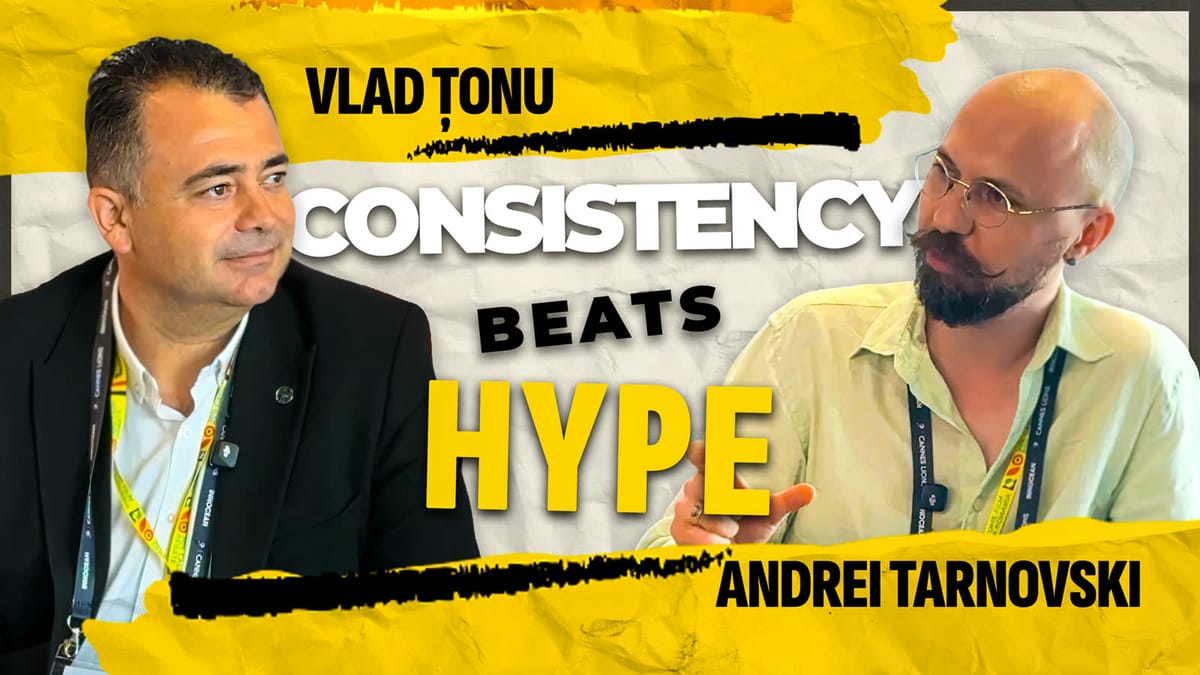


Language note: This episode was recorded in Romanian at the Romanian Creativity Pavilion, Cannes Lions 2026. The article is written in English. Every blockquote below reproduces the guest’s words verbatim in Romanian, exactly as they appear in the recorded transcript; the English line underneath is a translation for readers, not a quotation. Nothing has been added to his meaning.
The conversation in one paragraph
What does a national brand actually do for a small exporter? The question sounds abstract until you put it to someone who spends public money on national stands. Vlad Țone, Director de cabinet at ARICE — the Romanian agency for investment and foreign trade, which runs Romania’s national participation at international trade fairs — answers it without a single branding buzzword. His diagnosis: Romania’s creative industries have a brand (RoCreative), and individual firms have reputations, but the name “Romania” itself has to be able to lift an industry at the start of its road alongside the ones that have already proved themselves.
The strategy he describes is deliberately unglamorous. You cannot be competitive on every market, so choose presence over omnipresence: the same stand, the same deliberately simple identity — “simply Romania” — at fair after fair. The state shows up and, by showing up, vouches for the firms around it. Established exporters anchor the pavilion; startups borrow credibility from sitting next to them, because nobody is born big. And the ten-year ambition is not a slogan about creative superpowers. It is that Romanian firms be read as serious people and loyal partners, offering a partnership built for the long road.
TL;DR
- The national brand is the problem. Romania’s creative industries have a brand (RoCreative) and firms have reputations, but saying “Romania” should lift industries at the beginning of their road alongside the ones that have already proved themselves.
- Presence beats omnipresence. “You can never be competitive on every market, but you have to be present.”
- “Simply Romania” is an identity, not a rebrand. Very simple, with a very big impact, and applicable to every industry.
- The state’s presence vouches for exporters. By attending the business discussions, the agency gives them weight and signals that these firms matter to the economy.
- The pavilion works as a scaffold. Self-funded incumbents anchor it; medium firms get support; startups get minimis aid plus the know-how of sitting next to established brands — nobody is born big.
- The machinery is unglamorous and deliberate. An export calendar agreed with the federations of the Export Council, contracted logistics, minimis aid restricted to producers, and a digitalisation push so firms see the fairs, the conditions and the competition in advance.
- Consistency is policy, not taste. Strategy born of necessity, small steps from event to event, and the kind of patience Scandinavia spent on design and Korea on mass culture.
- Business needs stability. Political life is effervescent; the ARICE–Export Council partnership may be one of the few public-private partnerships that still works in Romania — “still” being the word Andrei Tarnovski picks up on.
Key Takeaways
1. The problem is the national brand, not the lack of industry brands
Romania does not need to invent a brand for its creative industries. RoCreative exists, grown by the creative industries themselves, and other sectors have built brands too — ARICE agrees with those efforts entirely. The gap Țone identifies sits one level up. When a foreign partner hears “Romania”, the name should carry enough trust to lift an industry that is only starting out, the way it already carries established ones. That is why the agency reached for a national visual identity rather than another sector brand.
2. Presence beats omnipresence
“You can never be competitive on every market, but you have to be present.” The strategy follows from that constraint. Romania cannot win every market, so it shows up consistently instead: one national stand, carried from event to event, so participants and beneficiaries feel the state’s support. The long view is not optional idealism — Țone is explicit that the strategy comes from necessity, and that the long perspective is built from small steps, event by event, day by day.
3. “Simply Romania”: an identity, not a rebrand
Asked about country brands in the mode of Scandinavian design or Korean mass culture, Țone keeps the ambition proportionate. ARICE tried to bring forward a visual identity rather than build a full brand: very simple, with a very big impact — “simply Romania”. It is the sign under which the country’s pavilion is to be built at every international participation, in every industry. Not a new slogan for the nation; a consistent flag to stand under.
4. The state’s presence vouches for exporters
Why does it matter that a state agency sits at the stand? Because credibility is the real export support. In Țone’s words, the agency’s presence gives weight to the business discussions and vouches for the participating firms — signals that they matter to the state and to the economy. Andrei Tarnovski connects this to what Mihai Lupu of FEPIC said in episode 4: sometimes it matters more to know that a credible institution stands behind you than to have the money the institution gives you — and if both come bundled, you can work miracles. Țone’s answer: “That is the conclusion I also wanted to underline, and I completely agree.”
5. Nobody is born big: the pavilion as a scaffold
Three kinds of exhibitor share the national pavilion. Established firms that already attend fairs on their own budget anchor it — external partners come to the stand to talk to them. Medium firms get the state support they still need. Startups need the minimis aid most, but they also gain the know-how of being next to recognised brands — because, as Țone puts it, a big brand can support a smaller firm, a child it has to raise, and nobody is born big from the start.
6. Unglamorous machinery, now being made transparent
The programme’s plumbing matters more than its polish. ARICE sets an events calendar together with the employer federations organised as an Export Council; a contracted partner handles logistics; companies selected through an ARICE procedure receive de minimis aid — and they must be producers, the ones actually making what gets exported. A new digitalisation push opens the programme up: the fairs, their locations, the expectations, how many firms participate and under what conditions are visible in advance. The point is more competition for the places and better-prepared firms on the floor.
7. Patience is the strategy
Andrei Tarnovski points to Scandinavia, Korea and Brazil — countries that built a country brand so their industries could become competitive, with the state supplying patience and incremental results. Țone accepts the frame and adds the institutional caveat: decision-making and political life move with more effervescence than a business needs for stability. The industry should define its priorities; the agency will back it financially and, as he says, morally, on whatever other level they identify together. And the partnership between the agency and the Export Council may be one of the few public-private partnerships that still works in Romania.
Best Quotes From the Episode
„Problema pe care eu am identificat-o, de fapt, este o chestie de brand național. În momentul în care spui România, cumva, să poți să ridici și o industrie aflată la început de drum, alături de o industrie care deja a confirmat.“ — Vlad Țone, verbatim from the transcript
“The problem I identified is actually a question of national brand. When you say ‘Romania’, you want to be able, in a way, to lift an industry that is at the start of its road, alongside an industry that has already proved itself.”
„Întotdeauna nu poți să fii competitiv pe toate piețele, dar trebuie să fii prezent.“ — Vlad Țone, verbatim from the transcript
“You can never be competitive on every market, but you have to be present.”
„Un brand mare poate susține o firmă mai mică, un copilaș pe care trebuie cumva să-l crească, că nimeni nu s-a născut mare de la bun început.“ — Vlad Țone, verbatim from the transcript
“A big brand can support a smaller firm — a child, in a way, that it has to raise — because nobody is born big from the start.”
„Practic, seriozitatea pe care firmele românești ar trebui să o prezinte trebuie să fie o garanție de business și un parteneriat de drum lung.“ — Vlad Țone, verbatim from the transcript
“Basically, the seriousness that Romanian firms should show has to be a guarantee of business and a partnership built for the long road.”
About the guest
Vlad Țone, Director de cabinet at ARICE — the Romanian Agency for Investment and Foreign Trade (Agenția Română pentru Investiții și Comerț Exterior) — whose remit includes export promotion: organising Romania’s national participation at international trade fairs in partnership with the industry federations of the Export Council, contracting the logistics of each stand, and awarding state minimis aid to the producing companies selected through its procedure. He recorded this conversation at the Romanian Creativity Pavilion during Cannes Lions 2026.
About the host
Andrei Tarnovski is a marketing strategist and the founder of TARNOVSKI, a branding and marketing consultancy. He hosts Boringly Effective, a show for marketers, founders, strategists and brand leaders who would rather understand what works than chase what’s fashionable.
Listen / watch / subscribe
- Watch the episode on YouTube.
- Listen on Spotify, Apple Podcasts, and your favourite podcast app.
- Subscribe to the Boringly Effective Newsletter at BoringlyEffective.com for a weekly round-up of the most important marketing news, plus links to the latest episodes.
This Cannes Lions series was produced by SYMBOLON, with support from the RoCreativity program by FEPIC and ARICE.
Questions & Answers
Quick answers drawn from the conversation.
What is this episode about?
Nation branding without the hype. Vlad Țone of ARICE and Andrei Tarnovski discuss how Romania shows up abroad: one national stand carried consistently from fair to fair, a deliberately simple identity, minimis aid for producers, and the way a state’s presence transfers credibility to firms too small to carry their own.
Who is the guest?
Vlad Țone, Director de cabinet at ARICE — the Romanian Agency for Investment and Foreign Trade — the state agency whose remit includes export promotion and Romania’s national participation at international trade fairs.
What does ARICE do for exporters?
It agrees an events calendar with the employer federations organised as an Export Council, contracts the logistics of the national stands, and awards de minimis aid to selected companies, which must be producers. A new digitalisation effort makes the programme transparent: fairs, conditions, participant numbers and expectations are published in advance.
Why a visual identity instead of a country rebrand?
Because the gap is the national brand, not a missing logo. ARICE chose a visual identity it sees as very simple with a very big impact — “simply Romania” — under which the national pavilion stands at every international participation.
What does a national pavilion give a small firm?
Know-how and credibility. Established exporters anchor the stand and draw partners in; medium firms get support; startups get minimis aid plus the borrowed trust of the pavilion — nobody is born big.
What is the long-term ambition for Romania’s image?
Țone declines to impose a personal wish — that choice, he says, belongs to the institution and to Romania, and should stay an open hypothesis so everyone has a chance. What he hopes for is that Romanian firms are seen as serious people and loyal partners, and that business relationships run for the long road.
Who is the host?
Andrei Tarnovski, marketing strategist and founder of TARNOVSKI Marketing Consultancy.
Where can I listen?
On YouTube (with English subtitles), Spotify, Apple Podcasts, and your favourite podcast app. For the weekly round-up of marketing news plus new episodes, subscribe to the Boringly Effective Newsletter.
What language is the episode in?
Romanian. It was recorded at the Romanian Creativity Pavilion, Cannes Lions 2026; the YouTube video carries English subtitles.
Related on this site: Mihai Lupu on Romanian creativity, consistency and the long road to recognition — the FEPIC episode quoted above — and Alexandru Stan on buying The Next Web.
Show full transcript · 2,298 words (RO)
0:01 Vlad Țone ARICE, Agenția Română pentru Investiții și Comerț Exterior, da, are printre atribuțiuni, are și această componentă de promovare la export. Și faptul că un brand mare poate susține o firmă mai mică, cumva un copilaș pe care trebuie cumva să-l crească, că nimeni nu s-a născut mare de la bun început. Problema pe care eu am identificat-o, de fapt, este o chestie de brand național. În momentul în care spui România, cumva, să poți să ridici și o industrie aflată la început de drum, alături de o industrie care deja a confirmat. Sustenabilă este susținerea din partea statului, prin prezența noastră aici, alături de expozanți și participările pe care le avem la discuțiile, practic, de business, în care pur și simplu cred că dăm o greutate acestor discuții și practic că noi suntem prezenți, dăm gir că aceste firme cumva au o importanță din partea statului pentru ce înseamnă economia noastră.
0:59 Andrei Tarnovski Bună ziua! Mersi că ați acceptat interviul.
1:05 Vlad Țone Bună ziua! Cu mare drag.
1:08 Andrei Tarnovski Suntem la Romanian Creativity Pavilion la Cannes Lions 2026 și o primă întrebare a mea e cum e să fii la standul României fiind unul dintre oamenii care a contribuit la acest lucru?
1:23 Vlad Țone Pentru mine este sincer o mare bucurie și este o mare bucurie pentru că în primul rând încep să descopăr acest domeniu. Domeniul de creativitate în general poate pentru mai mulți și pentru mine este o chestie cumva mai generală. Este cumva un picuț lăsat un orizont foarte mare, dar numai fiind aici poți într-adevăr să înțelegi de fapt care este esența și care sunt lucrurile importante pe care această industrie le reprezintă.
1:51 Andrei Tarnovski Credeți că în creativitate și nu zic doar de creativitate din industria de publicitate, ci în genere orice tip de creativitate, design de produs, fashion și așa mai departe, e acolo acea valoare adăugată care ne poate pune pe harta globală a granzilor?
2:12 Vlad Țone Cu siguranță, din ceea ce văd și din perspectiva instituțională pe care o am, este clar că diversitatea și, de fapt, diferențierea dintre un produs este dată de creativitate.
2:26 Andrei Tarnovski E miere pentru sufletul meu să aud această idee, pentru că uneori mi se crea impresia că creativitatea e văzută ca opțională și atunci văzând că devine posibil.
2:40 Vlad Țone Nu, nu este văzută din perspectiva de care am vorbit dumneavoastră, ba din contră, din punctul meu de vedere, întotdeauna pentru a putea evolua și a face lucrurile din ce în ce mai bune, întotdeauna ai nevoie, în primul rând, de creativitate, după care ai nevoie de a fi cât mai inspirat.
2:57 Andrei Tarnovski Anume acest stand a fost posibil cu ajutorul Federației Patronale care a gestionat partea asta de a găsi acei creativi care își doresc să aducă mai multă valoare în țară, care își doresc să pună România pe harta globală a industriilor creative. Dar partea asta instituțională, din perspectiva ARICE, care e contribuția voastră principală dincolo de a ajuta financiar?
3:29 Vlad Țone Aș vrea un pic și îmi cer iertare pentru chestia asta să reformulăm pentru a fi mai clar pentru a stabili câteva lucruri. ARICE, Agenția Română pentru Investiții și Comerț Exterior, are printre atribuțiuni, are și această componentă de promovare la export. Prin organizarea de aceste evenimente, pe care instituția le organizează într-un parteneriat cu federațiile, patronatele, care sunt structurate sub forma unui Consiliu de Export, ei sunt principalii noștri parteneri în această organizare. Cu ce contribuie fiecare lucrurile sunt foarte clare. Avem pe de o parte un patronat care din punct de vedere tehnic ne susține și ne dă informațiile și pur și simplu împreună definitivăm un calendar de evenimente la care România participă. Avem un partener care ne ajută în organizarea acestui eveniment, care cumva este o firmă responsabilă de logistică pe care instituția ARICE o contractează pentru a participa la aceste evenimente și firmele participante care în urma unei proceduri pe care instituția ARICE o organizează, ele pot participa și beneficia de aceste ajutoare care sunt ajutoare de minimis pe care statul român le oferă societăților comerciale care vor să participe la aceste târguri. În speță, eu aș deschide aici o paranteză, care trebuie neapărat să fie producători.
4:58 Andrei Tarnovski Adică, de fapt, cei care aduc acea valoare destinată exportului.
5:02 Vlad Țone Exact. Tocmai pentru a face legătura cu cele menționate mai devreme.
5:06 Andrei Tarnovski E bine că ați menționat chestia asta, pentru că pentru publicul larg s-ar putea să rămână acest gap informațional despre cum se întâmplă lucrurile de fapt.
5:15 Vlad Țone Tocmai pentru că și la nivel de instituție întotdeauna avem nevoie și de creativitate și de această componentă. Faptul că nu de mult timp ocup și ocupăm această poziție, referindu-mă aici și la colegii mei, pentru că întotdeauna nu poți face lucrurile de unul singur, ai nevoie de o echipă, noi încercăm cumva să venim cu o chestie creativă în acest program-proiect și tocmai că nu de mult am lansat câteva provocări acestui program. Am lansat partea de digitalizare în care pur și simplu ne dorim ca aceste firme care vor să participe să aibă parte de o transparentizare mai mare a acestui program și proiect în care practic târgurile să le vedem din timp, unde sunt organizate, ce ne dorim de la aceste participări, câte firme participă, în ce condiții participă, astfel încât, din punctul meu de vedere, trebuie să existe o competitivitate cât mai mare și firmele să vină cât mai bine pregătite la aceste evenimente.
6:19 Andrei Tarnovski Să înțeleg că abordarea ARICE e mai degrabă din perspectiva unui proiect de bătaie lungă.
6:25 Vlad Țone O viziune bazată pe niște principii și practic să avem la bază o strategie a României, pentru că întotdeauna nu poți să fii competitiv pe toate piețele, dar trebuie să fii prezent. Totodată este important cum te prezinți, tocmai de aceea am lansat și un brand al standului pe care noi ca și agenție ne dorim să-l avem prezent la toate evenimentele la care România participă. Să fim cumva sub un pavilion, să fim cumva sub o susținere a statului român pe care participanții și beneficiarii acestui program eu mi-aș dori să o simtă mai bine și mai mult.
7:09 Andrei Tarnovski În calitate de marketer sunt încântat să aud ideea că e urmărită acea consecvență care de fapt aduce rezultatul pe termen lung pentru că rezultatele instantanee de regulă nu sunt sustenabile și atunci mă bucură faptul că aveți abordarea asta de planificare, de a avea o strategie integrată, de a avea consecvența asta a unei expuneri a României pentru export.
7:38 Vlad Țone Strategia vine de fapt din necesitate. Întotdeauna în momentul în care ne gândim la o industrie și stabilim cumva care sunt prioritățile pe care noi le avem, într-adevăr ne gândim la o perspectivă pe perioadă mai îndelungată. Dar cumva această perspectivă îndelungată nu poți să o faci decât prin niște pași mărunți care vin cumva de la eveniment la eveniment sau în cazul nostru participarea acestora vine de la zi la zi. Încercăm întotdeauna să vedem cum putem să îmbunătățim, cum putem să venim cu un plus astfel încât participanții la aceste evenimente, atât din punct de vedere al know-how-ului și interacțiunii pe care o au participând la acest eveniment, să îl poată cumva cuantifica și valorifica prin contracte și prin parteneri noi. Dar totodată este important și ne dăm seama cât de sustenabilă este susținerea din partea statului prin prezența noastră aici alături de expozanți și participările pe care le avem la discuțiile de business în care pur și simplu cred că dăm o greutate acestor discuții și practic că noi suntem prezenți, dăm gir că aceste firme cumva au o importanță din partea statului pentru ce înseamnă economia noastră.
8:59 Andrei Tarnovski Ați răspuns parțial la întrebarea pe care urma să vă adresez. Dincolo de susținerea financiară cu ce mai contribuie ARICE și îmi dau seama că de fapt asta e contribuția probabil mai importantă decât componenta financiară, anume să ajutați industriile să-și construiască acest plan pentru ieșirea în afară, pentru atragerea...
9:19 Vlad Țone Exact. Sunt mai multe aspecte și din discuțiile pe care le-am avut cu partenerii noștri, am stabilit că este important să venim și cu firme care deja cumva ele au mai fost și participă la aceste evenimente pe cont propriu, adică nu au o problemă financiară și stau cu ghilimelele de rigoare în finanțarea pe care statul român o acordă. Într-o categorie sunt firmele medii care cumva au nevoie de susținere și de suport atât al statului cât și faptul că se află lângă firme deja consacrate și cumva partenerii externi vin la stand să discute cu firme consacrate, dar văd și ideile celor care sunt medii și foarte importantă este prezența startup-urilor. De ce? Pentru că startup-urile cu siguranță au nevoie de această susținere financiară, dar totodată venind sub un pavilion național, ei beneficiază de foarte multe lucruri, inclusiv îmi dau seama cât este de importantă componenta asta de know-how și faptul că un brand mare poate susține o firmă mai mică, un copilaș pe care trebuie cumva să-l crească, că nimeni nu s-a născut mare de la bun început.
10:28 Andrei Tarnovski Și aici avem inclusiv exemple cum ar fi țările scandinave, cum e Coreea și alte țări care au încercat, Brazilia de exemplu, în industriile creative, care au creat un brand de țară ca să ajute întreaga industrie să devină mai competitivă, adică în direcția asta văd că mergeți și voi.
10:49 Vlad Țone Nu trebuie să facem abstracție de realitatea în care trăim. Există industrii, cum avem aici RoCreative, care este un brand practic crescut de ceea ce înseamnă partea de industrie creativă, dar totodată sunt și alte industrii care cumva au încercat și au reușit să construiască un brand, cu care suntem întru totul de acord. Problema pe care eu am identificat-o, de fapt, este o chestie de brand național. În momentul în care spui România, cumva, să poți să ridici și o industrie aflată la început de drum, alături de o industrie care deja a confirmat. Și atunci noi am încercat cumva să aducem o identitate vizuală mai degrabă decât construirea unui brand. Această identitate vizuală noi cumva o vedem ca fiind foarte simplă cu un impact foarte mare, adică simplu România. Asta este brandul pe care noi dorim să-l promovăm și asta este practic cumva sigla sub care vrem să construim pavilionul țării noastre la toate industriile, la toate participările internaționale, să simțim practic mândria de a fi români.
11:55 Andrei Tarnovski Anume din acest motiv întâmpinăm cam toți oaspeții care vin aici la pavilion cu Welcome to Romania, nu în alt fel. Pentru că știm cât e de important ca să ne putem susține unii pe alții, noi cei din diferite industrii, ca să construim împreună acest brand despre care spuneți. Aveți vreun mod anume în care ați vrea să fie percepută România — în special industria creativă din România — în 10 ani sau în 15 ani? De exemplu, pentru multă lume Brazilia înseamnă design deosebit, pentru multă lume Estonia înseamnă o țară digitală, pentru România aveți vreo asociere pe care vreți să o aveți și nu zic neapărat asocierea cu o industrie, ci mai degrabă cu un fel de a fi sau cu un mod în care operează oamenii din România?
12:46 Vlad Țone Nu cred că ar fi o abordare foarte corectă să spun ce mi-aș dori, pentru că este o diferență foarte mare între ceea ce îmi doresc personal și ceea ce trebuie să-și dorească cumva instituția și în speță România. Dar, cu siguranță, trebuie să fie cumva o ipoteză total deschisă, astfel încât toată lumea să aibă o șansă. Din ceea ce pot să mă gândesc la întrebarea dumneavoastră, nu mi-aș dori decât ca noi, practic, să fim pe toate domeniile priviți ca niște oameni serioși, ca niște parteneri foarte loiali și, întotdeauna, aceste business-uri, cel puțin la nivel internațional, să fie pe perioadă cât mai îndelungată. Practic, seriozitatea pe care firmele românești ar trebui să o prezinte trebuie să fie o garanție de business și un parteneriat de drum lung.
13:46 Andrei Tarnovski Adică, practic, am putea să mergem pe scenariul designului scandinav, culturii de masă coreene, care a fost susținut de stat, dar statul are răbdarea să construiască pas cu pas, cu rezultate incrementale. Adică avem această răbdare să construim ceva de importanță majoră pentru țară.
14:10 Vlad Țone Pornind de la realitatea în care trăim, tot ce înseamnă aspect, să spunem așa, cumva decizional, politic, este într-o efervescență mult mai mare decât ceea ce înseamnă stabilitatea de care un business ar avea nevoie. Este important ca dumneavoastră să hotărâți care sunt acești itemi principali, iar noi cu siguranță vom fi alături de dumneavoastră și vom susține atât din punct de vedere financiar, pentru că ăsta este aspectul, poate, cel mai important, dar cu siguranță și un aspect, să spunem, moral sau de susținere pe orice alt palier conex putem identifica împreună și să susținem acest parteneriat public-privat. Ceea ce este de menționat că acest parteneriat pe care agenția îl are cu acest Consiliu de Export poate că este unul dintre puținele parteneriate public-privat care încă mai funcționează în țara noastră.
15:01 Andrei Tarnovski Mă îngrijorează cuvântul încă, dar îmi place ideea că funcționează și, cum spunea mai devreme și Mihai Lupu de la FEPIC, uneori e mai important să știi că te susține o instituție credibilă decât să ai acei bani pe care instituția ți-i dă. Dar dacă vin la pachet ambele, poți face minuni.
15:18 Vlad Țone Asta este concluzia pe care și eu am vrut să o subliniez și cu care sunt perfect de acord.
15:25 Andrei Tarnovski Mersi foarte mult și sper să avem tot mai mult ajutor reciproc, întotdeauna reciproc, în a pune România pe harta globală, să devenim o țară de invidiat pentru alții, o țară care își asumă și confirmă rezultatele pe care și le dorește.
15:42 Vlad Țone Cu mare drag și eu aș vrea în încheiere să vă felicit, să vă urez mult succes și apreciem foarte mult faptul că sunteți aici alături de noi și că reușim împreună să promovăm aceste evenimente. Doar împreună o putem face.
15:59 Andrei Tarnovski Mulțumesc, vă aștept foarte mult!
Show full transcript · 1,765 words (EN)
0:01 Vlad Țone ARICE, the Romanian Agency for Investment and Foreign Trade, yes, has among its responsibilities this export promotion component as well. And the fact that a big brand can support a smaller company, sort of like a child it needs to nurture, because nobody was born big from the start. The problem I identified is actually a matter of nation branding. When you say Romania, somehow, you can uplift an emerging industry alongside one that's already established. State support is sustainable through our presence here, alongside exhibitors and our participation in business discussions, where I think we simply give weight to these conversations, and being present, we endorse that these companies somehow are important to the state and to our economy.
0:59 Andrei Tarnovski Hello! Thanks for accepting the interview.
1:05 Vlad Țone Hello! My pleasure.
1:08 Andrei Tarnovski We're at the Romanian Creativity Pavilion at Cannes Lions 2026, and my first question is: what is it like to be at the Romanian booth, being one of the people who contributed to this?
1:23 Vlad Țone For me, it is honestly a great joy, and it's a great joy because first of all, I'm beginning to discover this industry. The creative field in general, for many and for me, is something broader. It leaves a very wide horizon, but only by being here can you truly understand the essence and the important things this industry represents.
1:51 Andrei Tarnovski Do you think creativity—and not just in advertising, but any kind of creativity: product design, fashion, and so on—is that added value that can put us on the global map with the giants?
2:12 Vlad Țone Definitely. From what I see and from an institutional standpoint, diversity and, in fact, product differentiation comes from creativity.
2:26 Andrei Tarnovski It's music to my ears to hear this, because I sometimes felt that creativity was seen as optional, and seeing that it's becoming possible.
2:40 Vlad Țone No, it's not seen the way you described; on the contrary, in my view, to evolve and make things better and better, you always need creativity first, and then you need to be as inspired as possible.
2:57 Andrei Tarnovski This specific pavilion was made possible with the Employers' Federation, which managed the part of finding creatives who want to bring more value to the country, who want to put Romania on the global map of creative industries. But institutionally speaking, from ARICE's perspective, what is your main contribution beyond financial support?
3:29 Vlad Țone I'd like to—and forgive me for this—rephrase a bit to clarify and establish a few things. ARICE, the Romanian Agency for Investment and Foreign Trade, has among its responsibilities this export promotion component as well. Through organizing these events in partnership with federations, employers' associations, structured as an Export Council, they are our main partners in this organization. What each contributes is very clear. On one hand, we have an association that supports us technically, provides information, and together we finalize a calendar of events in which Romania participates. We have a partner helping us organize the event, a logistics company contracted by ARICE to participate in these events, and participating companies that, through an ARICE procedure, can participate and benefit from this aid, which is de minimis aid, offered by the Romanian state to companies wanting to attend these trade fairs. Specifically—and I'd add a note here—they must strictly be producers.
4:58 Andrei Tarnovski Meaning those who actually generate that export value.
5:02 Vlad Țone Exactly. Precisely to connect with what was mentioned earlier.
5:06 Andrei Tarnovski It's good you mentioned this, because for the general public there might still be this information gap about how things actually work.
5:15 Vlad Țone Precisely because at the institutional level we always need creativity and this component as well. Having held this position for only a short time, along with my colleagues, because you can never do things alone, you need a team, we're trying to bring a creative touch to this project, and we recently introduced a few new challenges to this program. We introduced digitalization, simply aiming for companies wanting to participate to have greater transparency, so that trade fairs can be seen well in advance: where they're held, our goals, how many companies attend, under what conditions, so that, in my view, competitiveness should be as high as possible, and companies come as well-prepared as possible to these events.
6:19 Andrei Tarnovski So ARICE's approach is more of a long-term project perspective.
6:25 Vlad Țone A vision based on principles and, essentially, having a Romanian strategy at its core, because you can't be competitive in every market, but you must be present. It's also important how you present yourself, which is why we launched a pavilion brand that we as an agency want to have at every event Romania attends. To be under one pavilion, backed by the Romanian state, which I would like program participants and beneficiaries to feel more strongly and clearly.
7:09 Andrei Tarnovski As a marketer, I'm thrilled to hear that you're pursuing that consistency which brings long-term results, because instant results usually aren't sustainable, so I'm glad you have this planning approach, having an integrated strategy and consistent export visibility for Romania.
7:38 Vlad Țone The strategy actually comes from necessity. Whenever we think about an industry and define our priorities, we certainly think about a longer-term perspective. But you can only build this long-term perspective through small steps, going from event to event or, in our case, their participation day by day. We always try to see how we can improve, how to add value so event participants, both in know-how and interactions from participating in this event, can quantify and leverage it into contracts and new partners. But it's also important, and we realize how sustainable state support is through our presence here alongside exhibitors and our participation in business discussions, where I simply believe we give weight to these conversations and being present, we endorse that these companies matter to the state and our economy.
8:59 Andrei Tarnovski You partially answered the question I was going to ask. Beyond financial support, what else does ARICE bring? I realize that this is probably more important than the financial component, namely helping industries build this plan to expand abroad, to attract...
9:19 Vlad Țone Exactly. There are several aspects, and from discussions with our partners, we agreed it's important to include companies that already attended and participate in these events on their own—meaning they don't have financial issues, quote-unquote, relying on Romanian state funding. In another category are mid-sized companies that need support from both the state and being positioned next to established companies; foreign partners come to talk to established firms, but also see mid-sized ideas, and the presence of startups is very important. Why? Because startups certainly need this financial support, but under a national pavilion, they benefit from so much, including the crucial know-how component and the fact that a big brand can support a smaller company, like a child it must nurture, since nobody was born big from the start.
10:28 Andrei Tarnovski And we have examples like the Scandinavian countries, Korea, and others, Brazil for example, in creative industries, which built a nation brand to help the whole industry become more competitive. I see you're heading in that direction too.
10:49 Vlad Țone We shouldn't ignore the reality we live in. There are industries, like RoCreative here, which is a brand grown essentially by the creative industry, but other industries have also tried and managed to build a brand, which we fully support. The problem I identified is actually a matter of nation branding. When you say Romania, somehow, you can uplift an emerging industry alongside one that's already proven itself. So we tried to introduce a visual identity rather than build a brand from scratch. We see this visual identity as very simple, with a huge impact: simply Romania. This is the brand we want to promote, and this is essentially the logo under which we build our pavilion for all industries, at all international events, to truly feel proud of being Romanian.
11:55 Andrei Tarnovski That's why we greet almost all guests visiting the pavilion with "Welcome to Romania," nothing else. Because we know how important it is to support each other, across different industries, to build this brand you're talking about together. Is there a specific way you'd like Romania— especially Romania's creative industry—to be seen in 10 or 15 years? For instance, for many people Brazil means great design, for many people Estonia means a digital country; for Romania, is there an association you'd like to have, and not necessarily with an industry, but rather with a mindset or the way people operate in Romania?
12:46 Vlad Țone I don't think it would be right to say what I personally wish for, because there's a big difference between what I want personally and what the institution and, specifically, Romania should want. But it certainly must be an open hypothesis, so everyone gets a chance. Thinking about your question, I would only hope that we are seen across all fields as serious, loyal partners, and that these business relationships internationally are as long-term as possible. Essentially, the reliability Romanian firms demonstrate should be a business guarantee and a long-term partnership.
13:46 Andrei Tarnovski So we could follow the model of Scandinavian design or Korean pop culture, which had state support, where the state has the patience to build step by step, with incremental results. Meaning we have that patience to build something of major national importance.
14:10 Vlad Țone Starting from reality, everything decision-making and political is in much greater turmoil than the stability a business needs. It's important for you to decide what the key priorities are, and we will certainly stand by you and support you financially, as that may be the most important aspect, but certainly also morally and across any other related level we can identify together to support this public-private partnership. It's worth mentioning that this partnership the agency has with the Export Council is perhaps one of the few public-private partnerships still working in our country.
15:01 Andrei Tarnovski The word "still" worries me, but I like that it works, and, as Mihai Lupu from FEPIC said earlier, sometimes it's more important to have a credible institution backing you than just the money it provides. But if both come together, you can work wonders.
15:18 Vlad Țone That's the point I also wanted to emphasize, and I fully agree.
15:25 Andrei Tarnovski Thank you very much, and I hope for more mutual support—always mutual— in putting Romania on the global map, to become a country envied by others, a country that takes ownership and delivers the results it aims for.
15:42 Vlad Țone With great pleasure, and in closing I'd like to congratulate you, wish you great success, and we deeply appreciate you being here with us, and promoting these events together. We can only do it together.
15:59 Andrei Tarnovski Thank you, looking forward to seeing you!