
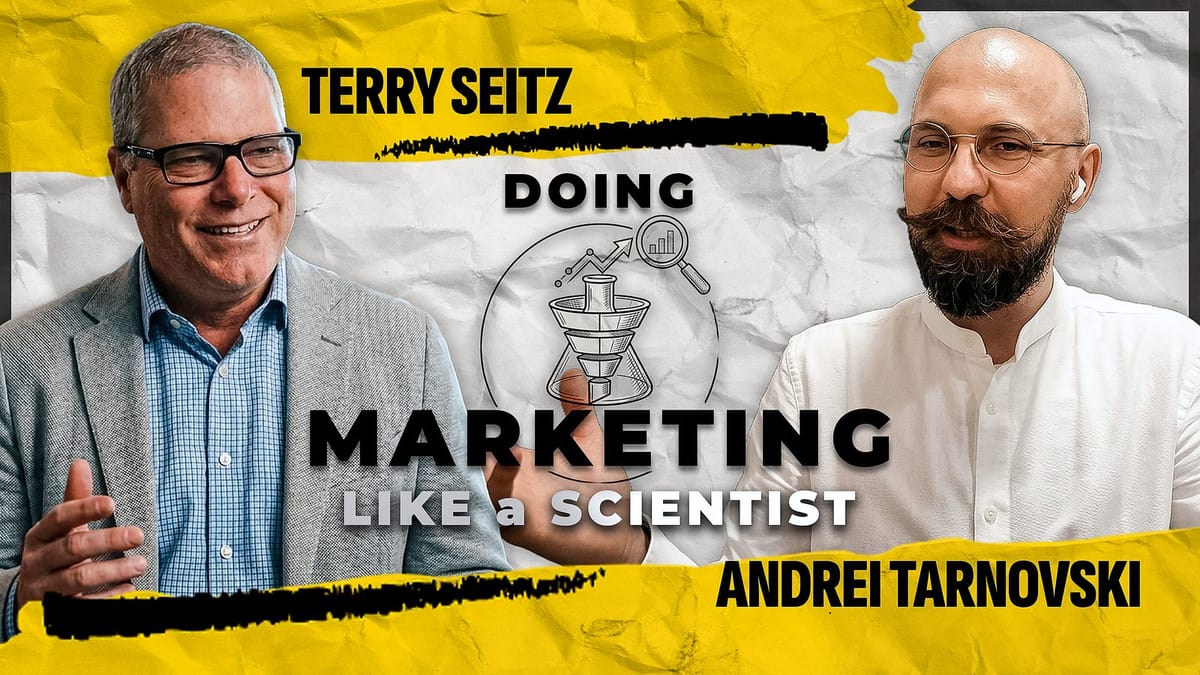


Recorded online (US–Bucharest video call), in English. Every quote below reproduces the guest's words verbatim from the episode transcript. Nothing has been added to his meaning.
Watch / listen: YouTube · Spotify · Apple Podcasts · your favourite podcast app
Related on this site: performance marketing and what it costs you and the brand vs performance budget split.
The conversation in one paragraph
Terry Seitz asked himself the same question for the twelve years he spent inside Visa's global marketing operation: why does a company that never issues a card, never charges interest and never owns the customer relationship spend over a billion dollars a year on marketing? The answer he lands on is not card usage. It is enterprise value, and above all pricing power. Awareness and preference drive usage. Usage gives Visa a stronger hand with the banks and fintech partners that actually issue the cards. The stronger hand is why, as he puts it, the margins are "the envy of every industry."
The conversation starts there and gets more interesting as it goes: what happens to marketing money inside a 25,000-person company, why the global CMO controls the narrative while the country managers control the dollars, how Visa tested a campaign about the pink tax past its own management, and why Terry, now a partner at The Nuance Collective after more than twenty years split between agencies and Visa, believes marketing's habit of promising guaranteed outcomes is what got the discipline sent to the kids' table.
TL;DR
- Visa advertises for pricing power, not card swipes. Usage matters, but the deeper return is the premium Visa can charge the banks and fintechs that issue its cards.
- If Visa stopped advertising tomorrow, nothing would move this quarter. Ubiquity buffers the short term and the erosion would be slow and long-term, which is exactly why the dashboard never shows it.
- The global CMO controls the narrative; the country managers control the dollars. "He or she who controls the dollars often controls the votes." Shared KPIs are the only durable fix.
- Inside a big company, testing is how an idea earns the right to exist. The Money is Changing campaign survived on proof of life: women loved it, men weren't upset, and most men were never going to see it anyway.
- Marketing is probabilistic, not deterministic. The industry's overcorrection, from no accountability to guaranteed outcomes, is what broke its credibility with finance.
- Finance prices risk; marketing is asked to eliminate it. "We're the only function that gets indicted for that."
- Leave room for alchemy. As Terry tells Rory Sutherland's argument: extraordinary returns come from surprise, not from optimising two or three percent.
Key Takeaways
1. Why Visa advertises: pricing power
Visa is what Terry calls a B2B2C business. The banks issue the cards, set the rates and collect the interest. Visa is the rails underneath, earning basis points on every transaction. So yes, the obvious reason to advertise is usage, and that is real. But he says the deeper reason took him time to understand, and it is the reason campaigns around the World Cup, the Olympics and a thirty-year NFL partnership make commercial sense: the advertising builds the preference that Visa then converts into pricing power with its partners.
"What we're able to do is if we're able to increase awareness and preference of Visa, which leads to more cardholder usage, what that ultimately means is pricing power when we go back to the banks and the fintech partners."
He describes the result as an emotional moat around the brand.
"It is the premium we are able to charge our partners and our clients, which is why our margins are the envy of every industry."
For anyone who has sat in a budget meeting wondering why a payments network sponsors sport at that scale, this is the answer: the marketing is not a cost of selling cards. It is a cost of protecting margin.
2. Stop advertising tomorrow? Nothing you'd notice this quarter
The team at Visa did kick the tires on the question of what would happen if they stopped. The answer was never actually to test it, but Terry's honest read is instructive, and slightly uncomfortable for anyone who wants marketing to show up in this quarter's numbers.
"I don't think you would see, if we stopped advertising tomorrow, a short-term drop in cardholder usage or equity or pricing power. I think it would happen in the longer term."
Ubiquity and the sheer number of credentials in market buffer the short term. The damage compounds quietly. Which is precisely the problem: the most valuable work brand advertising does is the work a quarterly report is structurally unable to show.
3. The emperor without clothes: who really controls the budget
When Terry joined Visa in 2013, the global CMO controlled far more of the marketing spend. Then management moved to a market-by-market P&L view. Marketing spends over a billion dollars a year, and the markets wanted those numbers inside their own ledgers. The result is what the marketing organization jokingly calls having two parents.
"One is a global CMO, and he or she is absolutely in control of the brand narrative... but they don't necessarily control a lot of the activation dollars which sit in the individual markets."
The country presidents and general managers hold the money, and money is power.
"He or she who controls the dollars often controls the votes."
Hence his image of the global CMO as "almost like an emperor without his or her clothing." Add the not-invented-here mentality of local markets, the difficulty of finding a universal insight that isn't banal — the fan in Uganda, Poland, Brazil and Japan is not the same fan — and global versus local becomes a permanent negotiation. The fix, he argues, is unglamorous and decisive: shared KPIs, agreed before anything else.
"If you're not singing from the same songbook from day one, that just leads to tension and turbulence throughout the process."
Global wants long-term brand equity. Markets have commercial outcomes with clients attached. Until both sign the same sheet, every campaign is a fight about funding dressed as a fight about creative.
4. Money is Changing: proof of life before the big check
His favourite piece of work at Visa is also a masterclass in how ideas actually get approved inside a conservative giant. Pre-COVID in the US, the women's empowerment movement was impossible to ignore. Visa's stance was deliberate: no political positions — "it's not red or blue." But research kept surfacing financial topics that were stifling women's economic progress: the pink tax, payment inequality, who controls household finances. Conversations happening woman to woman that brands mostly avoided.
The campaign they built, Money is Changing, made management nervous. The fear: you'll offend men, you'll offend the more conservative markets. So the team did what Terry now preaches — they tested their way in.
"Women, not surprisingly, overwhelmingly loved the campaign... And surprisingly, men weren't upset. They weren't upset that women were talking to women about female economic and financial issues."
And given how targeted the media plan was, most men were never going to be exposed to it anyway. Approval still took months and a series of steps. His summary is the episode's most useful sentence for anyone selling an idea upward:
"You have to do proof of life before anybody hands you a big check."
Even with a billion-dollar budget, a good idea has to earn its way past the organization that owns it.
5. Probabilistic, not deterministic: the promise that broke trust
Twenty years ago, Terry says, the industry was full of "commercial artists with a capital A" — writers, photographers, animators who produced advertising with little accountability. Then social and programmatic arrived, and everything became measurable.
"We now measure everything down to a breath because we can. Not because we should, but because we can."
The overcorrection followed. Having never been held accountable, marketing started guaranteeing outcomes it could not control. When the guarantees missed, finance stopped believing the next forecast.
"It's ludicrous to go, I put a dollar in a marketing investment and I expect a direct outcome of a dollar fifty."
His sharpest point is the asymmetry with finance itself. Net present value, CAPM, every model the CFO runs carries uncertainty and demands a higher return to compensate for it. Finance prices risk. Marketing, alone among functions, is asked to promise its way around it.
"We're the only function that gets indicted for that, which is just bananas to me."
The honest position, he argues, is probabilistic: better inputs raise the odds, and the discipline that says so plainly will be invited back to the adult table.
6. The mad scientist, and the room for alchemy
Terry's answer to the credibility problem is the framing he now carries into his own agency: the marketer as mad scientist. Not a lab-coat metaphor, but a working method — hypotheses, tests, debunking, repeatable learning — that also gives marketing a language the C-suite can evaluate. The science is the part that rebuilds trust with finance. The mad part is what he loves: the insatiable curiosity, and the alchemy that no system produces on schedule.
He points to Rory Sutherland's argument, as he tells it: extraordinary returns tend to be indexed to moments of unexpected magic and surprise, not to optimising two or three percent. His practical conclusion for budgeting:
"There should be a semblance of the budget, there should be a semblance of alchemy allowed... to iterate your way to better outcomes."
The artist in him is not a footnote. He trained as a painter — Pollock, de Kooning, Rothko, the New York school — and went into advertising because it was the day job that let him use the same instincts. The system and the alchemy are not competing philosophies. They are the two halves of the same working brain.
7. What he no longer believes
Asked what he was convinced of early in his career and has since abandoned, his answer is the direct effect of the thirty-second ad — the belief that a funny or heartwarming spot could change a heart and move a purchase on its own. He calls his younger self naive about context planning, touchpoints and how many exposures it actually takes.
"We are idiots for doing what we do for a living because we seem to think that there is a direct way, a systematic approach to get somebody who is non-binary, non-logical, irrational about how they make decisions to do the things we want them to do."
And yet he signed up for it again — leaving Visa for The Nuance Collective, a startup brand intelligence firm built on provocation. At Visa, he says, nothing he did materially moved earnings per share: "one dot on a chart." At the startup, the feedback is immediate and the impact visible — the client's product selling out at retail. The mad part, he says, is that marketers keep trying to move irrational humans with a system. The intoxicating part is that the game never finishes.
Best Quotes From the Episode
"It is the premium we are able to charge our partners and our clients, which is why our margins are the envy of every industry." Terry Seitz, verbatim from the transcript
"I don't think you would see, if we stopped advertising tomorrow, a short-term drop in cardholder usage or equity or pricing power. I think it would happen in the longer term." Terry Seitz, verbatim from the transcript
"He or she who controls the dollars often controls the votes." Terry Seitz, verbatim from the transcript
"Sometimes the global CMO is almost like an emperor without his or her clothing." Terry Seitz, verbatim from the transcript
"If you're not singing from the same songbook from day one, that just leads to tension and turbulence throughout the process." Terry Seitz, verbatim from the transcript
"You have to do proof of life before anybody hands you a big check." Terry Seitz, verbatim from the transcript
"We now measure everything down to a breath because we can. Not because we should, but because we can." Terry Seitz, verbatim from the transcript
"We're the only function that gets indicted for that, which is just bananas to me." Terry Seitz, verbatim from the transcript
"We are idiots for doing what we do for a living because we seem to think that there is a direct way, a systematic approach to get somebody who is non-binary, non-logical, irrational about how they make decisions to do the things we want them to do." Terry Seitz, verbatim from the transcript
About the guest
Terry Seitz has spent more than twenty years in marketing, split between agencies and a twelve-year run at Visa, where his remit covered global brand marketing, awareness and fortification campaigns around the NFL, the Olympic Games and the FIFA World Cup, work with Gen Z, millennial and underrepresented audiences, and product launches including Visa Checkout. He is now a partner at The Nuance Collective, a brand intelligence firm built on provocation: diagnosing the reputation and clarity gap between how a brand presents itself and what customers, and increasingly the LLMs, play back. He recorded this conversation with Andrei Tarnovski online, from the United States.
About the host
Andrei Tarnovski is a marketing strategist and the founder of TARNOVSKI, a branding and marketing consultancy. He hosts Boringly Effective, a show for marketers, founders, strategists and brand leaders who would rather understand what works than chase what's fashionable. This episode was recorded online (US–Bucharest video call).
Listen / watch / subscribe
- Watch the full episode on YouTube.
- Listen on Spotify, Apple Podcasts, and your favourite podcast app.
- Subscribe to the Boringly Effective Newsletter at BoringlyEffective.com for a weekly round-up of the most important marketing news, plus links to the latest episodes.
Questions & Answers
Quick answers drawn from the conversation.
What is this episode about?
Why a company that never issues a card spends over a billion dollars a year on marketing. Terry Seitz, who spent twelve years inside Visa's global marketing operation, explains how advertising builds pricing power, what would and wouldn't happen if it stopped, and why marketing must own its probabilistic nature instead of promising guaranteed outcomes.
Who is the guest?
Terry Seitz, a marketing veteran of more than twenty years who spent twelve at Visa across global brand marketing, NFL, Olympics and World Cup partnerships and launches like Visa Checkout, and is now a partner at The Nuance Collective.
Why does Visa advertise?
Usage is the obvious answer, since Visa earns basis points on every transaction. The deeper reason is enterprise value: awareness and preference create an emotional moat that becomes pricing power over the banks and fintech partners that actually issue the cards.
What would happen if Visa stopped advertising?
Terry's view: no short-term drop in usage, equity or pricing power. Ubiquity buffers the interim, and the erosion would appear in the long term — which is exactly why marketing's contribution is hard to see on a quarterly dashboard.
Why doesn't the global CMO control the marketing budget?
Because management moved to a market-by-market P&L view. Marketing has "two parents": the global CMO owns the brand narrative and C-suite influence, while country presidents and general managers own the activation dollars.
What is the "mad scientist" in marketing?
Terry's term for the modern marketer: someone who works through hypotheses, tests and repeatable learning instead of craft alone, and who still leaves room in the budget for the alchemy and surprise that produce extraordinary returns.
What does probabilistic vs deterministic mean in marketing?
Deterministic marketing promises a fixed outcome for a fixed input — a dollar in, a dollar fifty out. Terry argues humans are non-binary, illogical and emotional, so marketing is probabilistic: better inputs improve the odds but guarantee nothing. Finance prices risk into every model it runs; marketing is the only function asked to guarantee outcomes.
What was the Money is Changing campaign?
A Visa campaign from the pre-COVID US women's empowerment wave that opened conversations about the pink tax, payment inequality and household financial control. Management feared offending men and conservative markets; testing showed women loved it, men weren't upset, and targeted media meant most men would never see it anyway.
Where was the episode recorded?
Online — a video call between the United States and Bucharest, in English.
Who is the host?
Andrei Tarnovski, marketing strategist and founder of TARNOVSKI.
Where can I listen?
YouTube (https://youtu.be/BnCydbwCF8A), Spotify, Apple Podcasts, and your favourite podcast app. For the weekly round-up of marketing news plus new episodes, subscribe to the Boringly Effective Newsletter.
Full transcript
English verbatim, from the proofread transcript. Collapsed on the published page.
Show full transcript · 4650 words (EN)
Andrei Good. Hi Terry.
Terry Hi, how are ya?
Andrei Thanks, how you?
Terry I'm great. It's amazing that we can do this halfway around the world.
Andrei thanks to technology and to what the pandemics did to promote this kind of kin communications. Good. Now, Terry, when we were exchanging emails, you asked a question that I suspect many marketers couldn't properly answer. and that's the question why does Visa even advertise?
Terry It's a it's a it's a great it's a great question and and frankly an existential one that I was asking myself continuously over the twelve years that that I was there. and it has a really interesting sort of sort of answer. On the one hand, if you if you think about it at first blush, people would go, well it's a credit card company. And we say, look, look how many people, look how many cards have been issued, look how many people are using the cards, look how often they're using the cards, this is the average ticket size, et cetera. But what it does is it creates this sort of emotional moat around the brand where we can charge a premium because we are more preferred and used than any of our competitors. And so the sort of the the the hidden but incredibly economic, economically powerful.
Andrei The Super Bowl. So basically would it be correct if we would say that if Visa stopped advertising tomorrow, the first thing to suffer would be the pricing power that this advertising activity du gives.
Terry Yeah, I think i it's funny because we we we have talked ab we we had talked about that. Like would we do it would we ever do a test? and of course the answer is never, but like we you know, we we kick the tires on it. I think I think we eventually would, from an erosion perspective, but I don't think you would see if we stopped advertising tomorrow, a short term drop in card holder.
Andrei of course. I I I was I did mean the the longer term effects but but definitely they would be there.
Terry Yeah. Yeah, definitely. Definitely.
Andrei Okay. But another thing you told me was that the CMO may not control something like eighty percent of the marketing investment. How can someone at the same time be responsible for a brand and that and not have full control on o over the money for for marketing activities? How does that happen?
Terry it's a it's it's a great it's a great question that is attached to the organizational structure at Visa. And when I s when when I had started back in in twenty thirteen, that wasn't the case. That that the global CMO controlled much more of the marketing dollars because the P&L How do you come together to get to get alignment? and that's where sort of the interesting part about the politics of of a visa, and it's not just at Visa, right? But you know, a twenty five thousand person organization comes into play, which is why when you and I were talking before and I said, Yes, you know, sometimes the global CMO is almost like an emperor without his or her clothing, that's that's why.
Andrei can you take me inside of an example of a real disagreement b between a global and a local marketing team? Not necessarily visa, but to to better illustrate this kind of combination of having lots of power and at the same time not being able to to use it properly and fully. I don't know, from from any any company.
Terry Yeah, I mean you see it not invented here mentality of like thank you for your input I'm going to do what I want and we that is really that really comes to bear when we talk about the the the trials of trying to find and utilize a universal insight that isn't just basic. Right. So for the World Cup, like how do you talk about a fan What ends up happening, right, like in government is no one's ever like totally happy. But it's like, can you get to a point where they're happy enough and satisfied enough, right? And then what is interesting is is is this is all sort of the emotional underpinnings of how to get stuff done, right? But the ultimate arbiter of whether or not it was worth it is in the measurement, right? Is is is in the like, well, what was the performance of
Andrei Mm-hmm. Mm-hmm. Mm-hmm. Mm-hmm.
Terry The global guys will often say it's about brand equity, long-term brand equity, right? Which is, you know, another word for sort of like long-term acquisition, though they would never say that. the market guys are like, hey, we have we have very definitive bottom line business commercial outcomes that involve a lot of our clients, like that's a different set of KPIs that we have to go after and satisf and people to satisfy than global. And so it's like
Andrei G given that I've worked with some local branches of international brands, both automotive, healthcare, fast food and so on, I've seen that quite a lot of times there are some I wouldn't call them misunderstanding, rather what you were talking about earlier about each manager wanting to be
Terry Yeah, I th it's a great it's a great question. I would I would answer and start from the following. going back to my earlier answer of like, hey, everyone's gotta be aligned on the on the and it and sign up for the same KPIs, right? Once you do that, that starts the
Andrei Mm-hmm.
Terry I I think there are certain circumstances where the segments across the globe are the same. So if you think about an ultra high net worth individual, you know, somebody somebody worth, you know, a hundred thousand dollars plus well, that's high net worth, but you know, right? That person is l more likely the same in Shanghai as they are in Sao Paulo, as they are in New York City, as they are in right, Toronto, right? Like they are of a certain so cause and so their their needs and wants and desires are are the same.
Andrei okay, so basically we're talking about the possibility to implement something slightly different but aligned to the global stuff. But at the same time, I'm now me personally I'm a believer in that research done properly can almost always guarantee you in some way that you can do it straight away the right way.
Terry Yeah, it's a it's a great question. I'll answer it in in in two ways. going back to Visa and you know the the large global campaigns that were you know that that that get developed for things like the World Cup and and and the Olympics, research is critically important to to generate approvals and support internally at the sort of the the the corporate level. Hey, we're going to test
Andrei Mm-hmm.
Terry favorite things I was able to do at Visa. Back, this is I'm gonna jolt your memory. back a number of years ago, pre-COVID in the in the states, there was this female women's empowerment movement that was blossoming, right? It was Time's Up and the Million March on Washington, Me Too, and there was this groundswell of And the role and the status that we play in women's everyday financial and economic life. And so we started this campaign called Money is Changing. And it was about starting conversations and in encouraging conversations and new pers new perceptions on women's relationship to money. Right. If you think about visa as a proxy for money or the movement of money.
Andrei Mm-hmm, mm-hmm.
Terry But that even for Visa was a pretty provocative thing, which is like, wait, you're gonna talk about the pink tax and you're gonna talk about you know payment inequality and you're gonna talk about you know, the household financial responsibilities and and and some of the you know some of the the the arguments that come up from that, right? Like you think about the education disparity that is happening in the in the states and who pay for that and student debt. and so we went to management and said, we have this amazing campaign that is
Andrei Yeah.
Terry And we went out and tested it among non men and women. And what was interesting, which I think is an important learning to go back to the beginning of our conversation, is listen, you are never gonna make somebody happy a hundred percent of the time. However, if you can demonstrate that ultimately it's going to have a net positive impact on your business, right? Like a positive quote unquote ROI, however however you define that, like why wouldn't you do it? And so
Andrei Uh-huh.
Terry We went in and said, okay, women, not surprisingly, overwhelmingly loved the campaign, the messaging, the conversation, the provocations that we that we started. And surprisingly, and again to counter our own internal biases, men weren't upset. They weren't upset that women were talking to women about like you know, female economic and financial issues. you know, and as long as we weren't you know.
Andrei No.
Terry The affinity studies that we did, and we went back to management and said, Not only are we not doing harm, but you're going to see a lift on equity, which will then trans or or or translate, at least from a correlation perspective, into a a lift in usage by X and Y. This is a this is a a wonderful campaign. And then they said, okay, but it like it wasn't like someone just approved it like on day one and said, that's a great idea.
Andrei so I guess this is where your marketing mad scientist philosophy came to to to have a shape. But how is your advertiser or marketer as mad scientist differ from this more classical framework of big companies where you should do anything to mitigate even
Terry Yeah, it you know, it's interesting. So my my point of view about the the marketing discipline and and sort of my own career journey and how I define myself, sort of started to take shape twenty years ago when to your point, like the business was fundamentally different. I I coined the phrase like we were commercial artists back then, but with like a capital A. Like right the
Andrei Mm-hmm.
Terry The industry was writers and photographers and artists and social commentators and animation animators and and it was i it was a bunch of artists who needed day jobs to pay for their side quote unquote side hustles before that was a term, like for their passions, right? And so we produced advertising and and and marketing, but no one ever held us accountable. Right? It was like And then I do think that and maybe I'm being a little bit Pollyanna about it, but inherent in that process is this notion of alchemy, which is like magic that you can't touch, feel, see, conjure up. It sort of happens, and those are the moments or insights that unlock a new place to go, a a confirmation of where you where you wanted to go, and that's
Andrei Yeah.
Terry Because we're all going towards hopefully a an aligned set of financial KPIs. and then two is they start to see the process by which we do things and go, well, these guys aren't just about pastels and you know, photography lenses and right, like, you know wonderful manifestos that they are doing things with a defined purpose behind them.
Andrei But but at the same time, to the problem of CMOs and CFOs aligning among them. you argue that marketing is probabilistic, not deterministic, which I agree with. So why have marketers spent so much time promising executives predictable, precise results, which is ultimately damaging to the to the marketers?
Terry Yeah it It's a great it's it it it's a great and and fun question to to to answer. So again and these are generalizations, so so forgive me. But right twenty years ago it was like there's no accountability or little accountability. And then the advent of of of social media and programmatic advertising was such that we could measure everything. Seemingly everything. Eyelas you know, again, breaths and and blinks. and
Andrei Mm-hmm.
Terry And so we did. and the finance department and the CFOs and the boards were like, Okay, but I don't understand how these marketing metrics are correlated with enterprise value and commercial bottom line business outcomes. And we didn't have the confidence or the tools to be able to draw those more concrete, direct lines. And so what we did was we overcorrected and said, well, the social platforms
Andrei Mm-hmm.
Terry The realities of what we were trying to measure based on what we on what we could measure. That also leads to a lack of trust because finance goes, Well, you told us, guaranteed us that we would drive sales of X, margin of Y, right? Growth of Z, and it didn't happen. Because you know what? It never should happen. Like marketing by and large is not a one-to-one
Andrei Mm-hmm.
Terry On the back end, that's just not how human nature works. But we convinced ourselves through this idea of performance marketing that we could be deterministic, deterministic about the outcomes. And I think that that has also challenged us with the C-suite and and and and the finance department to go, well, that's not the case. I argue that we should never have gotten into that business. that gets indicted for that or or asked for that, which is just which is just bananas to me. It's just crazy.
Andrei It's just like asking for an HR manager to guarantee the output of a new hire. It's almost ridiculous. But so basically given that nothing much has changed over these 20 years, I mean the the basic rule of reach and frequency is still working the same way and nothing much besides some
Terry Yeah. Yeah.
Andrei specific tactical instruments has changed. I mean no fundamental changes. But at the same time this created for us the problem that, as you mentioned, we are the only one being demanded accountability. So would there be an honest way for marketers to deal with this uncertainty with the uncertainty of
Terry Yeah, it's it's a great question. my my builds are I do think the expectations of marketing and the and the investments and their performance has changed over over the last twenty years. Like we are now being held absolutely accountable for the dollars we put into market relative to bottom line commercial outcomes. Now we have a And if marketing's not contributing to that, then we will stay at the kids' table at Thanksgiving. So number one, align on the KPIs and they gosh darn it, better be finance and and and commercial outcome related. Two is we have to do a much better job going to the case point of going, here's how our investments and resources are going to be deployed to those very specific KPIs, right? It's
Andrei Uh-huh. Course.
Terry You know, he talks about, and again, you'd have to fact and stat check it, but he talks about the extraordinary returns to businesses are more often indexed to moments of unexpected magic and surprise and alchemy, my words, not his, versus the incrementality of well, we're gonna go two percent and three percent or like the the returns to businesses are based on taking some of those swings. Now again
Andrei Okay, sounds sounds good to me, sounds convincing to me. Now you've j just a brief mention off topic in a way. you you've used this idea of the the creative approach and the commercial artists so many times. Is this only a reference to
Terry I still I still wanna become a painter. in fact I submitted my portfolio on LinkedIn to someone who was outreaching for an abstract art an abstract artist. I harbor dreams and delusions about being a painter, but unfortunately, you know, mortgages and college and retirement have to be paid for and so the other side the other part of my brain kicks in. no but but yes, when I started off, I wanted to be a painter. I I'm a
Andrei Mm-hmm.
Terry and then have a day job that that sort of paid the that that paid the rent rent at the time. that was from like a personal front. what is interesting and I love your your your push on this is now as a as a as a mad scientist, but as I think about my career, but more importantly, and this in some respects goes back to Rory, or you know somebody like a a a Simon Sinek, is if we
Andrei Mm-hmm, mm-hmm.
Terry And how they lead their lives and and the decisions that they make. And that comes from creativity and figuring out the unlock that piques their interest, which in some respects, yes, can be influenced and and and led by a systematic approach, but not to the end. The end always requires s I think.
Andrei Mm-hmm.
Terry Efforts, but at the end of the day, nothing that I did or my team did had a material impact on earnings per share, or you know, moved the moved the quarter from it. Like it's just too big of an organization. And so I love the fact that my teams and I here at the at the Nuance Collective get graded on the work in an almost immediate manner, and that's an incredibly gratifying thing versus like.
Andrei Mm-hmm.
Terry Well, the returns on your work'll be seen or maintained over like ten years and you're like, Great, so I'm gonna be like one dot on a chart, right? Versus like, well we actually gr you know, we were actually able to help, you know, this electrolyte company sell out of their product at at at at a retailer, you're like, that's impact. That's gratifying.
Andrei Mm-hmm. All right. Absolutely, and to your point, I totally support this this point of view of yours because it's immensely satisfying to see. I remember one of my first projects was creating a totally new sugar brand on a market that had a monopoly. And in about six years or so, they I I want to
Terry Yeah, and and yeah. No, no, please, please, please.
Andrei Yeah, but please.
Terry Yeah. Yeah, I think the the one of the very good positives of having worked at Visa was the need for financial discipline and to become educated in corporate finance. that is something that I think a lot of startup agencies sort of struggle with in that they're very good at one or two or three things. But I
Andrei Yeah.
Terry And by that time you've lost so much momentum and and and interest. So I think speed to market is is is critically important. And that goes back to one of the things that you had pointed out earlier, which is like the expectations of marketing have changed, which is we we have to be much more nimble and in market because we are being graded on on a performance on a daily, weekly, you know, monthly, quarterly basis now and we weren't 20 years ago. No one was going
Andrei Okay. Mm-hmm.
Terry with with with working where I'm work where I'm working now. yes, do would I love a lot more resources? sure. You know, one of one of the things we always talk about is at a startup, right? So someone's like, We have this great idea or like we want to measure X in this particular way. And you go, Okay, well at a place like Visa or Coca-Cola or Procter & Gamble, fill in the blank, you go, Well we're gonna create a there's gonna be a meeting and I'm gonna hand that task off to somebody else who is a subject matter expert.
Andrei yeah. Mm.
Terry They need to trust your gut and intuition probably a little bit more than, well, we've tested this thing seventy-two times, you know, every day and twice on Sunday. Like it's been unequivocally validated now we can move. Like we everyone's gotta sort of move together at a at a at a an appropriate speed.
Andrei which also increases risk tolerance, which also increases the the the the number of of opportunities to put to work that intuition and that creativity you mentioned before. Okay, I I like your perspective and I resonate with
Terry Yeah and Yeah, and I and I will say I want to go back to something you said before, which I I do think is is somewhat true, is in this world where we now have really different expectations of marketing and marketing's remit because we can measure everything and do whether or not we should, because of people's presumed waning attention and our obsession with generating attention for the the sake of attention, we've almost created this like anxiety.
Andrei Absolutely. Mm-hmm.
Terry You gotta be in market and you gotta be in market constantly and consistently with a little bit of an, you know, outsized share of voice. And that ultimately over the longer term is what is going to generate commercial outcomes improve marketing's remit. But again, we've we've cond we've now conditioned ourselves from an expectation and in a timing perspective, in part because of our short term ism and
Andrei Mm-hmm.
Terry From being a little bit old and gray and and this notion of perspective and and this notion of perspective, which is like the more th this goes back to your point. The more things change, the more things stay the same. And it's like you can't change time. The the time could continuum doesn't change. We have just given ourselves almost an an unreasonable set of expectations that we can either change time or the human condition to drive things that aren't possible or over the
Andrei This is this is actually one of the the things that we were most heatedly talking to about with Mark Ritson and with David Tiltman of work this summer because they both are quite pissed off by the fact that even though there's more and more
Terry Yeah. Love those case.
Andrei proof that short term doesn't solve anything, people still nod and say yes, it's true, but then go to their office and then start doing again only short term things. Now, yeah. Yeah, please.
Terry But wait, can I just can I interject for a second? So Because we understand the frying pan existence that they live in, noting, of course, that that is only one half of the equation that needs to be solved for a la what Mark and and and Tom and Rory are talking about. It's really good theoretically, but when you're in that frying pan, it doesn't feel good to be like, hey, wait, can you just wait like eight quarters before we're able to prove this out? They get th they'll get bounced out of their jobs. So it's this.
Andrei Mm-hmm.
Terry Unfortunate reality to to try and divide.
Andrei Now I I have one more super important question because you've gone from wanting wanting to at least important for me you've gone from wanting to be an artist to running major marketing programs and now describing marketers as scientists. Now, what's something that you were completely convinced of earlier in your career?
Terry Yeah.
Andrei that you no longer believe if there is anything like
Terry That's a a great To consider you and to buy you. The mad part of this notion of being a mad scientist is like it is, if you think about that, we are we are idiots for for for doing what we do for a living because we seem to think that there is a direct way, a systematic approach to get somebody who is non-binary, non-logical, you know, irrational about how they make decisions to do the things we want them to do. Like it's
Andrei N now based on your both new role and your huge expertise based on your experience in the field, what's what's the most valuable thing that the Nuance Collective brings to the market and to its clients of course?
Terry I well thank you. well the the agency was founded on this notion of provocation. And it'd be it'd be interesting to get my partners, because I I harp on that. and we were were founded on this belief that again going back to this this new world paradigm and reality of of of of of AI, that there's just
Andrei What are you most proud of?
Terry An amount of volume that exists, content, assets, communication that is just noise. And how do you break through that noise? And so we were founded on this this premise that nuance and resonance, see above for sort of the emotional signals that ultimately drive purchase decisions or consideration is based on this idea that you you you have to have nuance and resonance where you are outputs to go. We've diagnosed your problem. We're fixing it. And then we of course optimize, track track it on a on a on a base on a on a on a on a real-time basis. That to us, and thank you for the the opportunity to do a hard sell on my agency, is what I think makes us is what I think kind of like makes us different. And certainly makes us different from the holding companies out there who really are about protecting their margins and and and their and their headcount. Like we're so
Andrei Mm-hmm.
Terry Visa to the nuance collective has put a spring in my step that I haven't had in many years. It's the like I get to whistle on my way to work now. And and that is just such a gratifying thing. And you go, okay, over the course of a 30, 35-year career, which I'm not at that end yet, but I'm you know moving closer to that. There's probably like five or six different opportunities to
Andrei Yeah.
Terry Do something very different that is going to pique your curiosity, stimulate your senses, you know, be, you know, inspire yourself and and and hopefully others. and but it's only like five or six, like maybe four or five, right? And so when you're sitting on that rocking chair in retirement, you're gonna look back and go, these were the five or six things, right? These are the, these are the ways in which I was modeling how I wanted to live my life and the career that I wanted to have, like onto my kids.
Andrei Nice. okay, on this note, if you want to share anything else, please do. If not, I will just read the the the closing note and and we can finish. Because I've stolen too much of your time. Sorry for that.
Terry No. No, you let me talk too long. no if again, thank you for for the the the opportunity in the platform. obviously I I'm all about plugging my my my agency and we we're the Nuance Collective, so find us on LinkedIn and the Nuance Collective dot net, you know, online. a lot of blue flame provocation and really wonderful thinking about
Andrei Terry, thanks a lot for joining me. I really appreciate that you gave me the chance to get beyond your theory and into what actually happens both when you try to make marketing work inside a large organization and inside a new agency which really helps move things for real clients, not j only for giants.
Terry Yeah.
Andrei So yeah, for anyone interested in Terry's work, as you mentioned, the Nuance Collective.com.
Terry Thank you. This was wonderful.