
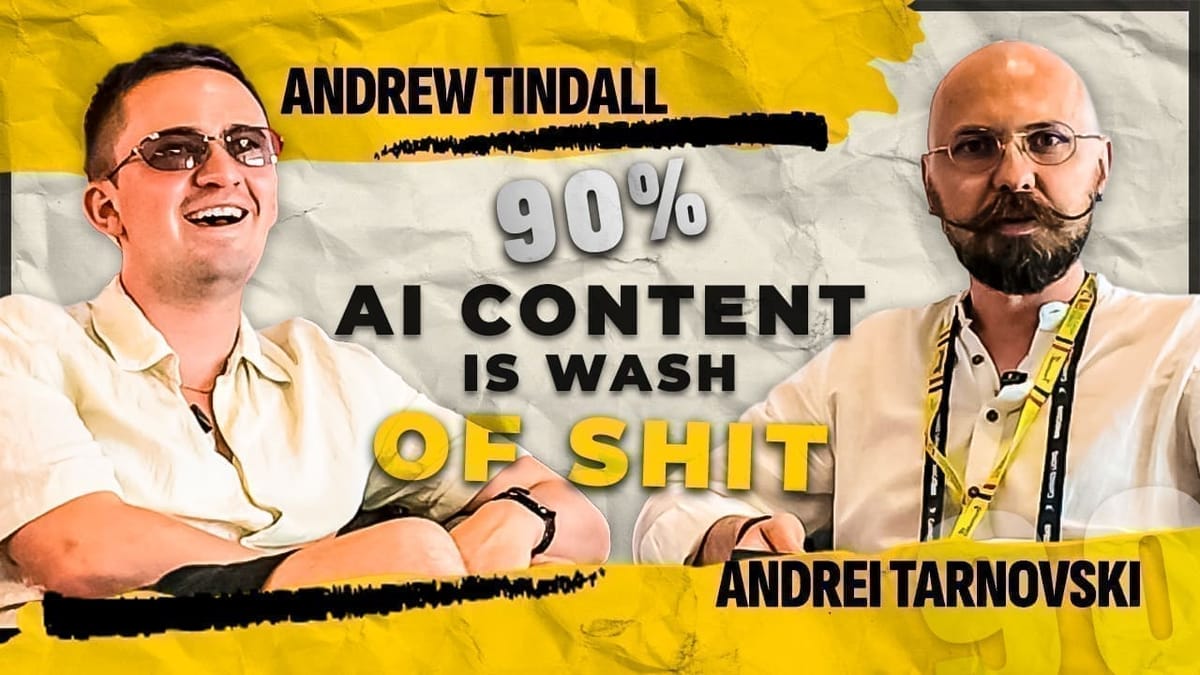


The second episode of Boringly Effective begins with a question that cuts against the usual creative-testing conversation:
“When not to measure creativity?” — Andrew Tindall
Andrew Tindall of System1 joins Andrei Tarnovski at the Romanian Creativity Pavilion to discuss creative testing, AI prediction, emotional response, B2B advertising, attention, brand memories, and the role of craft in a changing production landscape.
The conversation does not treat AI as either a miracle or a reason to stop thinking. Tindall describes it as a technology that can assist prediction, while maintaining that human data remains necessary to understand how advertising performs. He also returns to a broader marketing principle: work needs to make people feel something.
No shortcuts. No synthetic certainty. No pretending that a production tool is a strategy.
TL;DR
In this episode:
- Andrew Tindall says the question he does not get asked enough is when not to measure creativity.
- He says he would focus creative data on the small share of assets with sufficient reach, investment, and consistency to matter.
- He describes an AI model trained on System1's dataset as a way to predict creative effectiveness, while saying it cannot replace real human testing.
- He argues that effective B2B advertising should be interesting and emotionally engaging to a broad set of people, not only a narrowly defined audience.
- He describes emotional engagement as foundational to effectiveness and says positive outcomes tend to perform better, while noting exceptions depend on strategy, category, and brand.
- He expects AI tools to become a commodity and says brands will need to compete beyond the technology itself.
- He frames craft as a signal that can be used in communications strategy, alongside AI or blended production methods.
- In the quick-fire round, he prioritises emotion over attention because, in his view, attention alone does not explain brand memories.
Why this episode matters
This conversation is about the practical limits of marketing tools.
Creative testing can be useful. AI can be useful. Attention can be useful. But the interview repeatedly returns to the conditions around those tools: whether an asset has enough support to matter, whether a model has a meaningful basis for prediction, whether advertising creates an emotional response, and whether people remember the brand.
That is the Boringly Effective proposition in miniature. Marketing is not improved by a tool merely existing. The harder work is deciding where it belongs, what it can actually tell you, and what it cannot.
Key Takeaways
1. Creative data should follow the work that has a chance to matter
Tindall's first answer is not an argument against measurement. It is an argument for selectivity.
He says the industry produces a large volume of assets, particularly as AI makes production easier. His view is that only a smaller share will receive enough reach, investment, and consistency to do anything meaningful. That is the work he would prioritise for creative data.
“I would say only about the top 10% of that is going to get enough reach, enough investment enough consistency to even do anything I would not waste creative data on this 90 wash of shit I would only bother focusing on that on that 10 if I'm completely honest because most of the tools you get on that bottom 90 aren't really there yet there's a lot of people selling ai creative testing stuff that's just like an llm plugin that's made up and will change any time you bang it in.” — Andrew Tindall
The editorial implication is not that the stated proportion is a universal benchmark. It is Tindall's own rule of thumb in this interview: put the more rigorous measurement effort behind the work expected to have enough support to make a difference.
2. AI prediction does not remove the need for human response
Tindall describes System1's data as real emotional responses from people to a large number of advertising assets, and says the company has trained a model to predict that response. He positions this as a useful read, not a full substitute for testing.
His explanation is that surprise and difference from what has come before are important to creative response, and that AI still struggles with that. The point is a boundary condition: a model may assist, but it does not settle the question of how people will respond.
“So far, I think a lot of those AI testing tools have been, as I said, either trained on shite data or simply LLMs, open AI cloud plugins that are guessing from their vast model.” — Andrew Tindall
3. B2B work should still make people feel something
The B2B section starts with a practical problem: finding and recruiting specialist decision-makers for research can be expensive. Tindall says it is possible, but advises marketers not to care too much about the audience and sample at the expense of the advertising fundamentals.
“What I actually find is that good advertising makes a broad set of people, anyone, feel something, and it interests them.” — Andrew Tindall
His argument is that work which is interesting, emotional, and distinctive to a broader audience can also benefit broad media buying and organic distribution through engagement. That is a claim he makes in the interview, rather than a claim that all B2B campaigns can dispense with audience definition.
4. Emotion is more than an attention metric
When asked to choose between emotion and attention, Tindall chooses emotion. He says emotion drives and orientates attention, but also says attention alone does not explain brand memories.
Earlier, he calls emotional engagement “the ground floor of effectiveness” and warns against apathy, neutrality, and dullness. He goes on to say that advertising which leaves people more positive is generally more effective in the evidence he has seen, while allowing that exceptions depend on strategy, category, and brand.
5. Positivity can coexist with jeopardy
Tindall does not describe positive emotion as limited to one kind of cheerful advertising. He lists a range of positive emotions and says experienced creatives can use surprise and negativity—what he calls jeopardy—before giving the audience a positive ending.
“what's important as well is the expert creatives that understand this lean into um jeopardy so surprise and negativity but give a positive ending and that makes the end more ending even more positive” — Andrew Tindall
The interview's distinction is important: the issue is not simply whether an ad contains a negative moment. It is the emotional response it creates, including how the work resolves.
6. In Tindall's view, AI competition will become a brand competition
Tindall says he was initially depressed by AI's pace and breadth of impact, but came to expect it to become a commodity. He predicts a price war among providers and says brand is the way to get out of that dynamic.
“It's clearly going to end up in a commodity.” — Andrew Tindall
This is a forecast from Tindall, not an established fact. The actionable question they raise is not only whether AI can do something, but whether it should be used in a way that is commercially worthwhile.
7. Craft can signal effort—and AI is a production choice
When Andrei asks whether human-made work may remain a luxury signal, Tindall points to clay animation and describes visible craft as a form of costly signalling. He then refuses to treat AI as fundamentally different from other production choices.
“AI is just another fucking camera. It's just one way of making ads.” — Andrew Tindall
His position is that brands may use real production, AI, or a blend, depending on what they are trying to signal. The technology does not make the strategy for them.
Best Quotes From the Episode
“When not to measure creativity?” — Andrew Tindall
“What I actually find is that good advertising makes a broad set of people, anyone, feel something, and it interests them.” — Andrew Tindall
“It's clearly going to end up in a commodity.” — Andrew Tindall
“AI is just another fucking camera. It's just one way of making ads.” — Andrew Tindall
Question & Answer Section
What is this episode of Boringly Effective about?
It is a conversation between Andrew Tindall and Andrei Tarnovski about creative testing, AI prediction, human emotional response, B2B advertising, attention, brand memories, and marketing effectiveness.
What does Andrew Tindall say about when to test creativity?
Tindall says he would focus creative data on the smaller share of work that has enough reach, investment, and consistency to do something. He is speaking from his perspective in the interview, not presenting a universal threshold for every campaign.
Does Andrew Tindall think AI can replace human creative testing?
No. In the interview, he says AI can provide a useful read but that real human System1 data is still needed to understand how ads are performing.
What does the episode say about B2B advertising?
Tindall says good advertising should make a broad set of people feel something and interest them. He advises focusing on advertising and communications fundamentals—being interesting, emotional, and distinctive—rather than over-focusing on a narrow sample.
Does the episode argue that only positive emotion works?
No. Tindall says emotional engagement matters and that positivity generally performs better in the evidence he has seen. He also describes expert creatives using surprise and negativity before a positive ending, and notes exceptions by strategy, category, and brand.
What does Andrew Tindall say about attention and emotion?
In the quick-fire round, Tindall chooses emotion over attention. He says emotion drives and orients attention, while attention on its own does not explain brand memories.
What does Andrew Tindall say about AI and advertising production?
He calls AI one way of making ads and says brands may use real production, AI, or a blend. His examples connect production choices to the signals a brand wants to send, including craft and effort.
What is Boringly Effective?
Boringly Effective is a podcast hosted by Andrei Tarnovski about marketing fundamentals, effectiveness, and the difference between what works and what merely sounds clever.
Who should watch this episode?
This episode is especially useful for:
- Marketing effectiveness practitioners
- Brand and creative leaders
- B2B marketers
- Researchers and insight teams
- Agency professionals
- Marketers evaluating AI tools or creative-testing approaches
- People interested in emotion, attention, and brand memories
About the guest: Andrew Tindall
Andrew Tindall joins the episode from System1. In this conversation, he discusses creative testing, creative effectiveness, emotional response, B2B research, AI, and advertising production.
About the host: Andrei Tarnovski
Andrei Tarnovski is the host of Boringly Effective.
The show focuses on marketing fundamentals, effectiveness, and the difference between what works and what merely sounds clever.
Listen or watch
Watch the full episode on YouTube or listen wherever you get your podcasts.
This episode was recorded at the Romanian Creativity Pavilion and produced by SYMBOLON, with support from the RoCreativity program by FEPIC and ARICE.
Transcript
Related on this site: when to test advertising creative and emotional vs rational advertising.
Show full transcript · 2,693 words
0:00 Andrei Tarnovski I like the enthusiasm. Good. Andrew, thank you very much for coming to the Romanian Creativity Pavilion. Honored to have you here and congrats for your recent upgrade in your career.
0:15 Andrew Tindall Thank you, mate.
0:17 Andrei Tarnovski Now, what's the question you don't get asked enough about when it comes to your own category, your own profession? I mean about testing, about marketing effectiveness.
0:31 Andrew Tindall Sure, good question.
0:34 Andrew Tindall When not to measure creativity? Everyone always wants to talk to you about measuring creativity, the power of creativity and the value of creative data. And now as our industry develops and gets better, we are putting creative data into econometrics, programmatic media buying, all this stuff. But people never ask me when to not test creativity. Because I work at a creative testing business. That's a strange question to ask me, but I've got an answer that I'd like to share for it. So we create a lot of shit as an industry, a lot of assets these days, especially with agentic AI. We need to feed social platforms more and more content. I would say only about the top 10% of that is going to get enough reach, enough investment enough consistency to even do anything I would not waste creative data on this 90 wash of shit I would only bother focusing on that on that 10 if I'm completely honest because most of the tools you get on that bottom 90 aren't really there yet there's a lot of people selling ai creative testing stuff that's just like an llm plugin that's made up and will change any time you bang it in. So I don't think the initial is quite there yet in testing that wash of stuff. But system one might be bringing out a tool that might help them with that, which I've been working on eventually.
2:04 Andrei Tarnovski Can you tell us more about this tool or is it top secret yet?
2:09 Andrew Tindall Well, look, the creative measurement industry has been changed by AI, obviously. I'm predicting creative effectiveness via models versus using human responses.
2:24 Andrew Tindall So far, I think a lot of those AI testing tools have been, as I said, either trained on shite data or simply LLMs, open AI cloud plugins that are guessing from their vast model.
2:41 Andrew Tindall System One have been testing every TV ad with millions of people for 10-20 years now. So we've got this humongous data set of real emotional responses to hundreds of thousands of assets and we've trained a model to basically predict that which will be launching
3:03 Andrei Tarnovski In a few weeks. So it would basically help you in predicting what could work but could never replace
3:09 Andrew Tindall Real testing? Completely. To really understand whether something's going to carry the creative weight part of the response to that is surprise and how it's different to what's come in the past ai struggles at that stuff so to really get to the exact answer now the technology will change well you know ai is the worst it's ever going to be now obviously but right now from what I've seen whilst building this model and these products with our brilliant team um yeah it does a good enough job to give you a little bit of a read once you work like this but um no you still need real human
3:46 Andrew Tindall System one data so behavior emotional data to really understand how ads are performing okay
3:51 Andrei Tarnovski So it's that small difference that is always surprising that is unpredictable the most
3:58 Andrew Tindall Interesting stuff is the difference between the ai and the human response I I have a high hypothesis that that is actually going to be really explain how good an ad is
4:12 Andrei Tarnovski That's a subtle difference but yeah okay but since you're testing other brands ads how would you rate from one to zero if I'm one to five is that
4:24 Andrei Tarnovski Five point nine you're famous for having five point nine of five How would you rate your own LinkedIn content since you have millions of reach?
4:36 Andrew Tindall Yeah, no, good question. I'm sorry, but it's a 5.9 and I've got the data to prove it. It this AI creator testing platform called Favicon which like pulls in all the mass engagement and reach data and follow account and how much you growing but also how much genuine engagement you've got with the audience someone sent me the link to that the other day and I am a hundred out of a hundred I have a perfect score and no one else does so I'm technically top of the pile and which I I like telling people because B2B creators need all the support they can get because I meet famous Instagram B2C influencers and creators who have like 10,000 followers and it's their day job you know they get paid so much by brands You're telling me that I reach, I literally reach a million decision senior business people every week. And when they make a decision, it's to take their whole fucking tech stack, which is worth, you know, a billion quid or, you know. And what I'm meeting someone who's, you know, whole career is based on 10,000 consumer followers. Bullshit to that. People should be really leaning into the power of B2B creators and fucking paying us more.
6:11 Andrei Tarnovski Speaking of B2B, is there anything that you at System One have maybe in development or maybe an existing tool useful specifically for B2B people?
6:26 Andrew Tindall Yeah, we do B2B creative testing as well, where we find decision makers or... What was a fun one I worked on before? We have to find the audience, really, to test the ad with. Or you build these psychographic matching audiences because it's very expensive to pay CFOs to come do some fucking research. There's an art to it, but it's possible.
6:49 Andrew Tindall I worked on one at the moment where we had to recruit someone that buys chemicals exclusively for... Fucking dentists or something. Yeah, so it's just about finding the audience. But I would encourage anyone who does work in that space to not care so much about the audience and the sample. What I actually find is that good advertising makes a broad set of people, anyone, feel something, and it interests them. If you can make your B2B content, B2B ad, B2B campaign, your brand interesting to someone that doesn't buy chemicals at your dentist, then you've got something genuinely category growing and will work on everyone. So I actually won't bother, you know, because often you have to spend, you know, £10,000 to recruit 100 CFOs or something shy and, you know, an alternative solution to that would be, well, don't worry, guys, we've built the synthetic audience of CFOs from an LLM. Yeah, right, you have. You know, I wouldn't worry about that. I'd focus on the fundamentals of advertising and comms strategy, which is making your advertising interesting, emotional, and distinctive to everyone. Because that will do great things. It allows you to, when you do broad media buying, it will be interesting to everyone. But if you put that into engagement algorithms, algorithm reach for organic is based on how much you know who's interacting who's engaging so if you've got content that's broadly interesting all those people are interacting with it it's
8:40 Andrei Tarnovski Gonna push your content as well so yeah but you mentioned that any piece of content needs to get you get your emotions moving. Am I right in saying that it doesn't matter if it's exclusively positive? It can be both or maybe even asymmetrical in favor of not so pleasant emotions? Or does there need to be a balance? It's a good question. I get this a lot.
9:07 Andrew Tindall Fundamentally emotional engagement is the ground floor of effectiveness I.e not feeling nothing apathy neutrality dull you can't feel nothing so sure if it's that I'll piss someone off
9:32 Andrew Tindall Piss someone off however the affect heuristic so we have these heuristics that basically allow us to go about our lives that govern our behavior They learned behaviors that we make in split seconds One of them is an affect heuristic. The affect heuristic is if something comes to mind and it feels good, we do it. Similar to the familiarity heuristic, which is if something's familiar, it feels safe and we do it so sadly that means that advertising that leaves people feeling more positive is more effective I've seen this in tiktok data in fe data in ipa data in fucking uh customer sales data in the amount of car brands that enter the street every week depending on how positive the the ads were like it's anytime I look at it sadly and you know creatives hate this because oh I'm gonna have to make a fucking happy clappy app and add even you know there's a whole broad range of positive emotion there's pride this schadenfreude this humor there's pleasure for others there's sensory pleasure there's all sorts of different positive things and what's important as well is the expert creatives that understand this lean into um jeopardy so surprise and negativity but give a positive ending and that makes the end more ending even more positive so look emotion's important there's a huge cost of dull but sadly because of the way our human brains have been wired for the past millions of years positivity um goes a lot because generally they'll always be fucking exceptions um you know depending on the strategy category and brand um but generally
11:28 Andrei Tarnovski Positivity does much better especially when building on some as you mentioned jeopardy perfect the all you can eat ai buffet has closed uh I mean if ai can now generate tests uh and can also on the other hand generate ads is there any point in focusing uh on I mean is it worth testing every ad since we have so much shit.
12:17 Andrew Tindall Um, I don't think I understand the question but let me let me comment on the all you can eat AI buffet. Um, it is true. I was very fucking depressed about AI for like six months where
12:34 Andrew Tindall It feels like it's a big tech race and it's going to change everything. Which is true. That is still true. It is going to change everything. It's changed marketing and advertising. It's changed research. It's changed coding. It's changed marketing, science, machine learning, engineering. It's changed all industries.
12:57 Andrew Tindall And so it should. It's a step forward in technology and we should lean into that. Why I'm not depressed about it anymore is, you know,
13:06 Andrew Tindall It's clearly going to end up in a commodity.
13:12 Andrew Tindall There's enough players, thankfully, and global governance should be pushing for more competition in this space, to be honest.
13:21 Andrew Tindall There's enough players where everyone's going to have fucking AI and their own LLM. I do not believe this will not end. Well, this has to end in a price war.
13:34 Andrew Tindall It's going to be, okay, which one are you using? Ah, fucking, I'm on Claude this week. Why? Ah, they're doing $9.99 for three months, so I swap back. That's what it has to be. Yeah. I don't fucking believe that these players are going to different. They can't differentiate themselves. So they're trying. And then where that ends up in price war, but also a marketing war. And you're seeing the ripples of that now where Claude is leaning into human, more human and AI that, you know, really conversational and is a friend. Whereas Chad, which is going kind of mass,
14:08 Andrew Tindall They're almost away with it and futuristic. So yeah, it'll end up in a price war and brand is the only way to get out of that. And, but you're seeing the fact that people are realizing this because you know we burnt through all our fucking credits I like I on the phone to my cause now I use I use cloud to build a lot of my research because it amazing when you plug it into excel like jesus the shema I I'm able to do now is insane um and it's made me a better researcher but I'm on the phone to my I.t team every week like look mate I need some more credits can you just load up the account I'm trying to change the world here open it up every you know sunday evening in my pants Come on mate, fucking credits. So we burn through this stuff way quicker than we think. So yeah, we all now need to start thinking about, you know, profitable use of AI. Not can AI do this, but
15:02 Andrei Tarnovski Should AI do this? Speaking about should AI do this, lately more and more luxury brands started doing all human work. TV commercials filmed by hand, so to speak. Animations done like they used to do with them in the 60s and so on. Do you believe this could reach the mass market or will this remain only in the domain of luxury as a way to be distinctive? We have seen this, this isn't
15:33 Andrew Tindall New, Aardman. Do you know who Aardman are? Chicken Run, Wallace and Gromit, do you know these guys? Okay. Aardman is an animation studio that does most of animation with clay figures. Okay. And you can see the thumbprints in the clay yeah when they do it um uh barber do you know barber the luxury luxury brand they've done all their christmas ads by hiring aardman to do it with clay
16:02 Andrew Tindall Because it signals craft you know uh effort costly signaling this took time you can see the fingerprints in the dough you know that's marketing strategy that's common strategy
16:18 Andrew Tindall AI is just another fucking camera. It's just one way of making ads. Some people use it, some people go, oh I think that one of the ways we can signal that we're premium is this way. It's nothing new. So yeah, some people will use real, some people use AI, some people use a blend.
16:37 Andrei Tarnovski And now a quick fire round stars in system one or shares on any social media which oh yeah
16:54 Andrei Tarnovski Engagement rate is bollocks some stars obviously okay emotion or attention emotion because it
17:00 Andrew Tindall Drives attention and attend yes because it orientates attention and because attention doesn't explain alone brand memories and the industry needs to move to brand memories that's what we care about building you know I can have a one-second bit of attention or five second bit of attention the five second bit of attention might not be branded they might not make me feel something at one second bit of attention might be heavily branded and let me feel something I'd want that
17:32 Andrei Tarnovski One second of attention okay okay um a tricky one barion sharp or orlando wood orlando wood
17:38 Andrew Tindall Because because orlando was not an arsehole
17:47 Andrei Tarnovski We can cut this if you want no I don't care and the last one gin or rum
17:55 Andrew Tindall Oh, cool. How did I not flummox on any of them until this one? Rum. I've really enjoyed running some of the world's biggest rum brands in my career. This is why I'm asking.
18:08 Andrew Tindall I've not worked on... I worked on a very small niche gin once and... Oh, God, gin's boring. Rum has character, story, age, flavour. That... Oh! Yeah! That pirate spirit.
18:20 Andrei Tarnovski Spirit okay and one more since we have 30 seconds more TV or tik-tok if you had
18:31 Andrew Tindall To pick one but because this is the way I built this motherfucker look a good marketer is media agnostic yeah I know they set their strategy and then decide what media and creative needs to do it so I'm gonna remain media agnostic not because I work with big TV and TikTok brands, but I'm being a good marketer and you should too.
18:59 Andrei Tarnovski You shouldn't make such silly questions. Well, this is the kind of questions where we need to test if you are really true to your own principles. Thank you so much for this. All good, mate. Thank you.
19:10 Andrei Tarnovski Hope to see you soon. Yes.