
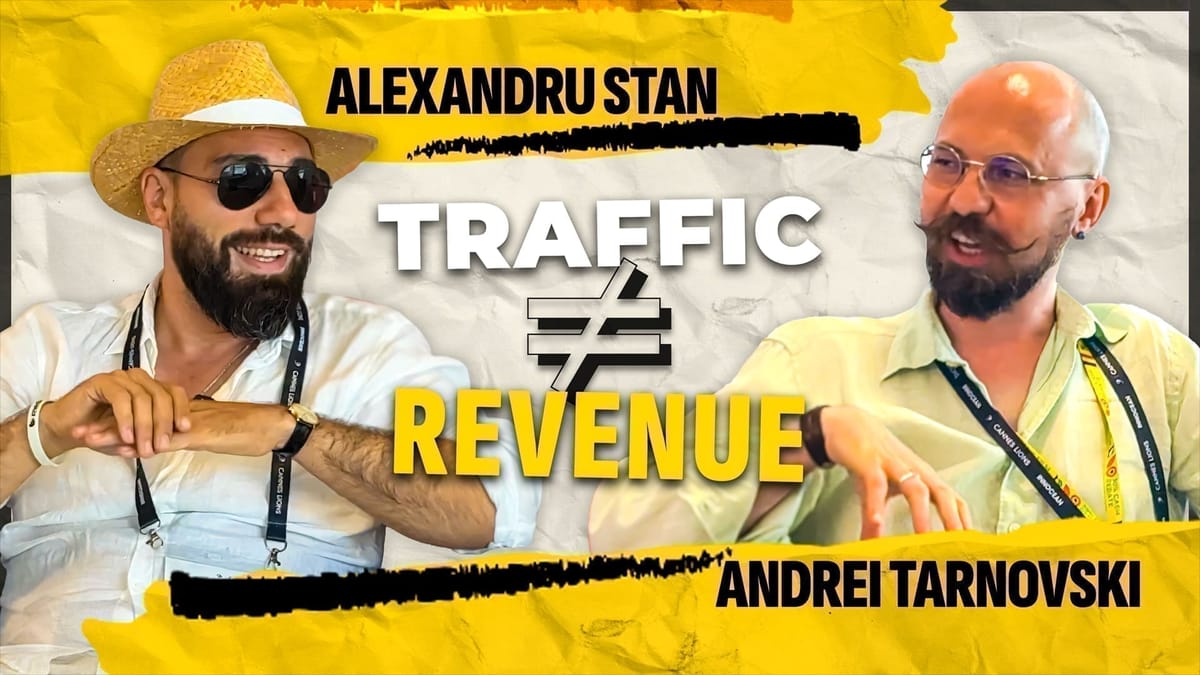


Language note: This episode was recorded in Romanian at the Romanian Creativity Pavilion, Cannes Lions 2026. The article is written in English. Every blockquote below reproduces the guest’s words verbatim in Romanian, exactly as they appear in the recorded transcript; the English line underneath is a translation for readers, not a quotation. Nothing has been added to his meaning.
The conversation in one paragraph
Most founder panels are either victory laps or hustle-culture pep talks. This conversation is neither. Andrei Tarnovski sits down with Alexandru Stan — the Romanian entrepreneur behind Tekpon, a B2B SaaS marketplace, and the man who bought The Next Web from the Financial Times rather than watch a 20-year internet institution be switched off — to talk about how durable businesses actually get built.
Stan describes a path that began with losing his first million to ego. He learned the unglamorous basics: build value for the market before you build wealth for yourself, watch cash flow more than your bank balance, and serve the client rather than chase the trophy. Then he lands a sharper point for marketers. In a media business, clients don’t buy traffic; they buy positioning. In a space flooding with AI-generated news, the only asset machines can’t fake is trust — and the people standing behind the brand.
TL;DR
- Value before money. Businesses built to enrich the founder tend to fail; those built to create market value get paid as a byproduct.
- Cash flow kills companies, not ambition. Stan’s early ventures died from the steady bleed of unwatched expenses, not a lack of delivery.
- Advertisers buy positioning, not reach. TNW roughly quadrupled its traffic in under a year, yet revenue barely moved. Trust is the product; traffic is a vanity metric.
- Credibility has a cost. Telling the truth about powerful companies costs ad budgets. That trade-off is the job of a media brand.
- The internet doesn’t forgive. A single 2014 article followed two people for more than a decade. Reputation outlasts the people it describes.
- The source is the new differentiator. As AI blurs the line between journalism and machine text, trust migrates toward brands where the humans behind them are known.
Key Takeaways
1. Value first. Money is a consequence, not a goal.
Between 2007 and 2014, Stan started several businesses and watched them fail. The lesson wasn’t about tactics or timing; it was about motive. A business built primarily so the founder can make money tends to collapse. A business built to create value for the market — for people and other companies — earns money as a byproduct of that value.
It’s an unglamorous insight, and the most reliable one in entrepreneurship. Every “overnight” success Stan mentions is built on a decade of this discipline.
2. Cash flow is the metric that actually kills companies.
His early businesses didn’t die because they couldn’t deliver. They died from a quiet bleed: a flight here, a few thousand euros there, drained from the company until the runway vanished. The failure wasn’t in the vision; it was in not watching money in against money out.
His current rule is deliberately boring: keep three to six months of runway and spend less than you produce every month, even by a small margin. Steady, uniform growth beats a fat margin in a single good quarter.
3. Clients don’t buy traffic. They buy positioning.
This is the point every marketer should take from the conversation. The Next Web grew from roughly 8–10 million monthly visitors to over 30 million — a fourfold jump in six or seven months — and, Stan notes, the revenue line barely moved.
Advertisers aren’t buying access to a raw number of eyes. They’re buying association with a brand an influential audience trusts. Traffic is the number you brag about; positioning and trust are what get you paid.
4. Trust is the business model — and the bill arrives regularly.
Media brands live or die on credibility, and credibility is expensive. The Next Web’s editorial posture is to report honestly regardless of the consequence: writing critically about large companies and powerful figures, and accepting that doing so burns bridges and loses ad budgets.
Stan frames this as the central tension of owning a media brand: you win the audience’s trust precisely by being willing to lose a client’s money. You can’t fake it, and you can’t shortcut it.
5. The internet doesn’t forgive.
A single negative article on The Next Web, published in 2014, followed two people for over a decade. They could find work only at small firms; larger, reputation-conscious companies kept rejecting them well into early 2026. When they returned with police and court evidence of their reformation, Stan’s team decided to delete the articles and give them a second chance.
His conclusion is blunt: people may forgive, but the internet does not. Reputation is durable in a way that people are not.
6. When content commoditises, the source becomes the asset.
As AI-generated news becomes indistinguishable from professional journalism, Stan bets that trust will migrate toward brands with known human leadership. By 2030, he predicts, before people trust a story or buy a product, they will want to know the founder and the core team running the organisation.
That explains the rise of founder and CEO personal branding. The medium — text, video, audio — is commoditising; the source is what differentiates. In a sea of synthetic content, the human behind the brand is a distinctive asset.
Best Quotes From the Episode
„Nu înțelegeam că business-ul nu trebuie făcut ca să faci tu bani, și business-ul trebuie făcut să aducă valoare către piață, către oameni sau către companii, și așa vei face bani ca urmare a plusului de valoare pe care tu o aduci.“ — Alexandru Stan, verbatim from the transcript
“I didn’t understand that a business isn’t built so you make money; it has to bring value to the market, to people or companies, and that’s how you make money, as a result of the extra value you bring.”
„Ei nu cumpără trafic. Sau acces la trafic, ei cumpără poziționare.“ — Alexandru Stan, verbatim from the transcript
“They don’t buy traffic — or access to traffic. They buy positioning.”
„Media influențează — vrem să credem sau nu, oamenii cred mai mult în media decât în adevăr.“ — Alexandru Stan, verbatim from the transcript
“Media influences — whether we want to believe it or not, people believe the media more than the truth.”
„Internetul nu iartă. Dacă oamenii mai iartă, internetul se pare că momentan nu reușește să se îndrepte, adică să ierte.“ — Alexandru Stan, verbatim from the transcript
“The internet doesn’t forgive. If people still forgive, the internet, it seems, isn’t managing to straighten out, meaning to forgive.”
„Un lider nu este cel care cu biciul, ci cel care îi servește pe ceilalți.“ — Alexandru Stan, verbatim from the transcript
“A leader isn’t the one with the whip; he’s the one who serves the others.”
„Poți să fii chiar și președintele lumii și nu mai știi efectiv ce tehnologie mai apare și cum se mai schimbă lucrurile.“ — Alexandru Stan, verbatim from the transcript
“You can even be the president of the world and you no longer actually know what technology appears next and how things change.”
About the guest
Alexandru Stan is a Romanian entrepreneur, the founder of Tekpon — a US-based B2B SaaS marketplace — and the investor and CEO of The Next Web (TNW), the 20-year-old technology media brand he acquired from the Financial Times rather than see it shuttered. He began building businesses in 2007 and, after years of failing, found his footing around 2014; today TNW reaches on the order of a million readers a day. He recorded this conversation at the Romanian Creativity Pavilion during Cannes Lions 2026.
About the host
Andrei Tarnovski is a marketing strategist and the founder of TARNOVSKI, a branding and marketing consultancy. He hosts Boringly Effective, a show for marketers, founders, strategists and brand leaders who would rather understand what works than chase what’s fashionable.
Listen / watch / subscribe
- Watch the full episode on YouTube.
- Listen on Spotify, Apple Podcasts, and your favourite podcast app.
- Subscribe to the Boringly Effective Newsletter at BoringlyEffective.com for a weekly round-up of the most important marketing news, plus links to the latest episodes.
This Cannes Lions series was produced by SYMBOLON, with support from the RoCreativity program by FEPIC and ARICE.
Questions & Answers
Quick answers drawn from the conversation.
What is this episode about?
Entrepreneur Alexandru Stan joins Andrei Tarnovski to talk about buying The Next Web, the boring fundamentals of building a durable business, and why trust — not traffic — is the real product of a media brand.
Who is the guest?
Alexandru Stan — founder of Tekpon; investor and CEO of The Next Web (TNW).
Why did Alexandru Stan buy The Next Web?
The Financial Times planned to shut The Next Web down; Stan proposed buying it rather than letting a 20-year technology media brand close, and raised the investment to do so.
Who is the host?
Andrei Tarnovski, marketing strategist and founder of TARNOVSKI Marketing Consultancy.
Where can I listen?
YouTube (https://youtu.be/tQxGFBFsbLw), Spotify, Apple Podcasts, and your favourite podcast app. For the weekly round-up of marketing news plus new episodes, subscribe to the Boringly Effective Newsletter.
What language is the episode in?
Romanian. It was recorded at the Romanian Creativity Pavilion, Cannes Lions 2026; the YouTube video carries English subtitles.
Show full transcript · 5,101 words (RO)
Alexandru Stan Am contactat presa mondială. M-am dus către The Next Web, m-am dus către BBC, CNN, Al Jazeera, France 24. Am contactat presa mondială. Am ridicat o rundă de investiție și am vrut să bag foarte mulți bani în marketing. Am contactat pe cei de la Financial Times și le-am propus să mi-l vândă. Au acceptat, dar a apărut o problemă: n-aveam banii. Visul meu era să scalez Tekpon, să fac o platformă globală, să pun România pe hartă cu acest business, să dețin un brand media — pentru că problemele la pachet care vin asociate cu a avea puterea asta pe mână sunt mai mari decât pot imagina oamenii. Zâmbesc pentru că m-am obișnuit deja, cu pumnii în cap, să zică așa.
Andrei Tarnovski Înțeleg că pentru asta ai venit la Cannes, pe podium, și să te mai conectezi cu oameni care vor fi următoarele vedete.
Alexandru Stan Da, o să fac și o glumă, care e și adevărată. Eu am venit și să-i fac o poză lui…
Andrei Tarnovski Lângă noi, lângă noi. Spune-mi mai mult despre ce faci și ce se întâmplă, în genere, în viața ta. Ești antreprenor. Da.
Alexandru Stan Am pornit în 2007 pe drumul ăsta, dar abia prin 2014 mi-am dat seama că se numește antreprenoriat. Și atunci a fost doar o alergare spre succes. Da. Căutam să aduc valoare cumva, să fac o societate comercială, să aduc valoare către oameni sau către companii și să îi conving suficient cât să mă plătească. Și după aia am auzit de un cuvânt — de „scalare” — de la un prieten de-al tatălui meu, și am căutat să scalez aceste companii. S-a întâmplat după foarte mulți ani, și pentru tinerii care probabil o să ne urmărească, vreau să spun: succesul real vine chiar după cel puțin 10 ani de muncă. Așa că, sigur, să tragi tare, să testezi mult, să încerci mult, să cunoști mulți oameni, să riști mult, să muncești mult din nou, și abia după o să reușești să ai o formă de succes.
Andrei Tarnovski Ce ai făcut din 2007, pe scurt, și după aia, în momentul în care a apărut succesul, ce te-a determinat și cu ce anume te ocupi, în ce domeniu ai avut succes?
Alexandru Stan Da, din 2007 am avut mai multe business-uri. Primul business pe care l-am încercat a fost o agenție de web design — să fac website-uri pentru companii, pentru diferite companii. La vremea când domeniul era destul de verde. Dacă în 2007 se cerea undeva la 200 de euro sau de dolari… dar în banii de azi a venit ca o mie, probabil, nu îmi dau seama, dar erau destul de mulți bani. Puteai să faci destul de multe chestii. Știu că mi-am cumpărat și un scuter și un telefon mobil cu banii de la un singur client. La vremea respectivă. Dar am reușit să dau faliment chiar și cu business-ul. Câțiva mulți ani, cred că din 2007 până în 2014 am tot dat greș cu business-urile. Nu înțelegeam că business-ul nu trebuie făcut ca să faci tu bani, și business-ul trebuie făcut să aducă valoare către piață, către oameni sau către companii, și așa vei face bani ca urmare a plusului de valoare pe care tu o aduci. Dar a trebuit să treacă destul până să îmi dau seama. Și acum am reușit să am succes prima dată mai puternic. În 2014 administram o pagină de Facebook, mai multe, dar una principală se numea a lui Toni Pop Tamaș. Și dădeam citate motivaționale pe această pagină de Facebook, care nu ne aparținea — era a artistului Toni Pop Tamaș. Dădeam citate motivaționale, prin citate motivaționale puneam linkuri către site-urile noastre, și așa monetizam. Aveam la nivel de jumătate de milion, un milion, chiar odată două milioane de vizitatori unici pe zi. Generați din social media. La vremea respectivă, pentru cei care nu știu, social media trimitea mult trafic pe website-uri. Acum nu se mai întâmplă chestia asta, dar la vremea respectivă nu existau limitările de astăzi, nici legislația, și reușeam să monetizăm cum vindeam reclamă pe website.
Andrei Tarnovski Și ce s-a întâmplat după asta? În momentul în care ai descoperit cuvântul „scalare”, ce s-a schimbat în viața ta și în mintea ta de antreprenor, și ce ai început să faci mai bine sau altfel?
Alexandru Stan Da, mi-am dat seama că cel mai important asset nu este website-ul pe care îl aveam, cel mai important asset nu este brandul pe care îl avem, nici măcar veniturile pe care le avem, care, da, erau din ce în ce mai mari, pot să zic și sumele. La vremea 2014, rămâneam cu undeva la 80.000 de euro pe lună. Într-o echipă mică, într-o echipă de 7 persoane, cu trei cofondatori. OK, rămâneam cu undeva la 80.000 de euro profitul nostru lunar. Știu că a apărut și o lege în 2015–2016 în care puteam să scoatem dividende la 3 luni. Și pentru noi să scoatem, la 3 luni, 250.000 de euro dividende, în niște tineri de 20 de ani, era impresionant. Și ce am schimbat? Mi-am dat seama că oamenii noștri din echipă sunt cei mai importanți. Și am făcut switch-ul ăsta să mă concentrez pe — cum să zic în engleză, *empower* — cum ajut echipa să devină o variantă mai bună, fiecare dintre colegii noștri, să nu-i zic angajați și să-i numesc colegi pe oameni, să văd cum pot să le insuflu mentalitatea asta de a ajuta pe ceilalți, de a fi cu picioarele pe pământ… și nu știu dacă „smerit” e un cuvânt potrivit, dar să fii un om, să nu te crezi mai mult decât un om, pentru că asta este partea negativă a succesului. Când ai succes, mai ales la 20 de ani, și nu știu… focus: primul milion de euro până la 30 de ani, cu siguranță. Fix ăsta, obiectivul meu. Chestia asta automat te poate umfla în pene, crezi că ești nu știu ce. Și așa am reușit să pierd tot milionul pe care l-am făcut. Primul milion, deci…
Andrei Tarnovski Succesul e, de fapt, o sinusoidă mai degrabă... până când înțelegi ce trebuie să faci pe termen lung. Cum ai ajuns la The Next Web? Că totul, și asta este un nume colosal de important pentru internet, inclusiv din perspectiva istoriei internetului.
Alexandru Stan Da, dacă spun povestea adevărată, e foarte greu de crezut. Așa. Dar o să spun. Că uitam să promovez principalul business pe care noi îl avem — un marketplace de soluții software în Statelor Unite. Tekpon se numește. Și mi-am făcut o listă cu principalele website-uri din lume unde pot să fac reclamă. Pot să zic și *broad*, da. Și la TechCrunch, m-am dus către The Next Web, m-am dus către BBC, CNN, Al Jazeera, France 24. Am contactat presa mondială și am zis: hai să îi contactez, să văd, să iau o listă de prețuri, să îmi fac un buget, să ridic o rundă de investiție și să bag foarte mulți bani în marketing, în paid promovate. Dar atenție — am citit eu undeva că Financial Times decide să închidă brandul The Next Web. În capul meu ceva nu se pupa: cum adică să-l închidă, e prea mare? Există oameni cu tatuaj pe gât „The Next Web”, există conferința de 20 de mii de oameni din Amsterdam. În Olanda e cunoscut 100% de oamenii care lucrează cu tehnologia, și în lume e cunoscut 3 din 10. Inclusiv în Statele Unite — am fost la New York și 3 din 10 oameni cunosc. Și am zis, e imposibil să-l închidă, nu are cum să-l închidă. I-am contactat pe cei de la Financial Times și le-am propus să mi-l vândă. Le-am explicat faptul că e mai bine să-l vândă decât să-l închidă — are o continuitate, 20 de ani de istorie. Au acceptat. Dar a apărut o nouă problemă: n-aveam banii. Și de aici apare partea interesantă. Am făcut un grup de WhatsApp, i-am adăugat pe toți cu care țin legătura și știu că sunt oameni cu caracter și oameni cu valori frumoase, asemănătoare cu cele pe care eu încerc să le am. Nu zic neapărat că le am, dar încerc. Percepția e uneori mai importantă decât realitatea. Și am ridicat o rundă de investiții, din păcate nu pot să spun cât, dar probabil că vă dați seama — un brand global, de 20 de ani pe piață, care astăzi are un milion o sută de mii de cititori pe zi. Wow. OK. Din toată lumea: sunt executivi, sunt fondatori, sunt CEO de companii de tehnologie în general, oamenii care ne recitesc, pentru că așa e conținutul platformei.
Andrei Tarnovski Presupun că focusul tău s-a mutat mai mult spre The Next Web decât pe celelalte business-uri.
Alexandru Stan Da, asta o spun și oftez în același timp, pentru că visul meu era să scalez Tekpon, să fac o platformă globală, să pun România pe hartă cu acest business. Un român care reușește — după povestea UIPath, de mare succes — mai reușește un român să facă ceva interesant. Partea foarte interesantă este că am reușit într-o mică măsură să pun. Am reușit în 2025 să aducem de două ori câte 1.000 de fondatori și executivi de la companii mari — Canva, Microsoft, Google — să vină la noi la București, la un eveniment organizat de noi. Dar n-am reușit să punem atât de mult România pe hartă cum ne doream. Prin achiziția asta, clar, s-au schimbat multe chestii, inclusiv faptul că ne-a umbrit, ne-a canibalizat, să zic așa, brandul Tekpon, chiar dacă e foarte cunoscut în nișa de SaaS, de B2B SaaS. La nivel global nu este așa de cunoscut. Și când o cafenea mică reușește să cumpere un brand cum este Starbucks, ca să fac o paralelă, brandul mic suferă foarte tare. Și da, duce lipsă de dragoste, de timp, de focus, de orice, celălalt brand, din păcate. Și chiar lucrăm la o oarecare pivotare pentru a ne apropia de media și cu acel brand Tekpon, pentru că brandul TNW este foarte mare în comparație cu el. Așteptările mele erau unele, în momentul achiziției, și realitatea de a administra un brand atât de influent, ca să spun așa, cum este The Next Web, este alta. La modul că oamenii care mă sunau înainte erau de obicei CEO, oameni decenți și OK, din industria de B2B SaaS; acum s-a schimbat, mă sună fondatori de companii listate la bursă. Direct pe telefonul mobil. Și indiferent dacă am sau nu am timp să le răspund, trebuie să le răspund, că te sună cineva care abia și-a lăsat compania la bursă. Sau cineva nu reușește să-și mai deschidă o companie sau să-și găsească un job din cauza unei știri din 2014 pe The Next Web, negativă despre ei. Că dau un caz concret: există o fostă știre pe The Next Web, despre niște tineri făcuseră ceva, nu mai țin minte ce, cu negativ, desigur, cu niște carduri. Ori păcăliseră pe cineva, ori nu, nu știu exact. Nu-mi mai amintesc despre ce era articolul, dar ei nu reușeau nici în 2026 — până ianuarie, februarie, s-a întâmplat chestia asta — să-și găsească job. Pentru că aveau știrea asta. La orice interviu se duceau, îi scoteau pe ușă afară: „Nu se poate, ne pare rău.” Deci oamenii se îndreptaseră. Oamenii învățaseră o meserie bine, dar nu reușeau să se angajeze la companii mai de renume. Dar reușeau mereu la companii mici, pe care nu le interesa, li se explica mai ușor. Când e corporație, la o companie mai mare, nu mai funcționează lucrurile așa — reputația e importantă a persoanei. Nu vreau o companie cum e Visa să se asocieze cu cineva care acum 15 ani de zile fura bani cu cardul pe internet. Au venit cu dovadă de la poliție și de la tribunal că s-au îndreptat, și că… până la urmă am discutat cu finanțistul și fondatorii și am luat decizia de comun acord să ștergem aceste articole, ca să dăm o șansă din nou la viață acestor oameni. Internetul nu iartă. Dacă oamenii mai iartă, internetul se pare că momentan nu reușește să se îndrepte, adică să ierte.
Andrei Tarnovski Spre ce te îndrepți în viitorul apropiat? Mergi mai mult spre mai mult business media, sau te îndrepți înapoi, spre mai mult B2B?
Alexandru Stan Fac o glumă, care e de fapt adevărată, și după aia răspund la întrebare. Spre moarte, că oricum moare omul, dar — unde mă îndrept. S-a schimbat narațiunea la nivel global. Nu se mai vorbește atât de mult de SaaS, de B2B SaaS. Se vorbește mai mult de AI, de agentic AI, agenți, și mă îndrepți spre media, pentru că deții un brand foarte mare media, căutăm companii care caută mai multă atracție, media influențează — vrem să credem sau nu, oamenii cred mai mult în media decât în adevăr. Dacă citești o știre despre un anumit subiect, o iei ca fiind adevărată. Poate să nu fie adevărată, că noi ne batem foarte mult timp să verificăm informațiile înainte să le punem, pentru că e reputația noastră în joc. Și modelul de business la media este să fii de încredere, și să te convingi pe tine în fiecare zi să zici adevărul, orice s-a întâmplat, orice consecințe ai avea, orice probleme întâmpini, orice. Dar nu e atât de ușor. Tocmai de asta, nu e… încerc să nu spun cu aroganță, dar nu e pentru oricine să deții un brand media, pentru că problemele la pachet care vin asociate cu a avea puterea asta pe mână sunt mai mari decât își imaginează oamenii. Deci zâmbesc pentru că m-am obișnuit deja, cu pumnii în cap, să zic așa.
Andrei Tarnovski Despre media, și cum influențează ea — eu am înțeles ce se întâmplă în legătură cu asta, în privința business-ului de media, că devine cumva foarte poluat spațiul informațional, în special pe internet, dar și în TV văd că se tot poluează lucrurile. Ce crezi că vă așteaptă pe voi ca industrie?
Alexandru Stan Cred că ne așteaptă o perioadă în care oamenii vor avea din ce în ce mai mult greu să deosebească dintre o știre scrisă cu AI sau o știre scrisă de un jurnalist cu experiență. Din ce în ce mai mare, din păcate, diferența dintre o știre adevărată și o știre inventată. Și cred că oamenii ar trebui să se îndrepte către branduri cunoscute în care știu și cine sunt oamenii din spate. Adică la foarte multe branduri noi știm doar brandul. Da? Coca-Cola, dar nu știi cine sunt oamenii din spate; noi știm brandul, și credem în brandul dacă automat are 100 de ani, a trecut proba timpului, a trecut peste două războaie mondiale, peste crize și așa mai departe. Dar cred că oamenii, pentru a avea încredere într-un brand în 2030 — dacă îmi permiteți o mică predicție — ar trebui să știe și cine e fondatorul și echipa. Cine sunt principalii, nu știu, cinci oameni, măcar dintr-o organizație, înainte să cumpere sau să consume produse de la acea companie — chiar dacă vorbim de o știre, chiar dacă vorbim de un obiect fizic.
Andrei Tarnovski Adică, practic, pe măsură ce avansăm, pe măsură ce AI e tot mai mult prezent zi de zi, devine mai important rolul persoanei, de fapt.
Alexandru Stan Da. Iar companiile — am văzut că fac din ce în ce mai mult, inclusiv noi facem asta — în personal branding al fondatorului lor, sau al fondatorilor, sau al CEO-ului, de ce? Să se vadă efectiv cine sunt oamenii din spate, dacă pot avea încredere într-o știre scrisă de noi sau nu. Noi ce vindem? Noi nu vindem direct, știi. Noi vindem publicitate către companii, iar știrile nu sunt plătite, sunt gratuite. Adică noi depunem un efort să scriem acele știri pentru oameni, să ajutăm oamenii să fie informați în domeniul tehnologic, și nu numai. E, tehnologic, dar să aibă legătură cu tehnologia. Și oamenii mă văd la podcasturi, mă văd în diferite contexte, mă văd la evenimente. Și ei pot să pună în balanță dacă pot avea încredere în noi sau nu. Motivul pentru care tot creștem e și acesta. Am crescut de la cât avea website-ul la — am ajuns la 8-10 milioane de vizitatori pe lună, la 30 și ceva. Avem un milion o sută de mii pe zi în medie.
Andrei Tarnovski Impresionant. În 6-7 luni v-ați făcut de 4 ori.
Alexandru Stan Da, da, da, da, poate de 4. Trăim o revoluție a industriei tehnologice prin inteligența artificială, sau datorată acestei inteligențe artificiale, tehnologii. Dar noi avem și un marketplace de soluții B2B SaaS, deci noi știm software-ul cel mai bun din lume, și automat că nu le dăm doar la clienți — software-urile le folosim și pentru noi, că așa știam ce să recomandăm și știm ce se recomandă cel mai bine. Și cu ajutorul unor software-uri foarte avansate, plus un pic de AI, dar, atenție, nu la 'luăm, băgăm, scriem cu ChatGPT o știre și-o punem pe internet, nu funcționează lucrurile așa. Dar am reușit să creștem foarte mult traficul website-ului.
Andrei Tarnovski Da. Ce crezi că se va întâmpla, având în vedere, din perspectiva monetizării unei astfel de platforme, având în vedere că tot mai mult din trafic e... vine din partea boților, indiferent dacă sunt automatizați sau la cererea consumatorilor, în diferite platforme?
Alexandru Stan Am observat o chestie și am analizat-o cu colegii mei, și cred că după toată analiza noastră nu ne înșelăm. Noi credem că nu face diferență atât de mare, din păcate, la venituri, dacă avem 10 milioane de utilizatori sau 35 milioane de utilizatori. De ce? Pentru că oamenii care vin la noi ca și client, ei nu cumpără trafic. Sau acces la trafic, ei cumpără poziționare. Pentru că despre The Next Web tot se știe că a fost și este un brand care spune adevărul. Indiferent de consecințele de rigoare. Repet, dacă scrie domnul Donald Trump ceva, dacă spune ceva de rău, noi îl criticăm, îl lovim, dăm în el. Dacă un brand mare, indiferent cât de mare este și cât de influență financiară ar avea, face ceva greșit, noi spunem. Câștigăm, pe cealaltă parte, încrederea oamenilor. Pierdem potențialul de a lucra cu acea firmă, să luăm niște bugete. Deci este un echilibru și e un bilant foarte greu de administrat. Dar să răspund la întrebare, cred că se îndreaptă într-o direcție în care nimeni pe fața pământului, inclusiv Sam Altman și CEO-ul de la Anthropic, nu poate prezice efectiv în ce direcție mergem. În momentul ăsta, inteligența artificială ne-a dat cu capul de pământ, și ne dăm seama că nu mai poate prezice efectiv nimeni. Oricâte resurse ai avea și oricâte informații ai avea. Deci poți să fii chiar și președintele lumii și nu mai știi efectiv ce tehnologie mai apare și cum se mai schimbă lucrurile.
Andrei Tarnovski Da. În lumea asta nouă, într-atât de imprevizibilă, care crezi că ar fi acele 1, 2, 3 skill-uri absolut necesare pentru un antreprenor ca să aibă succes?
Alexandru Stan Da. Prima, prin partea umană: să aibă empatie, să-i simtă pe ceilalți. Că dacă angajezi oamenii și îi angajezi doar pe baza CV-ului, poate după 6 luni, poate după un an, ajunge la concluzia: „mie nu-mi place să lucrez cu omul ăsta în birou”. Poate nici lor nu le place de mine. În schimb, dacă ai un pic de empatie, ei simt că, omule, îți dai seama că îți place, ți-ar plăcea să stai cu ei într-un birou sau să lucrezi cu ei — nu știu, acum se lucrează mult acasă — și asta e principala și prima. A doua chestie este să fie foarte atenți la cash flow. Nu la câți bani sunt în bancă, și la câți bani le intră și câți bani cheltuiesc. De ce? Atâtea business-uri pe care le-am construit, am ajuns la concluzia că majoritatea au dat faliment. Nu datorită faptului că noi, cu echipa mea, eram incapabili să aducem valoare. Ci datorită faptului că, atunci când vedeam o cursă scumpă, făceam eforturi și ce puteam din firmă legal, cât se putea scoate, mai făceam rost de niște bani și noi cumpăram. Evident că era 500 de euro, 2.000 de euro încontinuu. Și treaba asta m-a adus de multe ori în pragul de a închide compania ori a mă reloca într-un birou mai mic, așa, să pornim din nou într-o altă direcție. Pentru că nu administram corect banii. Astăzi, atât pe plan personal, cu familia, cât și pe plan de business, fac tot ce îmi stă în putință pentru a avea 3-6 luni de bani pentru orice se întâmplă, plus a cheltui în fiecare lună mai puțin decât producem, orice ar fi. Chiar dacă e mai puțin. Nu fac asta ca și criteriu de bază.
Andrei Tarnovski Din perspectivă de business, e totuși un pic mai important să ai acest flux foarte *steady*, foarte uniform, într-o continuă creștere, decât să ai o marjă foarte mare acum.
Alexandru Stan Sută la sută. Și a treia: să se focuseze pe client, nu să se focuseze să facă ei ca și companie bani. Când te focusezi pe client, automat, ca rezultat al faptului că tu aduci plus valoare, vei fi plătit. Și vei fi plătit foarte bine. Clientul te simte, te vede, te analizează și te remunerează în funcție de câtă valoare a primit el — că vorbim de bunuri fizice, că vorbim de servicii, că vorbim de… Sunt foarte multe firme de publicitate. Dacă reușești să te concentrezi pe nevoile clientului, pe nevoile lui — nu pe ce crezi tu că sunt nevoile lui — pe nevoile lui reale, și chiar îl asculți și chiar îi aduci valoare în funcție de ce vrea el în momentul acela, și chiar te adaptezi pe timpul colaborării cu clientul, cred că poți avea foarte mare succes. Atunci când am cumpărat The Next Web, mi-am imaginat că eu pot transforma conferința din Amsterdam de la un festival cu 20.000 de persoane îmbrăcate cum suntem noi acum, mai lejer, într-un eveniment de 1.000 de persoane îmbrăcate la costum. N-am știut că oamenii din Olanda nu apreciază neapărat oamenii îmbrăcați la costum — așa e în cultura olandeză. Și am făcut un anunț public fără să verific. Am spus că, din momentul ăsta, conferința s-a schimbat, evenimentul s-a schimbat: „Vă rog frumos să veniți la costum.” Vreau să spun că ce e important — oamenii din Olanda m-or fi contactat să îmi spună că am probleme mentale, or scris un comentariu pe LinkedIn, or transmis un mesaj că fac o mare greșeală, că nu înțeleg nimic, nici din ce înseamnă The Next Web, nici din ce înseamnă cultura olandeză — și prințul din Olanda a fost client de The Next Web la multe ediții. Am făcut greșeala asta, am și reparat între timp. Plus că olandezii acum sunt mulțumiți, totuși, că a fost preluat brandul și că e de 3-4 ori mai mare decât a fost înainte și deja e de notorietate în Olanda. Chestia asta în România nu s-a auzit momentan, dar se bucură că a luat cineva și a făcut ceva mai mare decât a fost vreodată.
Andrei Tarnovski Da. Oricum, chiar dacă ai impresia că în România nu prea a auzit lumea de The Next Web, e cumva unul dintre brand-urile iconice din istoria internetului. Adică ar fi o nedreptate față de brand să ai impresia că poate fi trecut cu vederea, indiferent de nivelul de notorietate.
Alexandru Stan Așa este. Din România, oamenii nu știu că Uber este în Europa datorită The Next Web, și au 10.000 de angajați în Amsterdam datorită TNW, sau câți sunt, nu știu. Datorită The Next Web, TechCrunch are o conferință TechCrunch Disrupt și în America, datorită fondatorilor de la The Next Web. Pentru că fondatorii, în 2006, l-au invitat pe Arrington, fondatorul TechCrunch, în Amsterdam la conferință. Și când a fost la conferință, a zis: „O, OK, îmi fac și eu o conferință.” Iar al doilea lucru — în anii următori, este prin 2007 sau 2008, fondatorii, Boris și Patrick, fondatorii cei care au făcut din The Next Web, am aflat fix de la Patrick faptul că ei au fost invitați la următoarea conferință TechCrunch în America, și s-au inspirat și și-au făcut și ei. Deci situl de știri pe care îl deținem noi astăzi, sau altă chestie — Gary Vaynerchuk, și nu știu care, ținut bine, printre primele apariții Gary Vaynerchuk, și au fost la The Next Web, și au mișcat foarte multe chestii. „Mințile luminate se vedeau la The Next Web” — asta era nu motto-ul, asta era realitatea. Un prieten bun, Cristobal Alonso, a fost CEO la Startup Genome, un fond de investiții de renume din Europa. Imediat după achiziție m-a sunat și mi-a spus: „Wow, toată viața eu mergeam la conferințe, mă întrebam ce urmează, *next*. Să știi că eu nu o să pun presiune foarte mare pe tine, dar o să spun altor oameni să pună presiune pe tine, să țineți standardul, să faceți cumva la conferințele voastre, chiar dacă le faceți mai mici, să se vorbească despre chestia asta: ce urmează.” Și acum am o problemă foarte mare, că nu știe nimeni ce urmează. Cu toții cred că știu, mulți cred că știu, dar în realitate, la fiecare lună, din păcate, și la o săptămână vedem tehnologii noi care dau afară companii despre care n-am auzit. Și vă dau un exemplu: în urmă cu 3 ani de zile nu vorbea nimeni de Anthropic. Acum este cea mai puternică companie din lume. Trebuie să fim realiști, și cu picioarele pe pământ, să nu dăm seama că nu știm ce urmează. Iar noi, la The Next Web, măcar vă spunem adevărul: că nici noi nu știm ce urmează, dar aflăm. Informație avem, conexiuni cu fondatori avem, mergem la conferințe. Cu mine este aceasta — cea mai exclusivistă — suntem în Cannes — de unde facem și acest podcast — și căutăm acei fondatori care vor schimba lumea, încercăm să îi identificăm, să îi prezentăm înainte ca ei să devină cineva, până ajung ei și la Google. Practic, poți pescui și soluții, dar și business-uri de investit. Și investitorii vin la noi. Media e un business de conexiuni — nu poți să fii în media dacă nu ai conexiuni și un sistem de management al conexiunilor. Și am realizat faptul că noi eram deja pregătiți: avem conexiuni, avem un business care ne permitea să deținem un brand ca The Next Web, dar nu suficiente. Drept pentru care, în ultimele șase luni, cred că am dormit 5 zile pe lună acasă — exagerând un pic, o știu, dar am dormit foarte puțin acasă, am dormit mai mult la conferințe, pentru a fi suficient de conectat cu ce se întâmplă. Și repet: chiar dacă ai resurse foarte mari și te duci și vorbești la toate conferințele și cu toți cei mai importanți oameni de la fiecare conferință de tehnologie din lume — de la New York, la Paris, de la Cannes, la București — nu cred că poți afla tot ce se întâmplă acum cu inteligența artificială.
Andrei Tarnovski Înțeleg că pentru asta ai venit la Cannes: să stai cu mâna pe puls și să te mai conectezi cu oameni care vor fi următoarele vedete din TNW.
Alexandru Stan Da, o să fac și o glumă, care e și adevărată. Eu am venit și să-i fac o poză lui Oprah. Avem o colecție pe care am pornit-o la The Next Web și la Tekpon, facem poze cu oameni gen Daniel Dines, nu știu, am fost în Statele Unite la Nvidia și am făcut o poză și un reportaj cu CEO-ul de la Nvidia, cu Jensen Huang, cu Prințul William al UK-ului. Și astăzi am reușit să fac poza la conferință cu Oprah, și urmează alte personalități. Dar da, și să aflu în ce direcție merge lumea care este influențată de tehnologia asta. Totuși, suntem The Next Web. The Next Web, cu bune și cu rele.
Andrei Tarnovski Când mai vii prin România, mai faci ceva, vreo conferință, vreun eveniment în România sau legat de România?
Alexandru Stan Voi anunța. Da, din păcate nu acum. Și nu aici, era bine. Dar în inima mea încă trăiește acel sentiment că sunt obligat, prin influența pe care o am, să vreau — nu, vreau să pun România pe hartă și să ajut țara noastră să fie relevantă cât merită. Pentru că România are talente, are oameni extraordinari — cunoști și tu, cunosc și eu — și vedem la conferințe, și avem prieteni oameni extraordinari, dar poate superiori față de ce cunoști în alte țări, dar nu sunt cunoscuți și nu sunt ajutați atât de tare. Nu vreau să dau vina nici pe politică, nici pe nimeni. E o vină comună: de ce nu suntem noi atât de vizibili, și de ce nu reușim să aducem oameni foarte importanți la noi în țară? Dar cred, odată cu achiziția asta istorică, că Financial Times n-a vândut nimic către un român, mai ales un brand atât de mare cum e The Next Web. Sper să putem să schimbăm chestia asta, și avem, cred că avem, influența necesară încât să putem să ajutăm tinerii antreprenori, mediul de afaceri. Și cred că orice om impactat din țara noastră — mai mult sau mai puțin, în funcție de ce face — pozitiv, de apariția unui brand ca The Next Web în mâna unui român.
Andrei Tarnovski În așa fel încât sper că, în primul rând, o să faci anunțul cât mai curând, și, în al doilea rând, sper să-l faci cu noi.
Alexandru Stan Bună, e bună ideea. În momentul de față planuim și lucrăm la un proiect care ajută foarte tare România, cu ajutorul infrastructurii pe care o administrăm acum.
Andrei Tarnovski Pentru asta, îți mulțumesc și din partea noastră, a celor care suntem aici la Romanian Creativity Pavilion, la Cannes Lions, și în numele tuturor românilor care se bucură că, în sfârșit, cineva — adică tu — a ajuns să aibă puterea de a ajuta, de a influența prin media lucrurile frumos.
Alexandru Stan Oamenii, în primul rând din România, mi-au dat puterea asta. Adică nu am căutat-o, nici n-am vrut-o, pur și simplu a apărut natural, după foarte mulți ani de muncă și de a mă pune în slujba celorlalți. Când mi-am dat seama — ca un ultim sfat pentru cei care ne urmăresc — Îmi dau seama că un lider nu este cel care cu biciul, ci cel care îi servește pe ceilalți. Și nu e un slogan pe care mi-l repet să pot să-l spun la podcasturi. Eu cred din adâncul inimii mele că un lider e cel care îi ridică pe cei din jur, și care le acoperă greșelile și preia asupra lui cât mai multe probleme și le rezolvă, iar când se duce la ședință caută să rezolve principalele probleme, nu caută să se simtă el relaxat și bine. Și trebuie sacrificiu mult. Mulțumesc foarte mult! Vă mulțumesc!
Related on this site: vanity metrics and positioning, and Vlad Țone (ARICE) on nation branding, recorded at the same pavilion.
Show full transcript · 5,357 words (EN)
Alexandru Stan I reached out to the world's press. I went to The Next Web, I went to the BBC, CNN, Al Jazeera, France 24. I reached out to the world's press. I raised an investment round and wanted to pour a lot of money into marketing. I contacted the people at the Financial Times and proposed that they sell it to me. They accepted, but a problem came up: I didn't have the money. My dream was to scale Tekpon, to build a global platform, to put Romania on the map with this business, to own a media brand — because the bundle of problems that come with having this kind of power in your hands is bigger than people can imagine. I'm smiling because I've gotten used to it already, through hard knocks, so to speak.
Andrei Tarnovski I understand that's also why you came to Cannes, on the stage, and to connect with people who will be the next stars.
Alexandru Stan Yes, I'll also make a joke, which is also true. I also came to take a picture of…
Andrei Tarnovski Next to us, next to us. Tell me more about what you do and what's going on, in general, in your life. You're an entrepreneur. Yes.
Alexandru Stan I set out on this path in 2007, but only around 2014 did I realize it's called entrepreneurship. And back then it was just a running toward success. Yes. I was looking to bring value somehow, to set up a company, to bring value to people or to companies and to convince them enough that they'd pay me. And then I heard a word — "scaling" — from a friend of my father's, and I set out to scale these companies. It happened after many years, and for the young people who'll probably watch us, I want to say: real success comes only after at least 10 years of work. So, sure, push hard, test a lot, try a lot, meet a lot of people, risk a lot, work a lot again, and only then will you manage to have some form of success.
Andrei Tarnovski What did you do from 2007, in short, and then, once success appeared, what drove you and what exactly do you do, in what field did you have success?
Alexandru Stan Yes, from 2007 I had several businesses. The first business I tried was a web design agency — to make websites for companies, for different companies. At a time when the field was still pretty green. If in 2007 you could charge somewhere around 200 euros or dollars… but in today's money that comes out to about a thousand, probably, I'm not sure, but it was quite a lot of money. You could do quite a lot of things. I know I even bought myself a scooter and a mobile phone with the money from a single client. At the time. But I managed to go bankrupt even with the business. For many years, I think from 2007 to 2014 I kept failing with the businesses. I didn't understand that the business isn't supposed to be built so that you make money, and the business has to be built to bring value to the market, to people or to companies, and that's how you make money as a result of the extra value that you bring. But it took a while until I realized it. And then I managed to have success for the first time, more strongly. In 2014 I was running a Facebook page, several, but one main one was called Toni Pop Tamaș's. And I'd post motivational quotes on this Facebook page, which didn't belong to us — it belonged to the artist Toni Pop Tamaș. I'd post motivational quotes, through the motivational quotes we'd put links to our websites, and that's how I monetized. We had at the level of half a million, one million, even once two million unique visitors a day. Generated from social media. At the time, for those who don't know, social media sent a lot of traffic to websites. That doesn't happen anymore now, but at the time there weren't today's limitations, nor the legislation, and we managed to monetize by selling ads on the website.
Andrei Tarnovski And what happened after that? The moment you discovered the word "scaling", what changed in your life and in your entrepreneurial mind, and what did you start doing better or differently?
Alexandru Stan Yes, I realized that the most important asset isn't the website we had, the most important asset isn't the brand we have, not even the revenues we have, which, yes, were getting bigger and bigger, I can say the amounts too. Around 2014, we were left with somewhere around 80,000 euros a month. In a small team, in a team of 7 people, with three co-founders. OK, we were left with somewhere around 80,000 euros, our monthly profit. I know a law also appeared in 2015–2016 that let us take out dividends every 3 months. And for us to take out, every 3 months, 250,000 euros in dividends, as kids in our twenties, was impressive. And what did I change? I realized that our people in the team are the most important. And I made this switch to focus on — how do I say it in English, *empower* — how I help the team become a better version, each of our colleagues, not to call them employees and to call the people colleagues, to see how I can instill in them this mindset of helping others, of being grounded… and I don't know if "humble" is the right word, but to be a person, to not think of yourself as more than a person, because that's the negative part of success. When you have success, especially at 20 years old, and I don't know… focus: first million euros before 30, for sure. Exactly that, my goal. This thing can automatically go to your head, you think you're I don't know what. And that's how I managed to lose the whole million I made. The first million, so…
Andrei Tarnovski Success is, in fact, more of a sine wave... until you understand what you need to do in the long term. How did you get to The Next Web? Since this is — and this is a colossally important name for the internet, including from the perspective of the internet's history.
Alexandru Stan Yes, if I tell the true story, it's very hard to believe. Right. But I'll tell it. That I had forgotten to promote the main business we have — a marketplace of software solutions in the United States. It's called Tekpon. And I made myself a list of the main websites in the world where I can advertise. I can say *broad*, too. And at TechCrunch, I went to The Next Web, I went to the BBC, CNN, Al Jazeera, France 24. I reached out to the world's press and said: let me contact them, to see, to get a price list, to put together a budget, to raise an investment round and pour a lot of money into marketing, into paid promotion. But attention — I read somewhere that the Financial Times decides to shut down the The Next Web brand. In my head something didn't add up: what do you mean shut it down, it's too big? There are people with a tattoo on their neck "The Next Web", there's the conference of 20 thousand people in Amsterdam. In the Netherlands it's known by 100% of the people who work with technology, and in the world it's known by 3 out of 10. Including in the United States — I was in New York and 3 out of 10 people know it. And I said, it's impossible for them to shut it down, there's no way they shut it down. I contacted the people at the Financial Times and proposed that they sell it to me. I explained the fact that it's better for them to sell it than to shut it down — it has continuity, 20 years of history. They accepted. But a new problem came up: I didn't have the money. And that's where the interesting part comes in. I made a WhatsApp group, I added everyone I keep in touch with and who I know are people of character and people with beautiful values, similar to the ones I try to have. I'm not necessarily saying I have them, but I try. Perception is sometimes more important than reality. And I raised an investment round, unfortunately I can't say how much, but you can probably guess — a global brand, 20 years on the market, which today has one million one hundred thousand readers a day. Wow. OK. From all over the world: there are executives, there are founders, there are CEOs of technology companies in general, the people who reread us, because that's what the platform's content is.
Andrei Tarnovski I assume your focus shifted more toward The Next Web than the other businesses.
Alexandru Stan Yes, I say that and I sigh at the same time, because my dream was to scale Tekpon, to build a global platform, to put Romania on the map with this business. A Romanian who succeeds — after the UIPath story, a big success — another Romanian manages to do something interesting. The very interesting part is that we managed, to a small extent, to put it. We managed in 2025 to bring, twice, 1,000 founders and executives each from big companies — Canva, Microsoft, Google — to come to us in Bucharest, to an event organized by us. But we didn't manage to put Romania on the map as much as we wanted. Through this acquisition, clearly, a lot of things changed, including the fact that it overshadowed us, it cannibalized us, so to speak, the Tekpon brand, even though it's very well known in the SaaS niche, in B2B SaaS. Globally it's not that well known. And when a small café manages to buy a brand like Starbucks, to draw a parallel, the small brand suffers a lot. And yes, it's left wanting for love, for time, for focus, for anything, the other brand, unfortunately. And we're actually working on a certain pivot to get closer to media with that Tekpon brand too, because the TNW brand is very big compared to it. My expectations were one thing, at the moment of the acquisition, and the reality of running a brand that influential, so to speak, like The Next Web, is another. In the sense that the people who used to call me before were usually CEOs, decent people and OK, from the B2B SaaS industry; now that's changed, founders of listed companies call me. Directly on my mobile phone. And regardless of whether I have time to answer them or not, I have to answer them, because someone who just took their company public is calling you. Or someone can't manage to open a company anymore or to find a job because of a news story from 2014 on The Next Web, negative about them. To give a concrete case: there's a former news story on The Next Web, about some young people who had done something, I don't remember what, negative, of course, about some cards. Either they had scammed someone, or not, I don't know exactly. I don't remember anymore what the article was about, but they couldn't even in 2026 — until January, February, this happened — to find a job. Because they had this news story. At any interview they went to, they'd be shown the door: "It's not possible, we're sorry." So the people had straightened out. The people had learned a trade well, but they couldn't get hired at more renowned companies. But they always could at small companies, who didn't care, where it was easier to explain. When it's a corporation, at a bigger company, things don't work like that anymore — the person's reputation matters. I don't want a company like Visa to associate with someone who 15 years ago was stealing money with cards on the internet. They came with proof from the police and from the court that they'd straightened out, and that… in the end I discussed with the financier and the founders and we made the decision by common agreement to delete these articles, to give a chance at life again to these people. The internet doesn't forgive. If people still forgive, the internet, it seems, can't currently manage to straighten out, meaning to forgive.
Andrei Tarnovski Where are you heading in the near future? Are you moving more toward more media business, or are you heading back, toward more B2B?
Alexandru Stan I'll make a joke, which is actually true, and then I'll answer the question. Toward death, since man dies anyway, but — where I'm heading. The narrative has changed globally. People don't talk as much anymore about SaaS, about B2B SaaS. They talk more about AI, about agentic AI, agents, and I'm heading toward media, because you own a very big media brand, we look for companies that are looking for more attention, media influences — whether we want to believe it or not, people believe the media more than the truth. If you read a news story about a certain subject, you take it as true. It might not be true, because we spend a lot of time verifying the information before we put it out, because our reputation is on the line. And the business model in media is to be trustworthy, and to convince yourself every day to tell the truth, whatever happened, whatever consequences you might have, whatever problems you face, whatever. But it's not that easy. That's exactly why, it's not… I try not to say it with arrogance, but it's not for everyone to own a media brand, because the bundle of problems that come with having this kind of power in your hands is bigger than people imagine. So I'm smiling because I've gotten used to it already, through hard knocks, so to speak.
Andrei Tarnovski About the media, and how it influences — I've understood what's going on regarding this, about the media business, that the information space is becoming somehow very polluted, especially on the internet, but I also see on TV that things keep getting polluted. What do you think awaits you as an industry?
Alexandru Stan I think a period awaits us in which people will have an increasingly hard time telling apart a news story written by AI or a news story written by an experienced journalist. Increasingly bigger, unfortunately, the difference between a true news story and an invented one. And I think people should turn toward known brands where they also know who the people behind them are. Meaning at a lot of new brands we only know the brand. Right? Coca-Cola, but you don't know who the people behind it are; we know the brand, and we believe in the brand if automatically it's a hundred years old, it's stood the test of time, it's survived two world wars, crises and so on. But I think people, in order to trust a brand in 2030 — if you'll allow me a small prediction — should also know who the founder and the team are. Who are the main, I don't know, five people, at least from an organization, before they buy or consume products from that company — whether we're talking about a news story, whether we're talking about a physical object.
Andrei Tarnovski Meaning, practically, as we advance, as AI becomes more and more present day by day, the role of the person becomes more important, in fact.
Alexandru Stan Yes. And companies — I've seen that they do it more and more, including we do it — in the personal branding of their founder, or of the founders, or of the CEO, why? To actually see who the people behind it are, whether they can trust a news story written by us or not. What do we sell? We don't sell directly, you know. We sell advertising to companies, and the news stories aren't paid, they're free. Meaning we put in an effort to write those news stories for people, to help people be informed in the tech field, and not only. Well, tech, but with a connection to technology. And people see me on podcasts, they see me in different contexts, they see me at events. And they can weigh whether they can trust us or not. The reason we keep growing is also this one. We've grown from how much the website had to — we've reached 8-10 million visitors a month, at 30-something. We have one million one hundred thousand a day on average.
Andrei Tarnovski Impressive. In 6-7 months you grew four times.
Alexandru Stan Yes, yes, yes, yes, maybe four times. We're living a revolution of the tech industry through artificial intelligence, or thanks to this artificial intelligence technology. But we also have a marketplace of B2B SaaS solutions, so we know the best software in the world, and automatically we don't just give it to customers — we use the software for ourselves too, because that's how we knew what to recommend and we know what gets recommended best. And with the help of some very advanced software, plus a bit of AI, but, attention, not "let's grab it, throw it in, write a news story with ChatGPT and put it on the internet", things don't work like that. But we did manage to grow the website's traffic a lot.
Andrei Tarnovski Yes. What do you think will happen, considering, from the perspective of monetizing such a platform, considering that more and more of the traffic is… coming from bots, whether they're automated or at the consumer's request, on different platforms?
Alexandru Stan I've noticed a thing and I've analyzed it with my colleagues, and I think after all our analysis we're not mistaken. We believe it doesn't make that much of a difference, unfortunately, for revenue, whether we have 10 million users or 35 million users. Why? Because the people who come to us as a client, they're not buying traffic. Or access to traffic, they're buying positioning. Because about The Next Web it's still known that it was and is a brand that tells the truth. Regardless of the due consequences. I repeat, if Mr. Donald Trump writes something, if he says something bad, we criticize him, we go after him, we hit him. If a big brand, no matter how big it is and how much financial influence it would have, does something wrong, we say it. We gain, on the other hand, people's trust. We lose the potential of working with that firm, of taking some budgets. So it's a balance and it's a very hard balance sheet to manage. But to answer the question, I think it's heading in a direction in which nobody on the face of the earth, including Sam Altman and the CEO of Anthropic, can actually predict in which direction we're going. At this moment, artificial intelligence has knocked us flat, and we realize that effectively nobody can predict anymore. No matter how many resources you have and no matter how much information you have. So you could be even the president of the world and you no longer actually know what new technology is still appearing and how things are still changing.
Andrei Tarnovski Yes. In this new world, so unpredictable, what do you think those 1, 2, 3 absolutely necessary skills would be for an entrepreneur to have success?
Alexandru Stan Yes. First, on the human side: to have empathy, to feel the others. Because if you hire people and you hire them only based on their CV, maybe after 6 months, maybe after a year, you reach the conclusion: "I don't like working with this person in the office." Maybe they don't like me either. Instead, if you have a bit of empathy, they feel that, man, you can tell that you like it, you'd like to be with them in an office or to work with them — I don't know, now a lot of people work from home — and that's the main one and the first one. The second thing is to be very careful with cash flow. Not about how much money is in the bank, and about how much money comes in and how much money they spend. Why? So many businesses that we built, I reached the conclusion that most of them went bankrupt. Not due to the fact that we, with my team, were incapable of bringing value. But due to the fact that, when we saw an expensive course, we made efforts and whatever we could from the company legally, as much as could be taken out, we'd rustle up some more money and we'd buy. Obviously it was 500 euros, 2,000 euros continually. And this thing brought me many times to the brink of closing the company or relocating to a smaller office, so, to start over again in a different direction. Because we weren't managing the money correctly. Today, both personally, with the family, and on the business side, I do everything in my power to have 3-6 months of money for whatever happens, plus to spend every month less than we produce, whatever it is. Even if it's less. I don't do this as a basic criterion.
Andrei Tarnovski From a business perspective, it's still a bit more important to have this very *steady*, very uniform flow, in continuous growth, than to have a very big margin right now.
Alexandru Stan A hundred percent. And the third: to focus on the client, not to focus on making money themselves as a company. When you focus on the client, automatically, as a result of the fact that you bring added value, you'll get paid. And you'll get paid very well. The client feels you, sees you, analyzes you and remunerates you according to how much value they received — whether we're talking about physical goods, whether we're talking about services, whether we're talking about… There are very many advertising firms. If you manage to concentrate on the client's needs, on their needs — not on what you think their needs are — on their real needs, and you really listen to them and you really bring them value according to what they want at that moment, and you really adapt over the course of the collaboration with the client, I think you can have a lot of success. When I bought The Next Web, I imagined that I could transform the conference in Amsterdam from a festival with 20,000 people dressed like we are now, more casual, into an event of 1,000 people dressed in suits. I didn't know that people in the Netherlands don't necessarily appreciate people dressed in suits — that's how it is in Dutch culture. And I made a public announcement without checking. I said that, from this moment, the conference has changed, the event has changed: "Please come in a suit." I want to say that what's important — people in the Netherlands contacted me to tell me I have mental problems, they wrote a comment on LinkedIn, they sent a message that I'm making a big mistake, that I don't understand anything, neither about what The Next Web means, nor about what Dutch culture means — and the prince of the Netherlands had been a client of The Next Web at many editions. I made this mistake, and I've fixed it in the meantime. Plus that the Dutch are now happy, after all, that the brand was taken over and that it's 3-4 times bigger than it was before and it's already of notoriety in the Netherlands. This thing in Romania hasn't been heard yet, for the moment, but they're glad that someone took it and made something bigger than it ever was.
Andrei Tarnovski Yes. Anyway, even if you have the impression that in Romania not many people have heard of The Next Web, it's somehow one of the iconic brands in the history of the internet. I mean it would be an injustice to the brand to have the impression that it could be overlooked, regardless of the level of notoriety.
Alexandru Stan That's right. From Romania, people don't know that Uber is in Europe thanks to The Next Web, and they have 10,000 employees in Amsterdam thanks to TNW, or however many there are, I don't know. Thanks to The Next Web, TechCrunch has a TechCrunch Disrupt conference in America too, thanks to the founders of The Next Web. Because the founders, in 2006, invited Arrington, the founder of TechCrunch, to Amsterdam to the conference. And when he was at the conference, he said: "Oh, OK, I'll make myself a conference too." And the second thing — in the following years, it's around 2007 or 2008, the founders, Boris and Patrick, the founders who made The Next Web what it is, I found out straight from Patrick that they were invited to the next TechCrunch conference in America, and they drew inspiration and made one themselves too. So the news site that we own today, or another thing — Gary Vaynerchuk, and I don't know who else, it held up well, among Gary Vaynerchuk's first appearances, and they were at The Next Web, and they moved a lot of things. "The bright minds were seen at The Next Web" — that wasn't the motto, that was the reality. A good friend, Cristobal Alonso, was CEO at Startup Genome, a renowned investment fund in Europe. Right after the acquisition he called me and told me: "Wow, my whole life I'd go to conferences, wondering what's next, *next*. You know, I'm not going to put a lot of pressure on you, but I'm going to tell other people to put pressure on you, to hold the standard, to somehow make it so that at your conferences, even if you make them smaller, people talk about this thing: what's next." And now I have a very big problem, because nobody knows what's next. Everybody thinks they know, many think they know, but in reality, every month, unfortunately, and every week we see new technologies that wipe out companies we hadn't heard of. And I'll give you an example: three years ago nobody was talking about Anthropic. Now it's the most powerful company in the world. We have to be realistic, and grounded, to realize that we don't know what's next. And we, at The Next Web, at least we tell you the truth: that we don't know what's next either, but we find out. We have information, we have connections with founders, we go to conferences. With me is this one — the most exclusive — we're in Cannes — where we're also doing this podcast — and we're looking for those founders who will change the world, we're trying to identify them, to present them before they become somebody, until they reach Google too. Practically, you can fish for both solutions, and businesses to invest in. And investors come to us. Media is a business of connections — you can't be in media if you don't have connections and a system for managing connections. And I realized the fact that we were already prepared: we have connections, we have a business that allowed us to own a brand like The Next Web, but not enough. For which reason, in the last six months, I think I slept at home 5 days a month — exaggerating a bit, I know, but I slept very little at home, I slept more at conferences, in order to be connected enough with what's going on. And I repeat: even if you have very large resources and you go and speak at all the conferences and with all the most important people at every tech conference in the world — from New York, to Paris, from Cannes, to Bucharest — I don't think you can find out everything that's happening now with artificial intelligence.
Andrei Tarnovski I understand that's why you came to Cannes: to keep your finger on the pulse and to connect with people who will be the next stars on TNW.
Alexandru Stan Yes, I'll also make a joke, which is also true. I also came to take a picture of Oprah. We have a collection that we started at The Next Web and at Tekpon, we take pictures with people like Daniel Dines, I don't know, I was in the United States at Nvidia and I took a picture and did a report with the CEO of Nvidia, with Jensen Huang, with Prince William of the UK. And today I managed to take the picture at the conference with Oprah, and other personalities are next. But yes, and to find out in what direction the world that's influenced by this technology is going. Still, we are The Next Web. The Next Web, for better and for worse.
Andrei Tarnovski When are you coming to Romania again, are you doing anything, any conference, any event in Romania or related to Romania?
Alexandru Stan I'll announce it. Yes, unfortunately not now. And not here, it would've been nice. But in my heart that feeling still lives, that I'm obliged, through the influence I have, to want — no, I want to put Romania on the map and to help our country be as relevant as it deserves. Because Romania has talents, it has extraordinary people — you know them too, I know them too — and we see at conferences, and we have extraordinary people as friends, maybe even superior to what you know in other countries, but they're not known and they're not helped as much. I don't want to blame politics, or anyone. It's a shared fault: why aren't we that visible, and why can't we manage to bring very important people to our country? But I believe, with this historic acquisition, that the Financial Times hasn't sold anything to a Romanian, especially a brand as big as The Next Web. I hope we can change this thing, and we have, I think we have, the necessary influence so that we can help young entrepreneurs, the business environment. And I think anyone impacted from our country — more or less, depending on what they do — positively, by the appearance of a brand like The Next Web in the hands of a Romanian.
Andrei Tarnovski In such a way that I hope that, first of all, you'll make the announcement as soon as possible, and, second of all, I hope you'll make it with us.
Alexandru Stan Good, it's a good idea. At the moment we're planning and working on a project that helps Romania a lot, with the help of the infrastructure we're now managing.
Andrei Tarnovski For that, I thank you also on behalf of us, of those of us who are here at the Romanian Creativity Pavilion, at Cannes Lions, and on behalf of all the Romanians who are glad that, finally, someone — that is, you — has gotten to have the power to help, to influence things beautifully through media.
Alexandru Stan The people, first of all from Romania, gave me this power. Meaning I didn't look for it, I didn't even want it, it simply appeared naturally, after very many years of work and of putting myself in the service of others. When I realized — as a last piece of advice for those who are watching us — I realize that a leader is not the one with the whip, but the one who serves the others. And it's not a slogan that I repeat to myself so I can say it on podcasts. I believe from the bottom of my heart that a leader is the one who lifts up the people around him, and who covers their mistakes and takes on as many problems as possible onto himself and solves them, and when he goes to a meeting he seeks to solve the main problems, he doesn't seek to feel relaxed and good himself. And a lot of sacrifice is needed. Thank you very much! Thank you!