


Related on this site: brand vs performance and reach and frequency.
Marketing knows more about best practice than ever. So why is actual practice moving in the opposite direction?
That is the central tension in this episode of Boringly Effective, recorded at the Romanian Creativity Pavilion at Cannes Lions.
David Tiltman, Chief Content Officer at WARC, joins Andrei Tarnovski to examine the widening gap between what marketing evidence recommends and what marketers do. Their conversation covers consistency, fragmented advertising, brand and performance, research limitations, lessons from Asian markets, AI’s second-order effects, machine-readable brands and the continuing importance of creative craft.
Tiltman’s argument is not that marketers lack knowledge. The industry has extensive research into how brands grow and how effective communications work. The problem is turning that knowledge into disciplined action inside an ecosystem that rewards speed, volume and constant testing.
Platforms encourage advertisers to produce more assets. Budgets are dispersed across a vast quantity of small executions. Marketers keep testing, but do not always apply what they learn. Meanwhile, the consistency that evidence supports becomes harder to maintain.
AI adds another layer. It will change marketing processes, but Tiltman believes the more interesting question is what happens after widespread adoption. If everyone uses the same technology, how does a brand remain distinctive? And if machines interpret creativity differently from people, how should brands communicate coherently with both?
This is a conversation about evidence without dogma, technology without hype and creativity without forgetting the work required to bring an idea into the world.
TL;DR
In this episode:
- David Tiltman says the gap between marketing best practice and work in the market is getting wider.
- Evidence increasingly supports consistency, while platforms push advertisers toward fragmentation and high-volume content production.
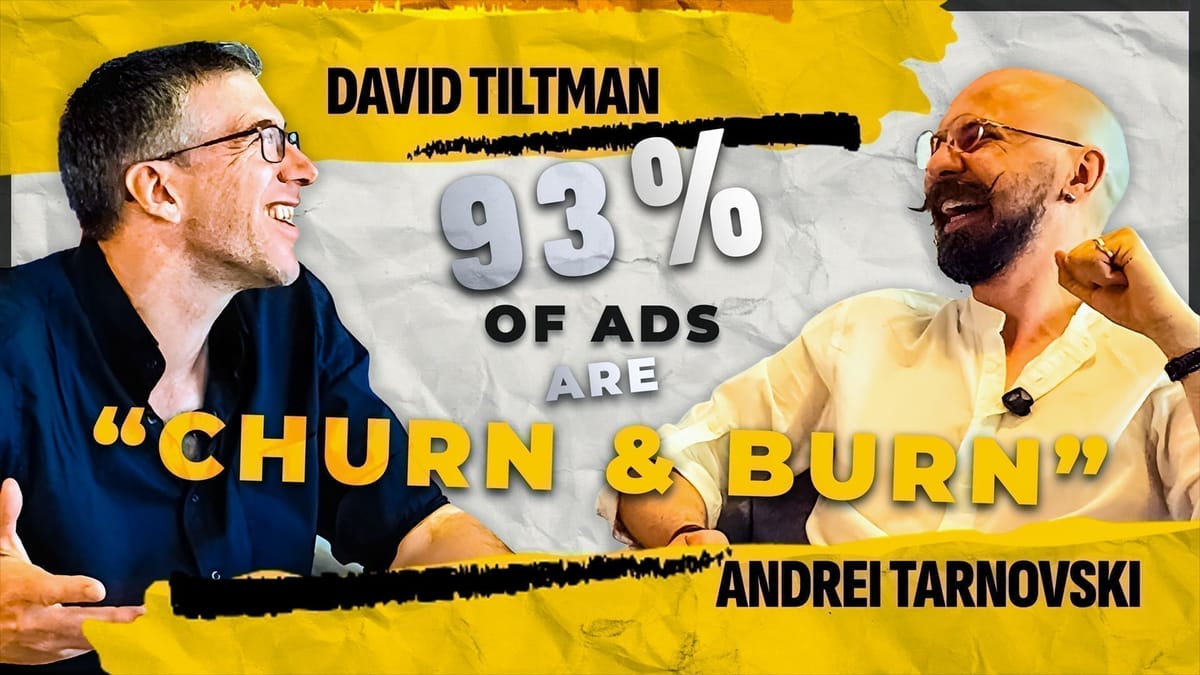
- WARC and CreativeX research found that 93 percent of ads in the studied sample had less than $10,000 in media spend behind them.
- Marketers appear to be doing a great deal of testing without consistently putting substantial budgets behind the winners.
- Principles such as balancing brand and performance can travel across markets because they reflect broadly shared customer behaviour.
- Tiltman rejects the assumption that knowledge flows only from large, developed markets to smaller ones.
- Research based on effectiveness award cases has limitations, but its findings can be tested against larger and different datasets.
- AI creates a new need for brands and advertising to be machine-readable without abandoning communication designed for humans.
- Creative craft still matters because marketing must ultimately produce something that connects with people.
Why this episode matters
Marketing’s evidence base is useful only when it changes decisions.
Tiltman identifies a structural contradiction. Marketers are urged to maintain distinctive, consistent brands, but they operate in systems that reward endless production. Platforms pull activity toward smaller executions, shorter durations and continuous testing. Even if each individual decision appears rational, the combined result can be fragmentation.
The scale of that fragmentation is striking. Tiltman cites research covering blue-chip advertisers in the United States and major European markets. In the sample, 93 percent of ads had less than $10,000 of media investment behind them. Those ads accounted for 30 percent of total spend, while the group receiving more than $100,000 represented only 18 percent.
That does not resemble a clean test-and-learn system in which marketers identify winners and then invest heavily in them. As Tiltman puts it, “There seems to be a lot of testing but not a lot of learning.”
The AI discussion makes the episode especially timely. Tiltman moves beyond asking whether AI can create advertising or reduce headcount. He asks what widespread adoption does to distinctiveness, strategy and the information brands give machines.
The emerging requirement is not to choose humans or models. Brands must remain meaningful to people while becoming legible to AI systems. That makes coherent brand strategy more important, not less.
Key Takeaways
1. Best practice and actual practice are separating
Tiltman describes a widening gap between established marketing knowledge and what appears in the market.
Consistency is his clearest example. Evidence says sustained messaging can pay off. Mark Ritson and Byron Sharp even agreed on its importance during Cannes. Yet brands are releasing more ideas, fragmenting activity and filling platforms with low-quality content.
Knowing the principle is not enough. Organisations need systems that make consistent execution possible.
2. Platform incentives encourage “churn and burn”
It is easy to blame inconsistency on marketers changing direction or CMOs becoming bored. Tiltman argues that the problem is also structural.
Marketers are told to keep producing so algorithms can determine what works. That pressure makes discipline around brand messaging harder to maintain. It also consumes money: many individually inexpensive assets can collectively absorb a significant portion of the budget.
The result is what Tiltman calls “churn and burn”—a large volume of small executions without enough concentration behind the strongest work.
3. Testing has value only when it produces learning
Testing should help marketers identify winners and direct more investment toward them. Tiltman says the data he discusses does not show that happening at sufficient scale.
The issue is not experimentation itself. It is experimentation without a disciplined mechanism for learning, choosing and scaling.
When more money flows into the long tail of low-budget content than into the strongest creative bets, testing risks becoming an activity rather than a decision tool.
4. Brand and performance reflect how customers behave
WARC’s work in Asia has tested whether principles developed in markets such as the United States, United Kingdom and Australia also apply elsewhere. Tiltman says the same broad rules largely emerge.
Most people are not actively shopping in a category at any given moment. Marketing therefore cannot focus solely on the small group currently ready to buy. It must also reach the much larger group that may enter the market later.
That behavioural reality supports the need for both brand and performance activity across different markets.
5. Research limitations should prompt testing, not dismissal
The work of Les Binet and Peter Field draws on IPA effectiveness cases, a dataset with clear constraints: it is concentrated in the UK and represents unusually effective work.
Tiltman accepts those limitations but rejects using them as a reason to discard the findings. When researchers tested similar hypotheses using different datasets and markets, many of the same patterns appeared.
A limited but deep dataset can generate useful hypotheses. The responsible next step is to test those hypotheses more broadly.
6. Smaller markets are sources of knowledge
Tiltman challenges the idea that big markets teach while small markets follow.
Asian markets, for example, moved ahead of Western markets in areas connecting social-first activity, creators and commerce. Not everything transfers directly: livestreaming grew dramatically in parts of Asia without achieving the same adoption elsewhere.
The productive question is not which market is superior. It is what a market’s technology, categories or consumer circumstances can teach marketers elsewhere.
7. AI’s second-order effects are the bigger strategic question
The earliest AI debate focused on what the technology was and whether it could create. It then moved toward its direct economic impact on advertising businesses.
Tiltman says the discussion is now becoming more balanced. AI will change strategy, research, creative possibilities and industry processes, but that does not automatically remove humans.
The next questions concern the consequences of universal use. If everyone has similar tools, distinctiveness becomes harder. Brands must consider how both their identity and their advertising are interpreted by models.
8. Machine readability makes coherence more important
Tiltman uses Mastercard to illustrate how long-term consistency can shape AI outputs. When several models were asked to compare Mastercard with other credit card brands, the word that repeatedly appeared was “Priceless.”
The company did not develop that line to influence language models decades later. Yet its sustained use created a clear association machines could retrieve.
Research discussed in the episode also found zero correlation between the way creativity worked on models and human minds. Brands therefore need an additional machine-readable layer, not a replacement for human communication.
9. Creative craft cannot be reduced to summaries
Asked whether marketers should read more of the work or spend less time on LinkedIn, Tiltman recommends both: less LinkedIn and more direct engagement with actual creative work.
Theory and data matter, but marketing communications ultimately require something to be made and released. Understanding execution means looking beyond the headline idea or an AI-generated summary to see how the work came to life.
Craft is part of creativity’s ability to connect.
Best Quotes From the Episode
Even though we know more about best practice, the gap between good practice and what's actually going on on the ground is getting wider.
There seems to be a lot of testing but not a lot of learning.
I think there's a lot of bullshit about that, and I think some of it is just researchers fighting with each other.
Knowing how to win is a different question to knowing how not to lose.
I don't always like the sort of idea that the big markets know what they're doing and the small have to learn from the big.
If everyone's using AI, what does it mean to be distinctive?
We don't stop the work of talking to humans because that matters. We just add a layer.
The craft is important.
Question & Answer Section
What is this episode of Boringly Effective about?
David Tiltman and Andrei Tarnovski discuss the gap between marketing evidence and practice, including brand consistency, fragmented content, brand and performance, research quality, emerging markets, AI and creative craft.
Who is David Tiltman?
Tiltman identifies himself as WARC’s Chief Content Officer. He manages WARC’s content operation and a team of around 30 people worldwide. He also manages content teams across Lions Intelligence.
Why does Tiltman believe marketing consistency is declining?
He says platforms encourage marketers to create a constant stream of small assets so algorithms can determine what works. That volume makes disciplined, coherent brand messaging more difficult.
What does “a lot of testing but not a lot of learning” mean?
It means advertisers produce many low-budget executions but do not necessarily identify winners and place substantial investment behind them. Testing is occurring without enough evidence of scaling.
Do brand and performance principles apply across markets?
Tiltman says WARC’s research in Asia largely found that they do. Details and emphasis may vary, but most consumers are not currently in-market, so brands must reach future as well as immediate buyers.
Does survivor bias invalidate effectiveness research?
No. Tiltman acknowledges the limits of award-case datasets but says their findings can generate hypotheses. Similar patterns appearing in other datasets and markets strengthen the evidence.
How does AI change brand strategy?
Brands must consider how models interpret their identity and advertising. Tiltman argues that marketers should add a machine-readable layer while continuing to communicate effectively with humans.
Why does creative craft still matter?
Marketing eventually has to create something and put it into the world. Studying how strong work was actually executed provides insight that abstract theories and summaries cannot supply.
Who should watch this episode?
This episode is especially useful for:
- CMOs and senior marketing leaders
- Brand and communications strategists
- Creative and media professionals
- Marketing researchers
- Performance marketing teams
- People responsible for AI and brand governance
- Marketers working across multiple countries
- Anyone trying to turn effectiveness evidence into practical decisions
It will be particularly relevant to teams producing ever-larger volumes of content without a clear process for learning, selection and sustained investment.
About the guest: David Tiltman
David Tiltman is the Chief Content Officer at WARC. In the episode, he explains that he manages WARC’s content operation, including a team of around 30 people around the world who publish, commission and research new material.
Because WARC is part of the Lions group, Tiltman also has a role within Lions Intelligence, where he manages content teams across its operations.
About the host: Andrei Tarnovski
Andrei Tarnovski is the host of Boringly Effective. In this conversation, he describes himself as a marketing strategist and interviews David Tiltman at the Romanian Creativity Pavilion at Cannes Lions.
Listen or watch
Watch the complete conversation or listen on your preferred podcast platform.
Show full transcript · 3544 words
0:54 Andrei Tarnovski Hi, David. Hi, Andrei. Thank you for joining us at the Romanian Creativity Pavilion at Cannes Lions. Great to be here. So first of all, tell us briefly about yourself and your role in WARC. I know I'm talking to one of the bosses, but.
1:09 David Tiltman Yeah, so I'm the Chief Content Officer at WARC. It does what it says on the tin. I manage all the content and you'd think WARC is a significant content operation. We're always publishing and commissioning and researching new stuff. So I've got a team at WARC of around 30-odd people around the world. Wow. Then I have a second hat because WARC is part of Lions, the Lions group. There is a division of that called Lions Intelligence, which is not just WARC, but also Contagious IQ, Creative Cycle, Effie Insights, and The Work which is a Cannes Lions spin-off product. So I manage content across all of those as well. I manage those content teams.
1:56 Andrei Tarnovski So basically, you're the one to blame for the sleepless nights when we are so curious to see what new.
2:02 David Tiltman Yes, I'm sorry, that is me.
2:07 Andrei Tarnovski You have probably the largest body of knowledge of intelligence on marketing. Is there any evidence which is incredibly clear, yet almost all the market gets it wrong? Is there anything you could pinpoint?
2:24 David Tiltman There's so much. So actually, one of the themes, there's lots of areas. One of the themes this year in Cannes Lions has been the widening gap between best practice, what the theory tells us to do, and actual practice. Actually, annoyingly, that gap seems to be getting wider. Even though we know more about best practice, the gap between good practice and what's actually going on on the ground is getting wider. That's for a whole bunch of reasons. But if I take one example, it would be around what some people would call consistency. So there is a growing body of evidence that consistency pays off. On Monday, Mark Ritson and Byron Sharp agreed that consistency was key. At the same time, seeing things get more and more fragmented, more and more ideas being put into market, more and more low-quality content flooding the platforms. Consistency is actually moving in the opposite direction, becoming less consistent, not more consistent.
3:26 Andrei Tarnovski Although we do know how important it is, is that influenced by how the platforms are trying to get people to produce more content?
3:37 David Tiltman That's a big part of it. It's easy to see it as a source of, "Oh, it's just marketers being silly and chopping and changing, and the CMO gets bored," and all of that sort of stuff. Maybe there's a bit of that. But yeah, there is a structural issue in the industry where marketers are being told that they need to just keep churning, churning, churning, churning, create the stuff, the algorithm, or figure out what works. Now, the problem with that is it gets very hard to maintain any form of discipline in terms of brand messaging. It's a really difficult, I'm not pretending this is easy, but some data we released this week with CreativeX from the US and some major European markets. The sheer volume of ads was astounding. It's all low budget stuff, so 93 percent of the ads by blue chip advertisers, not little like your local pizzeria, 93 percent of the ads by blue chip advertisers, all Fortune 500, had less than $10,000 of media spend behind them. So we're just pumping, pumping like we call it churn and burn. It's just, but it's sucking loads of our budget in. So actually we're spending more on the churn and burn stuff than we are against our big creative swings. What you might expect to see is that, yeah, we're testing and learning all the time and then we're picking the winners and putting a load of budget behind it. That's not happening. The winners, as in that we had a bucket that gained over $100,000 of media investment. That only counts as about 18 percent of the total spend. The 93 percent volume accounts for 30 percent of total spend. So if more money is going into the bottom end than it is to the top.
5:35 Andrei Tarnovski So basically, all of them are fighting for the same huge, immensely small amount of people that might or might not.
5:45 David Tiltman Well, partly it's about performance. So yes, there's lots of performance assets, but it's not just brand performance. It's the gravitational pull of these platforms is towards small. Small executions, small ideas, small duration, test, test, test, test, test. There seems to be a lot of testing but not a lot of learning.
6:07 Andrei Tarnovski Okay. You mentioned that this study of yours has been made on the more developed markets. Yes. Do you have lots of studies on the emerging markets, on the smaller markets?
6:20 David Tiltman So we have been looking at that. I mean, it does depend what market you mean, but I guess the closest thing we have to that, it's not as in much depth as the thing we've just talked about, but we've done a lot of work in Asia on whether the rules or laws of advertising that have been drawn up in places like the US, the UK, Australia, whether they apply in other markets, and largely we're finding there are, they do. So in Asia, we had a project called the Pace Principle, which was looking again at brand and performance, and in Asia, the dimension is often speed. It's like the Asia is such a fast moving place and everything gets the market quicker. Again, we saw the same rules play out in terms of you do need to be quick. There is room to be culturally resonant and all the rest of it, but that shouldn't come at the expense of a clear North Star strategy, everything laddering up to the same space because it makes intuitive sense. If you stop thinking about it as like rules of marketing and start thinking about how do customers behave, those sorts of things are universal. In all markets, in all parts of the world, most people are not actively shopping for something at any one time. So the job isn't just to find the few people who are in market, it's to find the much bigger people who are not currently in market, but might be and talk to them. Yes, we have started to look at that, not specifically for Romania unfortunately, but we have started that process in Asia. I think what we're really excited about over the next couple of years is, as we integrate the Effie into our organization, because the Effie case study data is so deep and covers so many markets, we'll be able to run these studies on a lot wider set of markets.
8:22 Andrei Tarnovski If on any of these smaller markets, you found anything that was unexpected, and anything that does work there, and could work on the bigger markets, on the more developed markets. And the second one is analyzing the brands that win. Isn't that a bit of survivor bias, or are those rules, do they apply to any...?
8:48 David Tiltman I'll start with the survivor bias one, because I think... Am I allowed to swear on this video? Please do. I think there's a lot of bullshit about that, and I think some of it is just researchers fighting with each other. We have this terrible tendency in the marketing world for one person's theory to argue with another person's theory. It's how science grows, yeah. It's quite annoying though. Now look, let's take the specific example of where this has happened, right? So, Les Binet and Peter Field produced a whole body of evidence based on the I.P.A. Effectiveness Awards. Or the Effectiveness Awards database. Yeah, over the past 15 years or so. Yes, that is a massively difficult data set, because it is largely UK cases, it is the best stuff that the industry produces, the best, most effective stuff the industry produces. There is this sort of accusation of survivor bias. Now, what is interesting is when the sort of rules that they... or the findings that they discovered in this body of evidence started being tested in very different types of data, the same things emerged. It's a relatively small sample size, it has that survivorship bias, yes, all of that is true. But what was super fundamentally interesting was when you took that to other data sets that were not case study based, that were based on large data sets that operated in different markets, like the US, we pretty much found the same thing. Of course, the nuances maybe changed, the angles changed slightly, but we've now found that, yes, you need to do brand and performance in data sets in Asia, in the States, different parts of Europe. I think we can put some of that survivorship bias stuff to bed, because we've actually seen that by taking a relatively small but very deep body of data that we know quite a lot about, it can give us hypotheses that we can then test more broadly. It does sort of annoy me that people would just dismiss that. That can't be right, because... OK, well, let's accept that the data has limitations, but take that as an encouragement to go and use the findings and test them somewhere else.
11:17 Andrei Tarnovski To test, again, the principles, not... OK. Are there any lessons we can learn from those who did not survive in the market? Is there anything we can find out new to us by researching...
11:33 David Tiltman Well, it depends what you want to know, I guess. If you're trying to find out why they didn't survive, then that could be useful, because knowing how to win is a different question to knowing how not to lose. Now, the problem you have with that is it's very, very hard to get good data on stuff that didn't work, because no one wants to own up to it. No one wants to go, "Yeah, I'm going to enter a case study "and how this thing totally bombed." Yes, in principle, but actually getting the data is quite difficult.
12:06 Andrei Tarnovski And there's probably more ways to lose than the number of ways to lose.
12:12 David Tiltman Of course, yeah. If you accept that the default is, the baseline position is you are probably going to lose, then you have to understand all the things it takes to then win.
12:24 Andrei Tarnovski Now, let's get back to the question about smaller markets. Is there anything that applies there and maybe would be relevant for the market?
12:33 David Tiltman Yeah, there's always stuff you can take. Again, I'm going to use Asia as an example, because we're closer to that at WARC. So we are doing a lot of work at the moment around the worlds of Social First, Creator, and the links between those areas with sort of commerce, because Asia leapfrogged the West in those sorts of spaces. Now, yes, they are smaller markets. I mean, China's obviously not, it's enormous, but they're very developed in certain areas. And so what we're seeing in terms of the way those spaces play out in Asia actually tells us about what may or may not happen in the West. It's not always a perfect one-to-one match. Things like live streaming became massive in Asia. It hasn't really ever caught on in other parts of the world for a number of different reasons. What's really interesting is where you might look at, you know, look at these different markets and think, what are the sort of universal stories in those markets where that market might be either slightly ahead or have a slightly interesting experience, like interesting set of circumstances? So, for example, I mean, it could be about technology, but it could also be about, are there specific categories in that market that are growing particularly quickly, where actually that might tell us how a category could be developed or you could find new ways to solve a particular consumer problem in another market. I don't always like the sort of idea that the big markets know what they're doing and the small have to learn from the big. It's often about, you know, each market's got its own specialisms and its own expertise and its own things. And once you learn about stuff, you can then translate it into... You go, "Actually, that could really have the relevance over here."
14:29 Andrei Tarnovski One of the important subjects at this Cannes edition is AI. Basically, every second speech had mention, at least. As a marketing strategist, partially I don't understand how AI is influencing my work, but how does it influence the creative part? By you, I mean WARC. Do you have a lot of studies on the creative effectiveness?
14:58 David Tiltman Yeah, so, look, it's hard to boil AI down into a few talking points because it's existential, yeah? Every single... It touches every single conversation in Cannes. Even the ones that aren't about AI are sort of about AI somewhere. I think there's some really interesting things going on. So, for us, I would say this Cannes has been about properly understanding what you might call the second-order effects of AI, or at least starting to. So, if initially it was the first year, a couple of years ago, the conversation was around, "Bloody hell, what is this? How do we make it work? "Can it actually create stuff? Are humans still required?" Last year, it was more about the direct impact on the economics of the advertising industry. Do we still need the same number of people? Are we going to be a much smaller industry? Et cetera, et cetera. Now, there's a bit more of a balance debate where we can see, "Look, this thing is going to change the industry. "It is going to change all our processes. "It's going to change the way strategy is done. "It's going to change the way the research category is. "It's going to change the possibilities of creation." Doesn't mean that humans come out of that. But we're starting to have more conversations around, as I say, the second-order effects, which is, if everyone's using AI, what does it mean to be distinctive? And what does a brand need to do to be machine-readable so that the distinctiveness comes through into the models? I'm going to give you an example. It comes back to the consistency point I've already made. We did a big guide on brand building and the age of AI, and as a little bit of fun, we looked at MasterCard, the credit card brand. We asked a bunch of the different models to tell us how does MasterCard compare with other credit card brands. Guess what word came up in all the answers? Priceless, I guess. Priceless. A consistent 20-year strapline that ties the product to the customer benefit perfectly, that's what shows up in the models. So, the very least, maybe we see a resurgence of consistent taglines, but actually it tells us something much more fundamental, which is that the models love consistency, and they love consistency in the information they read. So, how do we engender consistency through everything we do? Or at least, I think the word this year is "coherence" rather than "consistency". But MasterCard didn't come up with that strategy in order to affect an LLM 20 years into the future, but the knock-on effect of them having done that is that they are actually very well placed in this space.
17:45 Andrei Tarnovski Basically, there's not a huge difference between building this distinctiveness for humans and for machines.
17:52 David Tiltman There is a difference. So, we had a really interesting session this week where Jellyfish and INSEAD and WARC had done some research into whether creativity worked on models as well as human minds. And in short, there's no correlation. Zero correlation between the way it works on the two things. The next phase is about, as I say, how do you make a brand machine readable? How do you make your advertising machine readable? We don't stop the work of talking to humans because that matters. We just add a layer. But there is a layer of, "Okay, what does that mean?" Is there an additional layer of work we need to do to ensure this is coded in the right way? Do we see brand as the context layer through which AI understands who we are and how we behave? Actually, this creates a whole new level of brand strategy that probably didn't exist before or, at the very least, it makes doing that thinking, doing that brand strategy far more important upfront because if you're presenting inconsistency to the models, it doesn't know what to read.
19:05 Andrei Tarnovski Binet and Field or Byron Sharp?
19:07 David Tiltman I can't. How do you pick between those two? Whoever I choose, the other one will kill me. They're both right. Yeah, I think they're both right in different ways. I think the Byron Sharp, the work the Byron Sharp has done around popularising the work of Andrew Ehrenberg is really, really fundamental because it gives us a way of understanding how categories work, how consumer buying works, and then lots of other stuff layers on top of that. So, Binet and Field would not see themselves as in opposition to Byron Sharp at all. They would see what they are doing as a way to interpret some of the ideas in how brands grow into something that feels more practitioner-focused.
19:52 Andrei Tarnovski So, basically, Byron Sharp set the matrix where every other researcher can...
19:57 David Tiltman I do know of researchers who disagree with Byron Sharp, but certainly the people like Binet and Field, yeah, they might quibble on specific points and specific points of nuance and emphasis, but they wouldn't argue with a big picture.
20:09 Andrei Tarnovski A Cannes Lions or a sales uplift?
20:12 David Tiltman I'm going to be boring and say both, but I'm going to say a Cannes Lions because I think the game isn't just about driving sales come what may, it's about building sustainable brands that can drive profit as well as sales. Yes, of course, we need a sales uplift, but are we doing that, are we driving that sales uplift with techniques that are also driving, like, building that sort of sustainable, like, profit growth?
20:46 Andrei Tarnovski What is more useful for marketers? Reading more of the work or spending less LinkedIn posts?
20:54 David Tiltman Like, we should all spend less time on LinkedIn. I think we can all agree on that. But if you talk to marketers at Cannes... Still, the ones that get the most from the festival are the ones that work, that spend some time in the basement, looking at the work itself. Because it's really good stuff and it is a reminder. We talk about theory and data and these big abstract concepts a lot. But at the end of the day, a lot of, at least in marketing and communications, not all marketing, but the job comes down to actually creating something. Something has to go out into the world. You know, we're not just building pipes. We're actually... The craft is important. And I think reading more of the actual work itself and understanding the craft of it, not just the sort of the big idea or the ChatGPT summary or whatever it is, but how they actually got it done and the story behind how it came to life, I think is really important. Because it is a reminder that craft is a really important aspect of not just the creativity, but the ability, that creativity to connect.
22:10 Andrei Tarnovski This is a perfect thought for ending this discussion. Thank you so much again. And thank you not only for joining us here, but also for, I will repeat myself, the sleepless nights when we were curious to read everything you have available on WARC. You can never finish work, it's not possible. Definitely.