
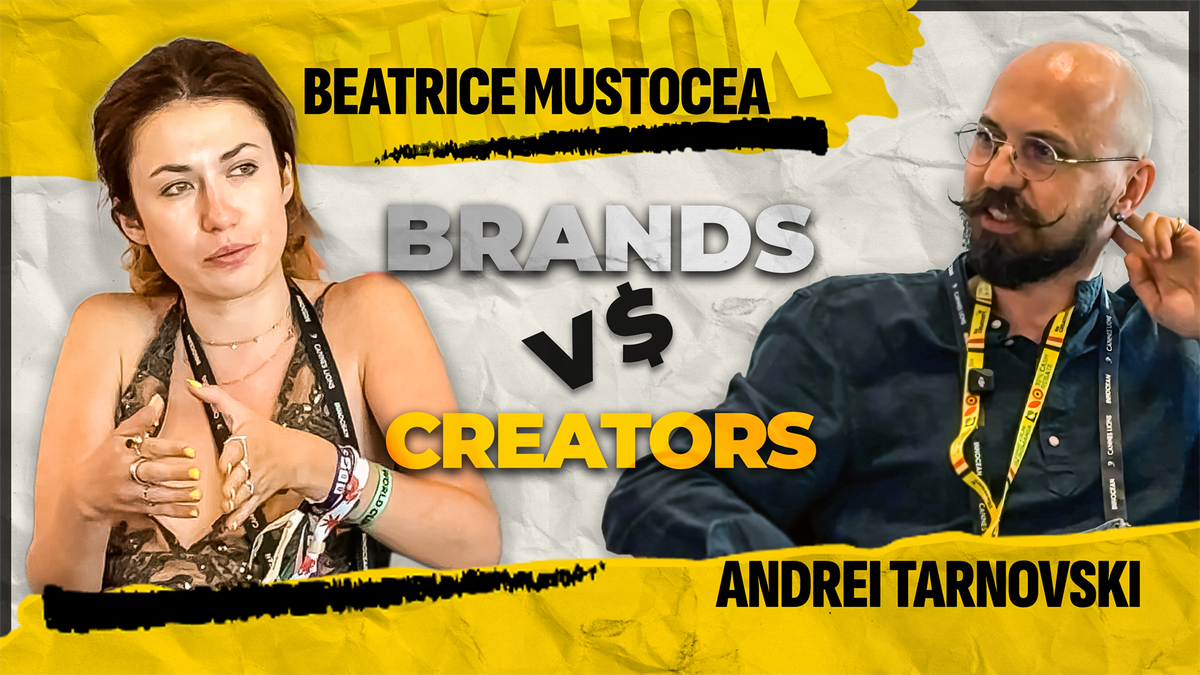


Boringly Effective · Season 1, Episode 5
Guest: Beatrice Mustocea, Creator & Public Figures Lead, TikTok Host: Andrei Tarnovski Recorded at: the Romanian Creativity Pavilion, Cannes Lions 2026
The conversation in one paragraph
Most "creator economy" content is either a TikTok hype reel or a marketer's complaint. This episode is neither. Marketing strategist Andrei Tarnovski sits down with Beatrice Mustocea, the person whose job at TikTok UK is literally to grow the creator ecosystem at scale, to ask the boring, effective questions: when does creator marketing actually beat paid media, when does it fail, what is a creator really "worth" to a brand, and who — platforms, brands or creators — is going to own the next five years.
In a nice bit of serendipity, the two met at the Romanian Creativity Pavilion during Cannes Lions — two Romanians who have both spent their careers navigating the global marketing stage. What comes back is a practical, evidence-minded view of creators as media, collaborators and distinctive brand assets, delivered without the usual chest-puffing.
TL;DR
- Right fit beats big reach. Creator marketing can outperform paid ads when the brand and creator genuinely align; without that alignment it's just expensive ad space.
- A creator is a media company. You're not renting a slot — you're hiring a producer, director, editor and videographer in one person.
- Think distinctive brand assets, not endorsement. Each creator is "a huge set of distinctive brand assets" the brand gets to borrow — but only if it collaborates instead of dictating.
- Authenticity is the wrong word; relatability is the right one. The relationship that holds audiences is a creator's ability to be relatable, not a mystical "authenticity" brands keep trying to quantify.
- The creator economy and the entertainment industry are merging into one. YouTubers are already dominating the box office; the next wave of film, TV and advertising will increasingly come from creators.
Five things to take away
- "Proof of concept" is the gap between paid and creator marketing. Paid media puts you in front of people who could care; an engaged creator community is proof that people already do.
- The best partnerships are long-term. A 12-month contract beats a one-off brief — it builds affinity, repeats the message, and is what audiences actually reward.
- One-off activations can still work — Beatrice's Netflix / Black Mirror example (the fictional "TCKR / Nubbin" pop-up) landed because it wasn't obviously branded.
- Monetization is broader than brand deals. Creator Rewards, live gifting (a serious income stream, including in Romania), affiliate, TikTok Shop and merch all matter; brand deals are "the life-changing money," but not the only path.
- Trend-chasing is a brand-erosion strategy. Jumping on every trend stops your audience understanding who you are and what you stand for.
Q&A highlights (lightly edited for readability)
Andrei: Where do creators actually sit on the media map? If you work with the right creator for your brand…
Beatrice: …effectiveness is 100% what you're going to get, because you're essentially tapping into a community that's already a fan of this creator… It's a lot more engaged than, say, paid marketing, where you just be reaching out and putting this content in front of people… but you don't have the kind of pproof of concept that they actually will.
Andrei: Is authenticity still a real thing in the creator economy, or is it a depreciating asset?
Beatrice: Yes, it's part of it, but I would argue that the better word is relatability… The biggest appeal… is that ability to be relatable and to just make those decisions and put that content out, that doesn't need to go to the same approvals and executives and red tape to get it made.
Andrei: Platforms, brands, creators — which of them owns the future?
Beatrice: They kind of coexist, to be honest, and they will both create the future together.
Andrei: Fame or freedom?
Beatrice: Depends on what way. Pass.
About the guest
Beatrice Mustocea is Creator & Public Figures Lead at TikTok UK, where she builds the strategy that grows the platform's creator ecosystem at scale — including programmes like the TikTok Film & TV Club. She has spent nine years in the creator economy, with prior work on the Google Pixel launch and LinkedIn's first move onto TikTok.
About the host
Andrei Tarnovski is a marketing strategist and the founder of TARNOVSKI, a branding and marketing consultancy. He hosts Boringly Effective, a show for marketers, founders, strategists and brand leaders who would rather understand what works than chase what's fashionable.
Listen / watch / subscribe
- Watch the full episode on YouTube.
- Listen on Spotify, Apple Podcasts, and your favourite podcast app.
- Subscribe to the Boringly Effective Newsletter at BoringlyEffective.com for a weekly round-up of the most important marketing news, plus links to the latest episodes.
This Cannes Lions series was produced by SYMBOLON, with support from the RoCreativity program by FEPIC and ARICE.
Full transcript
Related on this site: distinctive assets and reach and frequency.
Show full transcript · 5713 words
Andrei Fame or freedom?
Beatrice Depends on what way. Paid marketing where you just be reaching out and putting this content in front of people that could theoretically, based on their audience profile, interact with your product, but you don't have the pproof of concept that they actually will. YouTubers, but they are absolutely dominating the box office. Creative power to translate it elsewhere. The way the entertainment industry and kind of creator industries merging, it's almost becoming one really. All of the platforms will have their own monetization products that are available to different creators based on the type of content that they make. So yeah, I've got a lot of opportunity out there.
Andrei Hello Beatrice.
Beatrice Hello.
Andrei Nice to meet you here in Cannes at the Romanian Creativity Pavilion. Thank you for stopping by.
Beatrice Thank you for having me.
Andrei Tell us about yourself briefly. What do you do? What's the content?
Beatrice So in my current role, I'm a creator lead at TikTok UK, which means that I build a strategy of how we grow the ecosystem by partnering and nurturing, developing, and just investing in the creators that are building the content that our users want more of. So for example, we'd be looking at user behavior on the platform and see that they really love being entertained on TikTok. So then my job is to create the strategies and create ways where we get creators to post more, to be more just like want them to buy into the platform and choose TikTok as their place to go. But about me just more widely, I've been in the creative economy for the last nine years, which is a very long time to be working with creatives, considering we didn't even have the word creatives nine years ago. But yeah, it's been really, really fun. It's great to just be in this industry for so long, and especially at this time. I've compared it before to 1920s Hollywood, where we are, I think, and it's so exciting. The architecture, the infrastructure doesn't really, or it's starting to exist. But it's really nice to be part of building it.
Andrei I like the comparison with the Hollywood at its beginning. Do I understand correctly that actually your job is to come up with the structures that will help the creators? So basically, it's more of a strategic work.
Beatrice Yeah, a lot of it is strategic and a lot of it, because we are a platform. Everything has to be done at scale. Kind of individual partnerships are not necessarily going to move the needle in the way that we need them to. Part of my job, obviously, does include partnerships, because this is kind of what the creator economy is based on. But on a day-to-day basis, I'd be looking at kind of just the data and understanding. Maybe our users want more film and TV content, for example, and we don't have enough on the platform. So then what we would do is create programs that could engage creators at scale. So I run this community for the UK market, which is called the TikTok Film and TV Club. For example, this is how we get loads of creators. It's over 200 creators that are being incentivized through education, additional kind of monetization opportunities, events, industry opportunities, just to get them to kind of post high quality like film and TV content on an ongoing basis. Because, yeah, what we have to do is always at scale.
Andrei I wanted to talk to you about effectiveness, since my personal mission in my job is to find the effectiveness angle on everything. So basically, Byron Sharp says that in order to grow a brand, you need to reach out to as many people as possible. Yep, the creator economy is kind of a fandom. I mean, there's fans of some specific people. Now, where, though, do these creators actually sit on this map of the media landscape?
Beatrice You know, if you work with the right creator for your brand effectiveness is 100% what you're going to get, because you're essentially tapping into a community that's already a fan of this creator. So they exhibit fandom in a very kind of just natural way. And then if you align your product to a creator that can seamlessly use it, for example, let's say this bottle of water or whatever, if it's someone that's really into wellness or those kind of similar content categories, then you really kind of have that in-built kind of audience already done for you. And it's a lot more engaged than, say, paid marketing, where you just be reaching out and putting this content in front of people that could theoretically, based on their audience profile, kind of interact with your product, but you don't have the kind of pproof of concept that they actually will. Whereas with the creator having built this kind of engaged community, obviously, again, if it's the right creator with the right level of engagement, you're kind of tapping into a really good fan club already.
Andrei So it's basically the important thing, besides having the right media coverage, is to find that affinity between the brand's values and the creator's.
Beatrice Exactly, it has to kind of make sense. If someone's never spoken about your product before, it might be a bit random to kind of come in, and then you have to kind of just like build that alignment a little bit more naturally. Sometimes over time, like the best partnerships seem to always work on a more kind of like long-term basis, where you're looking at the creators and you're seeing that they kind of just like engage with that brand repeatedly, rather than kind of, you know, this is the first time that I'm going to talk about a car, although you don't even know that I drive.
Andrei In this case, basically, each creator is a huge set of distinctive brand assets. And basically, you want the brands, your own brands' distinctive brand assets to be merged with this universe. How do we manage this competition?
Beatrice It always has to be a collaboration, and it has to like the best kind of like creator partnerships work, if you're like as a brand, let's say, whether it's the marketing team behind the brand or like the founder or whatever else, and maybe depending on the product, if you have a kind of honest conversation with the creator and brief them really clearly, like these are your objectives, but essentially, you are kind of just buying the ad space that they control, and you're kind of showing up in their world, so you have to have that conversation. Like if you're talking about brand assets, where like a kind of brand just comes in with like predefined stuff, and they're super rigid in what they want, it may not be the best product in the end, because nobody likes to be kind of advertised to, like it's just like human nature, you don't like if in traditional kind of examples, if there is an ad that is where people, like on TV, that's where people go to the bathroom, you don't want to be advertised to. So it has to happen in a very natural way for it to make sense, like it has to be something that, oh, this person actually really loves this product, and the creators know their audience best, they've built it so of course the brand has to kind of just come with that respect and that kind of just like, kind of appetite for collaboration rather than, okay, let's do this, and.
Andrei Are usually creators good at implementing the client's, the brand's requirements? Do they do it naturally well?
Beatrice It's a very broad question, because obviously the creator economy is so broad right now, so of course there's bad examples, but if it's the right creator, they will normally know that already, and you will have to kind of be doing your own research to like decide if that creator is right for you. If they've worked for the brand before, like just check out all the bad examples and see what worked and what didn't, 'cause oftentimes like you're, when you're kind of working with the creator, you're not just buying the ad space, but you also buy this creative partnership where they're like, they're a producer, director, editor, videographer, all in one, which would cost you much, much more to kind of do on your own. So by you kind of showing off and being integrated in the world, it will work. If it's a good fit, it definitely will work, but it's hard to say like it will work 100% of the time. You don't necessarily have to know every product will make sense as a creator partnership. Like if you're selling perfume, it's really hard to sell a scent online. Like how's that kind of scent gonna translate?
Andrei Regarding these partnerships, basically you can find this synergy between a brand and a creator. But during these long lasting partnerships, what happens when eventually this relationship breaks up? How can both the brand and the creator protect themselves from this separation between, because in a way they do merge in the eyes of the creator and the brand in years and years.
Beatrice Well, I think merging is maybe a bit too far. I would never say there's really an example where a creator and a brand become like synonymous unless the creator is the founder of that brand. I would say though, at this point in time where we are in the kind of creative economy and how like more brands work with creators, back in the day used to be very much a brief, like amplify this campaign, we have this product, one-off, goodbye. Whereas right now we're really kind of seeing that creators are being like employed as like chief creative officers or they're being like creative directors for loads of brands. And they're really being brought to the table in a much more meaningful way. If you have that level of relationship based on that level of trust, I would imagine that the communication is always quite good between the brand and the creator. And it could be a time where like the job is done. Maybe you're collaborating with the creator to reach a specific kind of age group that the creator's kind of audience already has. And maybe if you've worked with that same creator over a year, you maybe have done the job. And maybe if that job is complete, then it's completely fine to kind of start building new relationships, kind of advertising in different spaces. And if the kind of, I suppose, relationship between the creator and the brand is solid, you could be like, "Hey, this job is done. Now, thank you so much for your collaboration." We'll part ways. And it's also just, I guess, for the creator, it's always beneficial to build new relationships. You don't just want to become that person that only knows about this one thing.
Andrei Since Les Binet is also here at Cannes Lions 2026, I have a question related to Binet and Field's 60:40 rule. A lot of creator work gets done more as an activation rather than a long-term partnership. It's unfortunately quite a frequent format of collaboration Where have you seen creators delivering that long-term brand-building effect, Les Binet and Peter Field are talking about this? They say it is important. Maybe you have an example or some principles.
Beatrice I think it's important to understand that there's definitely examples where you could be working with creators as an activation and it's still being really impactful as a one-off. So in the UK, for example, Netflix for the launch of Black Mirror's latest season, there is an episode where there's this fictional kind of like tech company called like TCKR. And they have this like product Nubbin, which is essentially something that you attach for your head and then it's just gonna access your thoughts and stuff like that. So what they did for that is that they build a kind of one-day pop-up where it was not kind of Netflix branded at all because they were kind of like promoting this fake company to kind of play along and they got them to kind of just wear the Nubbin. They sent it to them at home. And then loads of videos around that kind of like reach for virality on their own kind of way because it was such a strong kind of like idea and such a strong activation. And in that case, obviously, because it is a one-off kind of fictional company, it doesn't really make sense to bring that again. But they still create that really meaningful moment and it really kind of just like drove buzz for Black Mirror in such a kind of cool way. Like that's actually like, yeah, this is the kind of advertisement that I want to be given because it's so like entertaining. Other than that, loads of brands are kind of just looking at the ambassador model. So whether it's something that is as simple as like, again, in the UK, whether it's as simple as like giving creative black cards for like whatever it is, whether that's a restaurant or a cinema or whatever. And that means that they kind of just like organically keep coming back to your brand. And then, you know, if it makes sense, it might feature in their content organically. Or there's like loads of ambassadorship kind of models because the industry has kind of heard creatives that both the way that we drive kind of effectiveness the most, but also kind of how you support the creators is by doing it repeatedly. So for example, if a brand comes to a creator with a 12-month contract, which has a certain set of deliverables, maybe that repeats every like three months and other brief every two months, it's a lot more appealing for the creator to prioritize that. But then again, it also brings that affinity between the creator and the brand over time, which is much stronger that way. And the audiences really kind of support that way of working because essentially they are fans of these creators. So they want, you'll see that most of the comments that they leave are like, go get this bag or so. They want their kind of favorite creators to be paid because this is what keeps them making content.
Andrei I found a quote that says that you create in real life fame for digital stars. However, my question is, what does this in real life fame actually buy these creators that digital cannot buy them?
Beatrice I think the kind of main thing by traditional fame, there's a level of stickiness that kind of just comes with the creator. One, obviously you could have a really viral moment and you can have a really strong community that's built over time, but to kind of make sure that this is long-term and that this is still gonna be with you in a year, you have to kind of just like kind of invest in your, both your kind of profile, but invest in like your long-term trajectory. So from a TikTok perspective, like what we do is necessarily is like collabing with the industry, collabing with kind of publisher partners and kind of getting them sometimes from digital to TV or getting them in real life spaces and getting them to kind of have that buzz and kind of really build their profile as a kind of just public figure in their own right type of thing. For a creator to kind of have this theme that translates beyond digital, it's really important because it could be like getting people in a room, getting people to buy merch, getting people that actually would, you know, follow them from digital into other ventures. And that is what we are trying to support as well as much as possible with some of the initiatives we do. Like we've partnered with the BBC for the last three years on this thing called Creator Lab, which is kind of a joint proposition from TikTok and the BBC that we will get creators that apply through the app and want to have a career in kind of like traditional television, whether they want to be a sports pundit or they want to be doing kids TV or whatever else it may be. We kind of incubate those creators and we get them kind of the training and the kind of industry access to kind of take their career one step further and become like, you know, traditional presenters.
Andrei So you're basically extending the digital version of the community to the offline world.
Beatrice Exactly. And like extending the reach as well and making sure that this kind of like, you know, sticks around.
Andrei This sounds like a very useful endeavour for most creators.
Beatrice You'll see now that the journey from creator to kind of like, like proper, like insane fame is happening more and more. Obviously, it's been happening for years, but like right now we're at the point in time where like Obsession or Backrooms are two films that like have come from creator minds, from YouTubers, but like they are absolutely dominating the box office. And it is because they've already kind of demonstrated this kind of level of creativity online and they've got the skill set and they've got the kind of just like creative, like just power to translate it elsewhere. So the way the kind of entertainment industry and the kind of creator industry is merging, it's almost becoming one, really. So fame comes with that.
Andrei Since we've mentioned the word "digital" so many times, actually we don't have anything that is not digital anymore. Basically offline and online are merging more and more. So actually what creators do is not so far away from the real life as it used to be at the beginning of the social media phenomenon.
Beatrice A hundred percent. It's the only and probably most sustainable way to modern day fame.
Andrei Let's talk about authenticity. Yesterday, I probably shouldn't have said where I've heard it, but in a room, someone from the stage said we've quantified authenticity, which sounds kind of strange to be able to... You cannot quantify things such as authenticity or, I don't know, sincerity, love and so on. Now, everyone sells it as if it's the main superpower of any creator. Is actually this a depreciating asset? Does it still exist in the creator economy? Is this a real thing any longer?
Beatrice Yes, it's part of it, but I would argue that the better word is relatability, because of course they have to be authentic and they're true to their followers and everything. But the biggest appeal of what's basing the relationship between audience and creators is that their ability to be relatable and to just make those decisions and put that content out, that doesn't need to go to the same approvals and executives and red tape to get it made. So it is authentic in that way and the fact that this is a person's idea that they've then produced, made and kind of bring into their audience. And it's more like, I don't want to say raw, because it doesn't have to be raw. It could be high quality and then it still is just one person's idea and they have kind of just believed in it and they're putting it out there. Whereas more traditional media, for example, doesn't have that exact same pathway to being published just because there's so many more heads involved that have to get it live.
Andrei Now, to a more tricky question, we have platforms, brands and creators. Which of them owns the future? Where is the power struggle right now?
Beatrice They kind of coexist, to be honest, and they will both create the future together. And I think it's happening in a very kind of harmonious way that we are actually, at least in the UK, we are in a very good place where even more traditional brands, and I'm going to use the example of someone like the BBC, for example, because everybody knows it, but as a kind of traditional broadcaster, a lot of their commissioning is now happening for YouTube because of the accessibility, because this is where audiences are and this is kind of where they see the future. But yeah, it's happening more and more and you're seeing that across the UK, like Channel 4 as well is behaving in the same way. Same for TikTok, like we are developing a lot of micro dramas and we're seeing, although I don't have an example for you just yet, there are micro dramas being made by these brands that are going to be living on TikTok very, very soon. So micro dramas is a huge trend, it's something that we're talking about a lot at the moment. And it's the epitome of all these three things coming together to deliver a product that is entertaining and kind of, you know, has everybody's best interests at heart.
Andrei Talking about platforms, most creators are more like tenants. They rent their space on a platform. Is there any danger to the creators, the creator economy in general? Should they treat this as a business-wise, as a risk to be mitigated or is there no risk at all for them? And as a second sub-question, I suppose this is part of your job to help them hedge this risk.
Beatrice It can be bad because you think, you know, not everybody that is creating wants to be a full-time creator and they don't necessarily want this to be their job. Sometimes people create just because they like something and they're a fan of something and they just want to kind of join the conversation. And that's completely fine if that's how they show up in that way and this is why they're creating content. It's still just as valuable as if we're comparing to someone that's actually doing this like seriously and really is business-minded and wants to make it a long- term career. And you'll find that a lot of the creators that have become full-time creators and are kind of just like doing their own businesses and everything were maybe not always that intentional about it. And at one point throughout their journey, this switched and it was like, oh, it's going well. And like people actually cared what they had to say. And now it's kind of where they're taking it seriously and really building kind of businesses and infrastructure around it.
Andrei Tell me now about monetization. Is there a way that is unexpected for many people outside the creator economy, a way of monetizing this kind of effort or is it just the traditional advertising money just in a new format?
Beatrice So, and I'm going to speak for the UK because that's where I know what the products are. On TikTok, for example, as a platform, you can monetize in a lot of different ways and the kind of infrastructure is there to help you do so. So, for example, in certain markets, we have the Creator Rewards program where you'd get monetized for your kind of high quality one-minute plus content that is just like money that's based, that is coming to you based on the views that type of content gets. Obviously, you could be live streaming and then your audience has the kind of just like power to send you gifts, which then support your journey, which is happening a lot. And I know this is a big thing in Romania as well, where people are kind of just like creators are making like really strong careers based on kind of like just live gifting. And then, of course, there's even more kind of like brand deals are one part of the puzzle, yes, for sure. But I think that this point in time where we are with the industry, you can also do like affiliate links. You could do TikTok shop. You can do you can build your own merch. You could you could really kind of just like be a lot more creative and the kind of monetization opportunities for you are quite sophisticated there. And brand deals are, of course, a really big part of it. And it's something that is really kind of just where that life changing money is. But it's not the only way. And there's all of the platforms will have their own kind of monetization products that are available to different creators based on the type of content that they make. So, yeah, I've got a lot of opportunity out there.
Andrei I'm hearing this quite often from clients, things like there's a new super hot trend on TikTok and we should do X or Y or Z. Some of them are 24, 72-hour trends. How is there any set of criteria that can help you identify which are fads and which are real trends that do come with behavioral changes, with attitudes?
Beatrice I think it's important to make a difference between what a TikTok trend is, which is when essentially a moment goes viral and has a certain lifespan. Like we're not talking about trend as in like a trend is like a color or haircut or Brat summer or something like that. Like Brat summer, for example. Yeah, that's a three month trend. But in the kind of social media sense of the word trends are something that's a lot shorter than that. So as a brand, to be able to tap into that, you really have to be agile and you have to build your own infrastructure internally. And I think the biggest mistakes that we see when we work with brands is that like they have so many like approval processes and it has to go to so many different people to kind of get this piece of content out. And I'm like, the quicker you are, the better it's going to be to kind of reap those rewards if you're adding your kind of voice to a kind of like really timely conversation. Of course, there's stuff that's a bit more evergreen, like something like Brat summer, which had like such a long kind of like the Charli XCX moment in the UK had quite a long lifespan. And that being like almost a year, although it was a summer and we're still talking about it now. So, you know, you have to kind of just like think about it and take it all and as to what that specific trend is and not everything is going to work for every brand. I think also the kind of sometimes the mistake brands make is that like they see a trend in there, like their whole strategy is trend based and they just jump on trends and they jump on trends. And like that is not necessarily the most substantial way to show up. It doesn't really allow your audience to kind of understand who you are and what you stand for if all you're doing is jumping on trends started by other people. You're losing that consistency that is crucial in marketing. Yes, it's just yes, getting your kind of message in front of people is not always going to be done best through trends.
Andrei Talking about other types of trends, for example, you said micro dramas are quite a big deal and I've heard people speaking about them for maybe a year, year and a half. How do you spot such a trend right from the beginning of it?
Beatrice Micro dramas are a little bit different because we are building the infrastructure for that. We have a separate app called Pine Drama, which is and we are kind of like building playlists for for it. They have their own place to live on on the app, which is just a little bit more sophisticated with a lot of the other trends. They kind of just have been culturally and it will come from the creators themselves. They will just so in my job, I have to always kind of have my finger on the pulse and just see what's happening. You have to really be a user of the platforms if you want to kind of adequately advertise there and speak the language of the audience. So I think sometimes again, another mistake that I see brands doing by just being like Googling, I mean, like what's trending right now? I'm like you will if you're a user of the platform, you will know and you'll be able to spot that as it as it's taking off and as conversation is starting to build around it.
Andrei You started your career quite long ago in the creator realm. Now you've had some experience with Google, with LinkedIn, am I right? What's one thing that you were taught?
Beatrice For example, what I did for I worked on the Google Pixel campaign, which is like their Google Pixel phone, which is Google's own phone. So we were doing this was like eight years ago. We were what we were doing there was kind of like building a rational desire for the phone. It was a time when we didn't actually have the word creator. But it was a lot of it was kind of like being strategic with who we wanted to align the phone with. And it was like seeding the phone out to people. We would call them influencers and it was mostly done on Instagram. And it was around like, you know, we wanted them to whenever they take their mirror selfies, we wanted them to use like a Google Pixel phone to kind of just like embed that into their life naturally. So that was an example of a kind of just like a long term advocacy program. Every year a new phone would come out and we would just send that phone out to the influencers then and then kind of just see who was like, you know, naturally kind of embedding it as part of their lives. We did have like additional activations and events for them, but it was not really like and I guess that was a very early example of a kind of just like en masse scalable strategy of like kind of aligning them to the phone without being too kind of forceful on the advertisement front, because it just was like natural alignment. Whereas, yeah, LinkedIn is actually like was also quite a fairly, I suppose, like to push the boundaries when it came to creator work, what we did for them in whenever we kind of were working together, it was building this thing called the hype office. So there was a huge trend in the UK and US around hype houses where creators would go in and kind of like live together for like, like a couple of weeks and kind of create content from that house. So it was just like a really strong content machine and loads of those houses were kind of like popping up around the world. And then LinkedIn were basically trying to kind of launch their TikTok account at that time, because a lot of the kind of challenges were around like younger people using LinkedIn and seeing it as a kind of friendly platform, not like something that's really intimidating. So to do that, they wanted to launch on TikTok. And we did that by building a hype office, which was, again, another kind of like long term example of I think it was a six month long partnership where we had creators kind of just like come together once a month, create content together and, you know, just kind of naturally show up as kind of teammates and coworkers, which is really, really cool. So it's a really natural way of bringing creators together and giving them a level of freedom while still having like the overall creative wrapper, which was the link back to LinkedIn.
Andrei Let's switch to a quick fire round of questions. It's either or no place to be bothist as it's the case with most of us marketers. One million super fans or 100 million strangers?
Beatrice Super fans, one million super fans.
Andrei TikTok, YouTube?
Beatrice TikTok, obviously.
Andrei Distinctive or different?
Beatrice Distinctive.
Andrei Bigger reach or better trust?
Beatrice Better trust.
Andrei Brand deal or equity in a brand?
Beatrice Equity in a brand.
Andrei A creator everyone knows or creator everyone loves?
Beatrice A creator everyone loves.
Andrei Fame or freedom?
Beatrice Depends on what way. Pass.
Andrei A creator with 10 million followers and no brand or a brand with no followers, who do you bet on being bigger in five years?
Beatrice A creator.
Andrei And creator burnout. Is it inevitable or is it solvable?
Beatrice It is definitely solvable. Quick fire. I was going to answer, but no, it's quick fire. So, yeah, solvable.
Andrei What do you think will happen in the next five years more broadly in the creator economy? What can we expect?
Beatrice I think the creator economy and the entertainment industry will continue to merge, really become one closer. I think right now, I did mention Obsession and Backrooms and everyone is talking about it, but because of these films being made, I think a lot more of the kind of like power shift will be in favor of the creators. We're going to see a lot more kind of execs now, kind of like really paying attention to seeing like the next hit in the next wave of entertainment, of content, of ads or film, long form, whatever else, and maybe is coming from creators. So, yeah, it's a really interesting time and...
Andrei Thank you very much. It was very insightful. I hope to see you again at the Romanian Creativity Pavilion.
Beatrice Thank you very much.